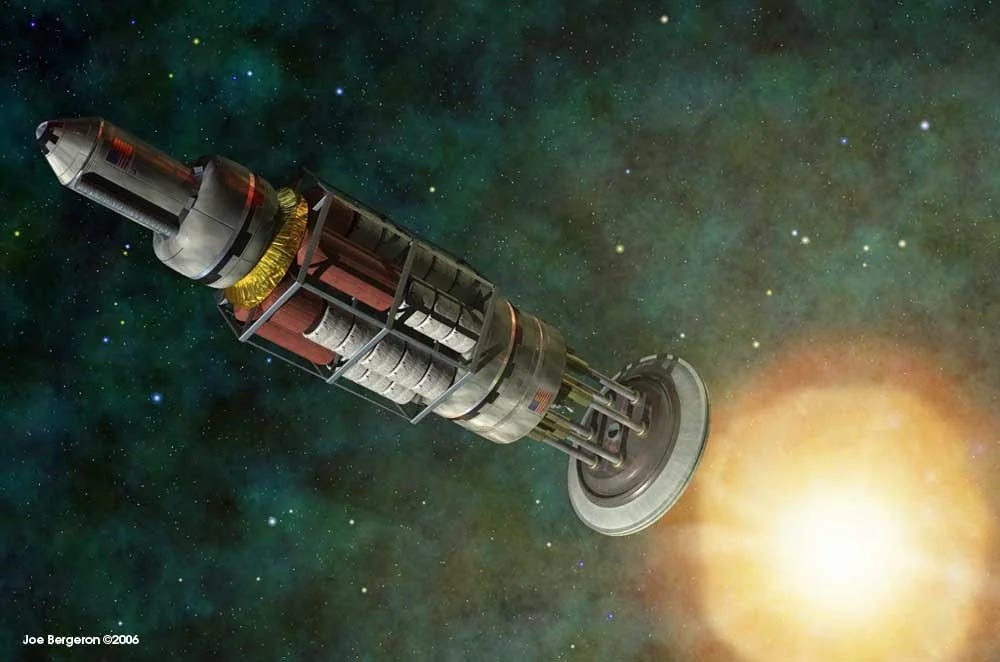
My purpose, and my belief, is that the bombs that killed and maimed at Hiroshima and Nagasaki shall one day open the skies to man.
—Freeman Dyson, A Space Traveler’s Manifesto, 1958
The nuclear pulse rocket is what you’d get if you hired a 12 year old to get you to Jupiter. It works by farting a continuous string of nuclear bombs (at the rate of about one per second) out its back end and riding the ensuing blast waves on a giant shock absorber, like a pogo stick. A series of hundreds or thousands of nuclear detonations accelerates the spacecraft to pretty much any speed you want, and when it’s time to slow down, you just turn around and start nuking in the forward direction.
Simple, easy, and fun!
The performance on this thing is sensational. Rocket engineers have always been stuck having to choose between thrust and efficiency. Chemical rockets that are powerful enough to get things off the ground (like Saturn V or Starship) are hopelessly inefficient, while the efficient ion motors we put on probes and satellites have only a few ounces of thrust. It’s like forever being forced to choose between an electric tricycle and a top fuel dragster, with no middle ground.
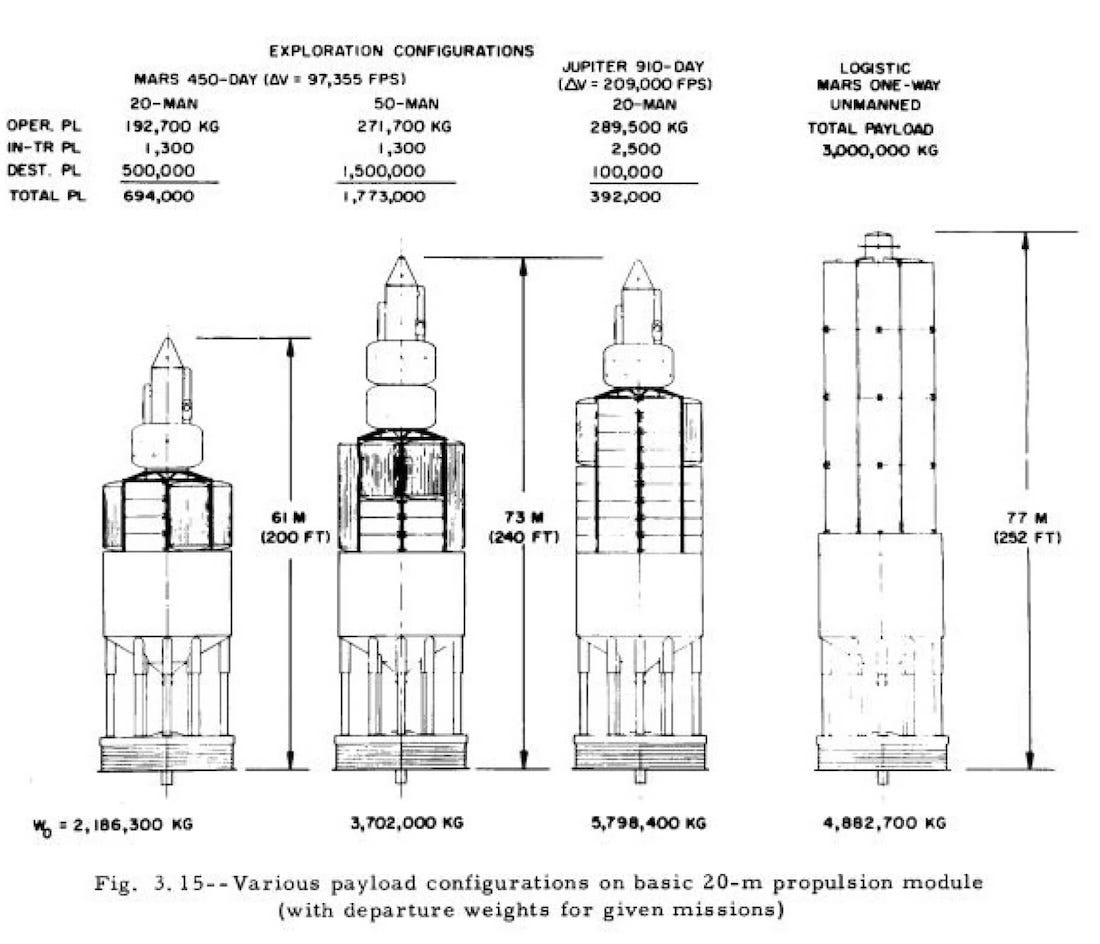
Like an El Camino rolling coal, nuclear pulse rockets occupy that missing middle. The energy density of nuclear fuel gives them incredible miles to the mushroom cloud, while thrust is only limited by how much the hammering the spaceship can take before shaking apart. Where the Apollo rockets had six stages and a mass ratio of about 540:1 (for every kilo of astronaut or spacecraft that landed back on Earth, you needed more than half a ton of fully-fueled rocket on the launch pad), a nuclear pulse rocket has a mass ratio closer to 1.5. It can take off from Earth, land 4,000 tons of scientists and equipment on Mars, and come back in one piece to refuel, as many times as you want.
That kind a mass budget is what Mars mission planners call ‘ample’. Consider that the International Space Station, the biggest object ever assembled in space, weighs 400 tons. Nuclear pulse propulsion means no more worrying about life support or radiation. You can stock the inside with all the oxygen and frozen steaks a crew can eat, encase the whole thing in radiation-blocking plastic, cap it with a glass-domed rotating casino for the view, and still have room for the thousands of fission bombs (dispensed like coke cans) you will need to detonate to get the thing moving. A crew on such a rocket would travel to Mars in comfort and style and arrive refreshed.
For that matter, they could travel to Saturn and arrive refreshed. An early 1958 design envisioned sending a crew of 20 to Enceladus and back within a span of three years, or about as long as it would take to fly astronauts to Mars and back on a conventional mission using chemical rockets. And they could do it in a fully reusable vehicle on a single launch from Earth.
In short, the nuclear pulse rocket solves all of the problems that plague chemical rockets, albeit at the cost of replacing them with much bigger, scarier problems.
Here are some other representative missions enabled by nuclear thunder:
Soft-land 5,700 tons on the Moon (compare to 17 tons for Apollo)
Land a 1300 ton payload (three times the mass of the International Space Station!) on Enceladus and return it to Earth on a 3 year round trip.
Send a crew of 20 on a two year round trip to Callisto or Europa (with enough shielding to make Europa survivable)
Send a crew of 50 on a 200 day round-trip to Mars, with 30 day surface stay
Send 10,000 tons to medium Earth orbit.
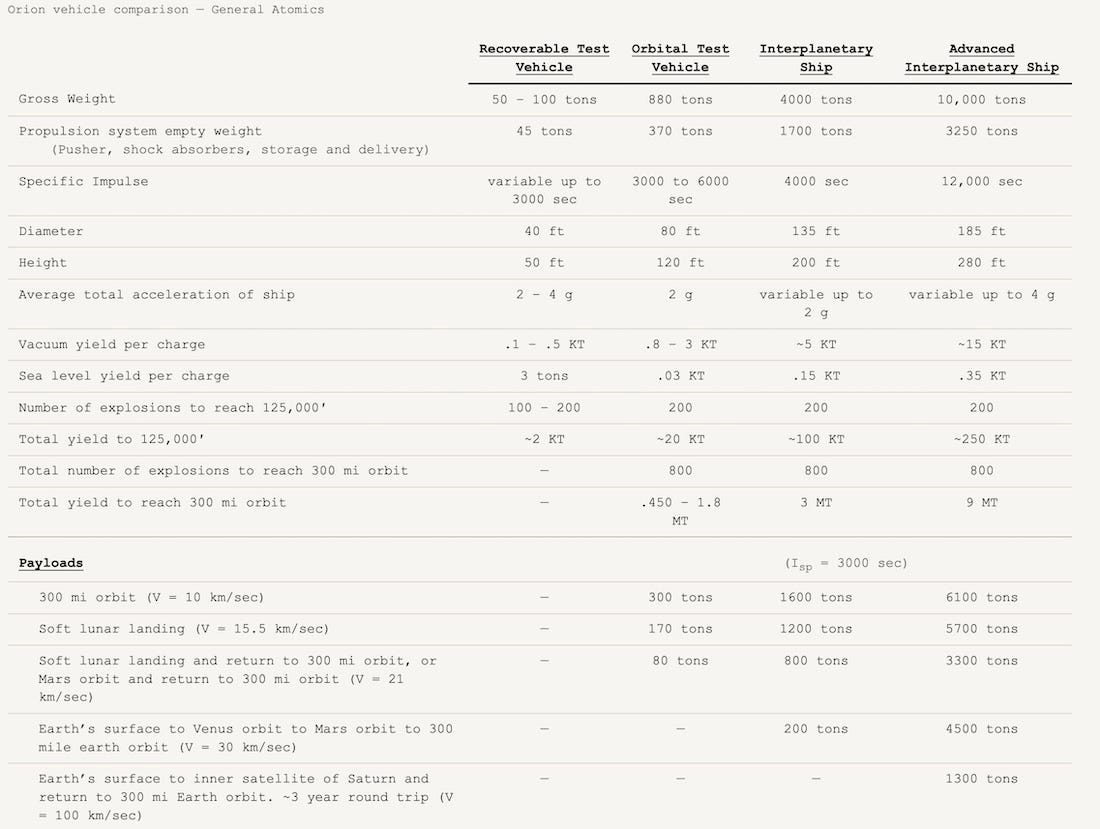
Unlike every other kind of spacecraft, the only size constraint on a nuclear pulse rocket is that it can’t be too small. A practical nuclear pulse rocket—and just typing the adjective ‘practical’ here kind of sets my heart racing—weighs around 4,000 tons, about the size of a decemt apartment building. But you get much better performance if you build one the size of a cruise ship, or a city.
Like so many good ideas, nuclear pulse propulsion started with a Polish guy living in New Mexico. While working at Los Alamos in the 1940s, the mathematician Stanisław Ulam sketched out an idea for a spacecraft that could be accelerated by small nuclear explosions behind it. Freeman Dyson and Ted Taylor (the Rembrandt of American nuclear weapons design) later fleshed out the idea at General Atomic and got it modestly funded in the wake of the 1957 Sputnik panic.
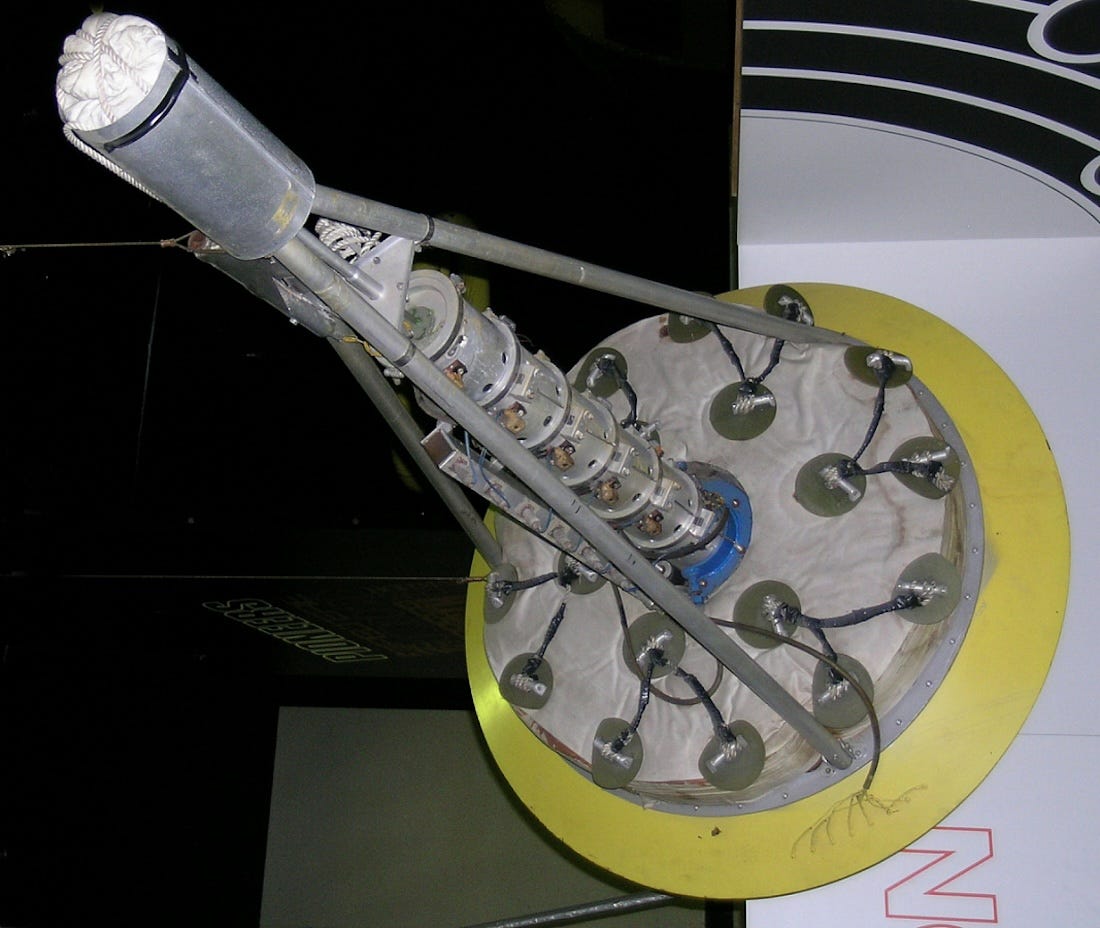
Even in the 1950s, it was hard to get anyone with budget authority to stop screaming long enough to appreciate the benefits of the design. And so the budgets for Project Orion were always stingy; no one wanted to take the responsibility of actually making the rocket happen. A toy version of the design was built and tested (with conventional explosives) in 1959, and the project came within a whisker of having a proper atomic test before luck and funding ran out in 1964.
It would have worked great! Like with so many nuclear technologies, whether or not it worked was really low on the list of problems with it.
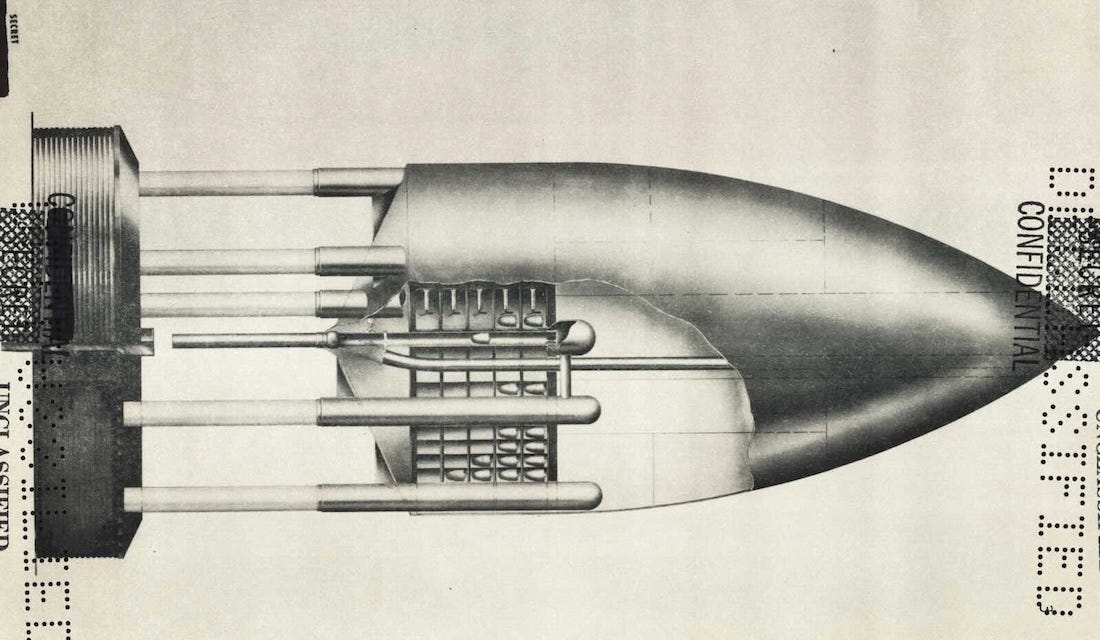
The nuclear pulse rocket as envisioned in 1958 was a 4,000 ton behemoth that looked like a cartoon bullet, attached by a forest of shock absorbers to a broad, flat pusher plate.
The plate was a flat disk of metal that weighed about 1/6 as much as the ship proper. It’s easiest if you imagine it as a piston in a big two-stroke engine.
The full propulsion cycle looks like this:
A small (0.1-3 kiloton) nuclear bomb detonates about a hundred meters behind the pusher plate. The explosion vaporizes a disk of propellant (this can be anything from ice to metal to the crew’s own stored waste) and flings it at the plate at a velocity of many thousands of kilometers per second.
The plasma cloud hits the pusher plate, accelerating it with the force of a cannon shot. The intense heat of the collision ablates away a thin layer of oil on the pusher plate, protecting the main body of the plate from damage.
Giant airbags and shock absorbers turn the impulsive acceleration on the pusher plate into a longer pulse gentle enough (2-4 g) to be endurable by a human crew, and transmit it to the spacecraft.
A spritzer spritzes the plate with a fresh layer of oil.
The compressed shock absorbers rebound and return the pusher plate to its original position just as another bomb reaches the detonation point.
You can think of the process like accelerating a golf cart by hitting it with a sledgehammer. How rough the ride is depends on the size of the spacecraft, the size of each bomb, and how far the shock absorbers travel in each stroke.
The bombs go off about once or twice a second, and every explosion adds about 20 mph to the vehicle’s speed. It takes 200 bombs to get Orion out of the atmosphere, and another 600 or so to put the spacecraft in a 300 mile circular Earth orbit.
Normally we think of nuclear bombs as vaporizing everything around them. The Orion concept works by minimizing the time the plate spends in thermal contact with nuclear debris. A round trip to Mars and back might involve 2,000 nuclear detonations, but the pusher plate will have spent a total of less than one second in contact with superhot plasma. The same technique that lets you carry a hot potato comfortably by tossing it hand to hand gets you to the outer planets.
It’s a Gatling gun for atomic bombs, what do you think can go wrong? But Orion has some fascinating ways to fail besides the obvious.
One challenge is how to handle a dud. In normal operation, the pusher plate rebounds against each successive explosion like a racket bouncing off of a tennis ball. If a bomb fails to go off, the rebounding piston will want to fly off the back of the rocket into space. So you need a mechanism to arrest its momentum, along with special procedures for firing a half-charge to restore it from a hyperextended state to a neutral position.
Another interesting failure mode is a fizzle—a scenario where the chemical explosives in the nuclear bomb go off, but fail to detonate the nuclear pit. Remarkably, this is far more dangerous to Orion than an atomic blast. The pusher plate is designed to absorb the impact from a uniform cloud of hypervelocity plasma, not sharp chunks of shrapnel. So a lot of design work has to concentrate on making sure the pusher plate isn’t dinged up too badly by flying debris from a conventional explosion.
The most complicated part of Orion is the mechanism for delivering bombs to the correct spot behind the pusher plate. The bombs are heavy (several hundred pounds) and have to arrive at a point a couple hundred meters behind the spacecraft with precise timing. You are basically building an accurate, low-velocity machine gun for nuclear shells.
Several mechanisms were considered: one was a series of angled tubes arranged around the rim of the spacecraft, which would only be exposed when the piston was maximally compressed at the top of the stroke. Another was a rocket launcher that would send little nukes curving around the edge of the pusher plate, detonating when they reached a pair of crossed radar beams. Since the core problem (reliably delivering identically sized containers from a rack) had already been solved in Coca Cola vending machines, Orion famously consulted with that company to help with aspects of this design.
But the biggest technical obstacles facing Orion had to do with computers, not nukes. One was navigation; a big reason the early design had a crew of 20-40 was that so the boys in the nose could get to work with graph paper and sextants when it came time to steer the spacecraft.
Another was making sure bombs with the right yield were fired in the right sequence during takeoff (a problem that became trivial with dial-a-yield fission weapons developed just a few years later).
And there were fundamental questions of design. How turbulence in the plasma wave would interact with the pusher plate was a question only atomic testing could answer in 1959, though it would be easy to simulate on computers today.
There are some drawbacks to the nuclear bomb rocket.
For one, there’s the matter of launching any of this into space. Unless you start nuking Florida from ground level (and I’m not saying ‘no’), you need dozens of traditional rockets to lift this affront to God and Nature into orbit. Even then, its fission products will get caught in the Earth’s magnetic field and eventually spiral their way back home.
But probably the biggest drawback of nuclear pulse propulsion is the thousands of nuclear bombs.
It was not lost on potential funders that whoever sat in the pilot’s chair of this rocket would immediately command one of the largest nuclear arsenals on Earth. All it needed to turn Orion into a Pez dispenser for Armageddon was to redirect the bombs a little bit so they rained down on Earth instead of exploding against a pusher plate.
The list of launch hazards for Orion was also spectacular. A serious accident on the launch pad would cook off thousands of tons of high explosive and contaminate a huge area downrange of the spacecraft with plutonium. An out-of-control Orion zigzagging around the sky would also be a memorable sight, for anyone who was not instantly blinded by it (another awkward hazard). And how exactly do you handle range safety on a 4,000 ton vehicle full of atomic bombs?
Or consider the question of misfires. While the ship could be built to tolerate duds, each misfire meant that someone along the flight path was waking up to an almost-functional nuclear bomb in their backyard.
Some of these risks could be mitigated by launching Orion from remote Pacific islands. But the problem of fallout was pernicious. The 200 explosions that get Orion out of the atmosphere are the equivalent in fallout terms to a ten-megaton air burst. Back in the 1950s, when we were firing multi-megaton H-bombs every other Tuesday, this didn’t seem so bad. But we live in more delicate times, and the problem doesn’t go away once the vehicle reaches space. Any bombs that explode in Earth orbit create clouds of charged particles that eventually fall back down on Earth. Unlike the ascent plume, this fallout is not localized, and settles on the just and unjust alike.
Efforts to ameliorate the fallout problem run us into the final drawback, which is a little bit more abstract. To get the most out of its nuclear fuel and minimize fallout, Orion needs to use shaped nuclear charges with very low yield, that consume as little fissile material as possible. But these happen to be the worst kinds of nukes imaginable from a proliferation standpoint.
No one is really afraid of terrorists blowing up a big, meaty H-bomb that has to be carted around in a truck and needs a couple hundred kilograms of plutonium to detonate. But at the low end, nuclear weapons can be made frighteningly small and light. Ted Taylor describes a working six-inch atomic bomb that he could hold in one hand, while strongly hinting that bombs made with even smaller amounts of fissile material are feasible, provided you’re willing to wrap them in a lot of conventional explosive.
Unfortunately, addressing the fallout problem exacerbates the political problems that doomed Orion in the first place. The best rocket design we have unavoidably pushes the frontiers of nuclear miniaturization, a technology that is inherently destabilizing to a fragile status quo.
And that’s why no one today is riding Orion to the stars.
Let’s not be negative Nellies, though. There is also a lot of good to say about the nightmare bomb rocket!
Engineers have been so beaten down by the rocket equation that it can be hard for them to grasp the full possibilities of a spacecraft unconstrained by weight. Rocket design has always been about squeezing the last drop of performance out of lightweight materials. Nuclear pulse rocket design is more about making sure the billiards table stays level during acceleration, and that the ship’s wine cellar strikes the right balance between tannic reds and dry whites. In his blueprints for Orion, Ted Taylor always made sure to include a heavy barber’s chair, just to drive home the point that this was a new class of vehicle.
Only three components on a nuclear pulse rocket need to be built to a high engineering tolerance: the shock absorbers, the bomb dispenser, and the bombs themselves. Everything else can be riveted together out of whatever material is handy. In other words, the nuclear pulse rocket is the thing Starship aspires to be: a rocket that is cheap to mass-produce, fully reusable, and capable of rapidly colonizing the solar system. The only hitch is that no one wants to give Elon nukes.
The fact that nuclear pulse rockets are huge and fast solves the hardest problem of interplanetary travel: protecting crews from radiation. Galactic cosmic radiation is annoyingly dangerous and extremely penetrating, to the point where you need something like ten meters of polyethylene or water to provide protection on par with Earth’s atmosphere. Galactic cosmic rays also have the awkward property that partial shielding can be worse than none, since secondary radiation created when high energy particles collide with the shielding can do more damage than the particles themselves.
Because GCR flux gets worse the further out you go in the solar system, and because voyages to the outer planets would necessarily last many years, cosmic rays set a practical limit to human exploration with chemical rockets. The moon is reachable, Mars is marginal, but anything further than that is off-limits.
There is no way a chemical or nuclear thermal rocket could ever carry adequate shielding against cosmic rays1. But Orion can. Nuclear pulse rockets can be built large enough and fast enough to make trips to Jupiter or Saturn with low cumulative radiation exposure, and armored with enough shielding to protect the crew not only from cosmic rays, but from the intense planetary radiation at desirable destinations like Europa.
And the bigger you make your rocket, the easier it gets to throw in artificial gravity, solving the other big physiological problem of space flight. As I wrote about in an earlier post, you need a structure about 112 meters in diameter to get a livable rate of spin at 1g. If you’re using chemical rockets, you’re limited by the fairly narrow diameter of the rocket fairing, and so spacecraft big enough to provide spin gravity have to be assembled in orbit. But 112 meters is a perfectly workable diameter for nuclear pulse rocket. All you have to do is spin one up once it’s headed in the right direction and live comfortably on the walls until you reach your destination.
As a last benefit, nuclear pulse rockets solve the entry and landing problem on distant worlds through brute force. Instead of worrying about aeroshells and supersonic retropropulsion, you can just null out your orbital velocity, then make judicious use of nukes to slow your descent straight downwards. If you’re squeamish about nuking your landing area, you can always switch to parachutes or chemical retro-rockets at the last minute, or deploy a dedicated lander, like one of those mega-yachts that carries a smaller superyacht as cargo.
The point is you’ll be landing 1950s torch-ship-style—slowly and under full control, without needing to husband every ounce of propellant. Abundance!
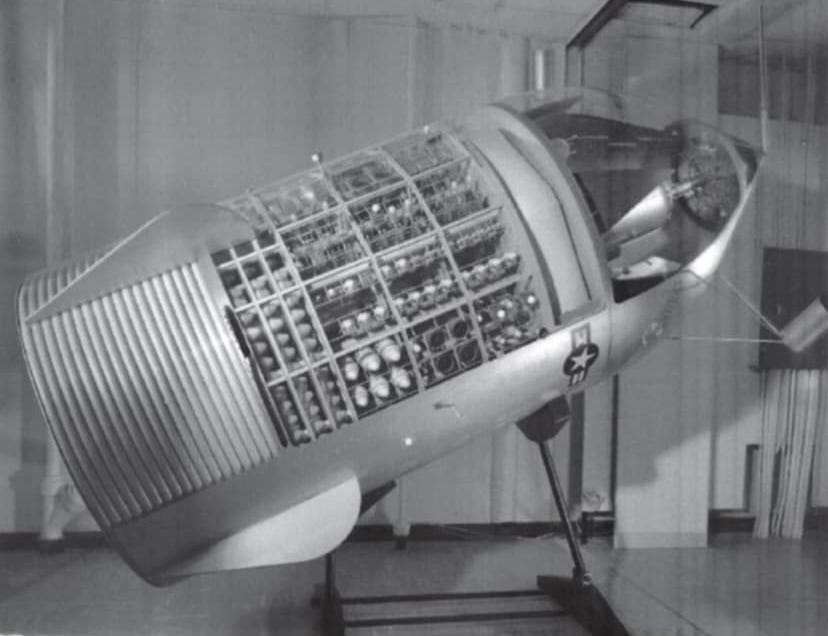
We came very, very close to building this thing!
Like Taylor Swift, the nuclear pulse rocket went through several distinct eras in its development.