Restaurant operators continue to see industry sales growth, but growth alone will not solve the industry’s margin problem. The National Restaurant Association forecasted that restaurant and foodservice sales could reach $1.55 trillion in 2026, but more recent data showed a tougher reality: 49% of restaurant operators reported lower customer traffic in April, and the industry recorded its 14th net traffic decline in 15 months. While the market is growing, many brands struggle against softer traffic, higher costs, and tighter margins.
On top of these economic pressures, operators are increasingly making technology decisions that carry higher operational stakes. These systems can be the difference in improving execution, reducing friction, and accelerating decisions. Within these new technology stacks is the growing demand and adoption of AI, but many brands are struggling to translate investment into measurable operational improvement.
According to a recent industry report, 73% of restaurant brands are investing in AI or plan to begin within the next year. While investments are increasing, only 9% have found meaningful or transformational impact, while 43% say the value remains limited. This disconnect between adoption and ROI suggests the problem is not ambition but readiness. Many restaurant organizations are attempting to deploy AI atop fragmented systems that vendors never designed to work together.
Years of digital advancement and expansion have created separate ordering channels, reporting tools, menu databases, and operational platforms. Each tool may solve a specific operational need; when combined, they often foster disconnected environments that limit visibility across the business. For AI to deliver reliable outcomes, the underlying systems must communicate clearly. Operators may think they are solving their next problem by layering in more automation. In reality, they will still struggle with inconsistent reporting, disconnected workflows, and operational blind spots if the foundation remains fragmented.
The Operational Risks of Fragmentation
Fragmentation creates problems that reach far beyond IT management. With each system, menu items, pricing, customer records, and order data can become inconsistent across channels. Inconsistent data then ripples across an operation, weakening the reliability of forecasting, labor planning, inventory management, and most importantly, operational reporting. Leaders who lack a comprehensive view often make slower and less precise decisions.
With AI adoption becoming more prevalent, these inconsistencies can become critical points for business failure. AI-empowered systems rely on clean, connected, and standardized data to generate accurate recommendations and automate workflows effectively. Without it, operators will not receive the clarity they expected from the investment; rather, they will only deepen the fragmentation of their existing environments, accelerate confusion, and reduce confidence in automated outputs.
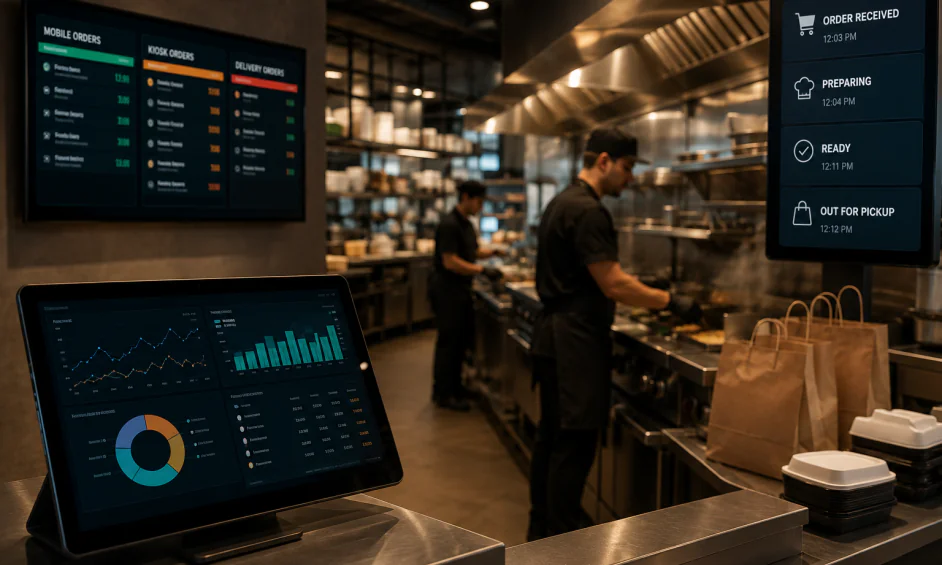
On top of the technological advancements, restaurant operators are also inheriting more operational complexity than their counterparts had a decade ago. A single location likely balances in-store dining, drive-thru traffic, mobile ordering, delivery marketplaces, kiosks, and catering workflows at the same time. Each new ordering channel brings new expectations, timing constraints, and fulfillment requirements, but they all converge in the kitchen. When systems do not communicate clearly and consistently, orders can create traffic jams behind the counter, delaying promised ready times, increasing order errors, and weakening the guest experience. Connected systems are the key to reducing complexity without compromising quality, allowing operators to gain valuable insights in real time.
Operators must also account for the broader economic environment. For example, according to the Bureau of Labor Statistics, in April 2026, food away from home rose 3.6% year over year, with both full-service and limited-service meals continuing to increase in cost. Price adjustments cannot be the only tool operators turn to, especially as customers weigh value versus quality. Operational success will depend on systems that improve execution consistency, reduce operational waste, and help teams respond faster to changing demand conditions.
The Difference Between Layered AI and Integrated AI
Restaurants have traditionally adopted AI by layering it onto existing systems. This strategy may improve isolated processes or unlock pockets of automation, but the systems remain disconnected from the broader operational environment, limiting the potential for full operational coordination. An example of this would be an operator using AI to improve forecasting, automate reporting, or uncover new patterns in customer behavior. Those tools can create value, but if they are isolated and unable to connect to consistent data on orders, menus, labor, and the kitchen, their recommendations remain limited.
A stronger approach is to integrate AI. The biggest difference between simply layering and integration lies in the depth to which AI can embed itself. Integration creates a pathway to the organization’s digital information foundation, including ordering systems, APIs, kitchen workflows, and much more. It establishes bridges across technology stacks, allowing information to flow freely and consistently across locations and channels.
This distinction in approach matters because restaurants do not operate in isolated workflows. Mobile orders can impact kitchen timing. A fresh menu update affects pricing, prep, and fulfillment across multiple channels. If the systems underneath do not share accurate information, AI can only optimize the partial view it has of a business.
As restaurant technology continues to rapidly advance, operators cannot afford to treat every new capability as another standalone tool. AI-integrated environments create opportunities for operators to adopt new ordering channels, automation tools, and additional specialized technologies without adding friction to the business. An integration-first approach enables the future introduction of new ordering channels, the expansion of automation capabilities, and the integration of specialized technologies, while preventing teams from fragmenting or siloing data sources. The capability to scale technology effortlessly is becoming a significant competitive advantage.
Why the Kitchen Has Become the Center of Digital Complexity
For years, restaurants centered technology investments around guest-facing experiences. Examples of these investments included the rollout of mobile ordering, loyalty engagement, kiosks, delivery integrations, and an emphasis on personalized marketing. These investments fulfilled their tasks of expanding customer access; however, they also introduced significant operational pressure behind the scenes. One of the greatest points of friction arose in the kitchen, which had to handle more complexity than it was designed to .
This is where the impact of disconnected technology becomes reality. Every ordering channel may create a different promise to the guest, but the kitchen is tasked with fulfilling all of those promises simultaneously. If ordering systems, kitchen display systems, menu data, and timing logic do not communicate clearly, small inconsistencies can arise and quickly cascade into slower service, inaccurate orders, and inconsistent guest experiences. Add unpredictable traffic, and those pressures can quickly become impossible to manage.
According to the National Restaurant Association’s Restaurant Performance Index, March 2026 saw a decline in overall restaurant performance as operators reported softer same-store sales and weaker customer traffic compared to February. Even so, many operators responded that they planned to continue spending on equipment, technology, and expansions or remodels. This means that every dollar invested in technology must work harder and prove its worth.
Kitchen operations are a prime example of why AI cannot succeed as a disconnected layer. If an AI-enabled system provides a potential pick-up time without context for the current order volume, kitchen capacity, menu complexity, or channel mix, that recommendation may create more pressure rather than reduce it. This is why AI must connect to the systems that shape execution at every level.
Why Unified Infrastructure Is Becoming More Important
Today’s restaurant owners are looking for every opportunity to simplify operations and maintain profitability. That requires resilience during economic headwinds such as persistent inflation or unpredictable gas prices. Part of this resilience is also rethinking how technology ecosystems promote flexibility and innovation. Modern restaurant operations require more adaptability as brands integrate specialized technologies across ordering, payments, kitchen operations, and customer engagement. This has increased interest in API-first architecture and unified data environments that allow systems to communicate more effectively.
As conversations shift from broad adoption to precise execution, the next challenge will be ensuring that legacy and modernized systems work together efficiently while improving profitability and operational resilience. Restaurants that prioritize interoperability and unified infrastructure will be better positioned to unlock meaningful AI value as technology continues evolving.