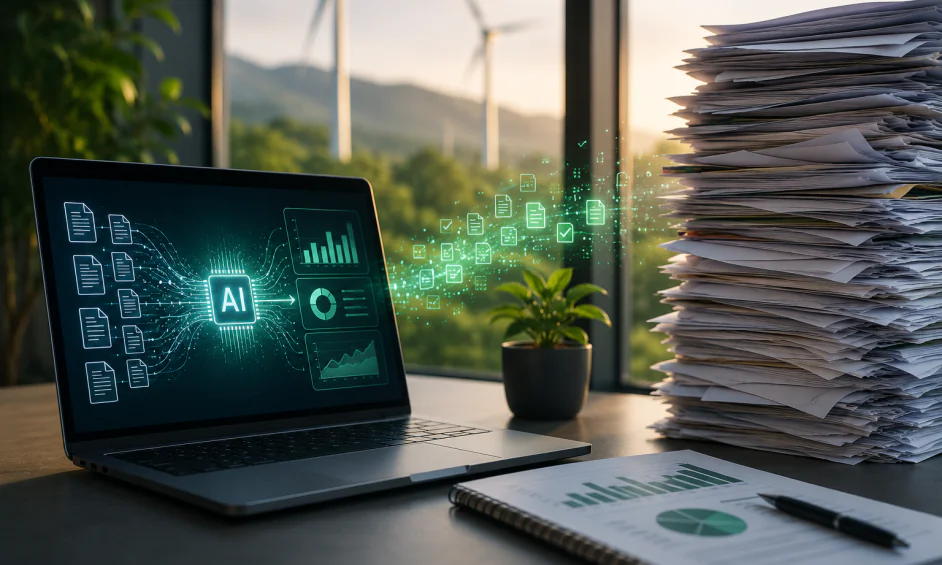
Somewhere right now, an analyst is staring at a folder of four hundred utility bills because a regulator, a customer, or the board wants to know the company’s carbon footprint, and much of that number is buried in those documents.
Building AI systems that do this work has convinced me of something: corporate sustainability teams are running a few years ahead of the rest of the enterprise on AI adoption because structural conditions forced the issue early. If you want to understand how AI actually reshapes white-collar work in practice, they are the group to watch.
Change is happening at the task level
Start with what the data says. McKinsey’s latest State of AI survey found that 88% of organizations now use AI in at least one business function, and roughly a quarter report scaling AI agents somewhere in the enterprise, though usually in only one or two functions. Adoption is nearly universal, but transformation is not. So where is change happening? The answer, consistently, is at the task level. Anthropic’s Economic Index, which analyzed millions of real-world AI conversations, found usage skewed toward augmentation (57%) over full automation (43%), and that only about 4% of occupations used AI for three-quarters or more of their tasks. AI is diffusing across the individual tasks inside jobs.
The effects on workers are already measurable. Stanford’s 2026 AI Index reports productivity gains that are real but uneven (roughly 14–15% in customer support, versus 26% in software development) and documents a nearly 20% decline since 2024 in employment for software developers aged 22 to 25, one of the first measurable white-collar contractions attributable to AI. Zoom out further, and the World Economic Forum’s Future of Jobs Report projects 170 million jobs created and 92 million displaced by 2030, with 39% of core skills changing along the way. Jobs mostly won’t vanish, but their composition is being rearranged task by task, and the rearranging has started.
Why sustainability teams got there early
Three structural conditions pushed sustainability to the front of this curve:
First, the data burden is huge relative to headcount. Carbon accounting is a data engineering problem wearing an environmental costume. The inputs are utility bills, fuel receipts, freight invoices, refrigerant logs, and supplier spreadsheets, thousands of documents in inconsistent formats, none designed to be machine-readable. The teams responsible are often two or three people at a billion-dollar company. BSR interviewed twenty corporate sustainability teams about their AI use and found the same pattern: time goes to collecting and cleaning data, not to deciding what to do about it.
Second, the deadlines are hard and the penalties are real. Under California’s SB 253, companies with over $1 billion in revenue doing business in the state must report their scope 1 and 2 greenhouse gas emissions starting in 2026, with scope 3 to follow and administrative penalties of up to $500,000 for non-compliance. Europe’s Corporate Sustainability Reporting Directive (CSRD)imposes its own timelines. Regulation converts “it would be nice to automate this” into “we cannot staff our way out of this,” which moves budgets.
Third, the work has a natural division of labor. There’s a clear difference between extraction and judgment. Machines excel at pulling kilowatt-hours, therms, and gallons out of messy documents, mapping them to emission factors, and catching the meter reading that jumped 400% month over month. Humans are needed for the hard parts: deciding organizational boundaries, choosing methodologies, and figuring out what to do about the number once you have it. Few knowledge-work domains split this cleanly. Sustainability does, which is why AI is transforming sustainability reporting faster than most adjacent functions.
How roles are evolving
Here’s what I’ve watched happen on teams that adopt this tooling seriously: the center of gravity of the job moves.
Less time keying numbers from PDFs into spreadsheets, and more time reviewing exceptions, validating what the machine produced, and defending the result. Climate disclosures are moving toward third-party assurance, and “the model said so” is not a defensible audit trail. A human has to be able to stand behind the number. The analyst’s core skill shifts from data entry to knowing when the machine is wrong.
I’d also gently push back on anyone who describes this as an unambiguous win. There’s a real trade-off: if junior people never do the manual work, how do they develop the judgment? Reviewing a thousand extracted bills teaches you what a wrong number looks like. Stanford’s researchers flag the same concern that heavy AI reliance may carry a long-term learning cost. I don’t think anyone has a complete answer here yet. Companies now have to design junior roles deliberately, instead of letting the grunt work build expertise by accident.
The trade-off sustainability teams know best
There’s one more reason this corner of the enterprise is worth watching. Sustainability teams are the only AI adopters required to count the energy and environmental cost of their own tools. The International Energy Agency projects that data centre electricity consumption will roughly double by 2030, to around 945 terawatt-hours, approaching 3% of global electricity. It’s also true that the energy used per AI task has been falling at a remarkable rate. Both are true at once, and a sustainability team can’t pick whichever framing is convenient, because the consumption lands in someone’s emissions inventory either way.
That constraint produces a discipline the rest of the enterprise would do well to copy: match the model to the task. Extracting fields from a utility bill does not require the largest frontier model reasoning from first principles; a smaller, cheaper, more efficient system usually does it better and at a fraction of the energy. Measured AI use, where consumption is a tracked input rather than an afterthought, is coming for every function eventually. Sustainability just gets there first because measuring things is their job.
What the rest of the enterprise can learn
The conditions that pushed sustainability ahead are not unique. Any function that is small relative to its data, accountable to external parties on hard deadlines, and buried in unstructured documents will follow the same curve: finance, procurement, legal, and more. When that happens, the sustainability playbook is worth stealing: automate the work that crowds out judgment, not the judgment itself; keep a human accountable for anything that needs to stand up to scrutiny; and measure what the automation costs you, in dollars and energy.
The interesting question was never “will AI take the jobs?” It’s “which tasks move to machines, in what order, and what the people do with the hours that come back?”
Sustainability teams are answering that question, on a regulatory deadline, with auditors checking their work. That’s as good a preview of the AI-reshaped enterprise as you’re going to get.