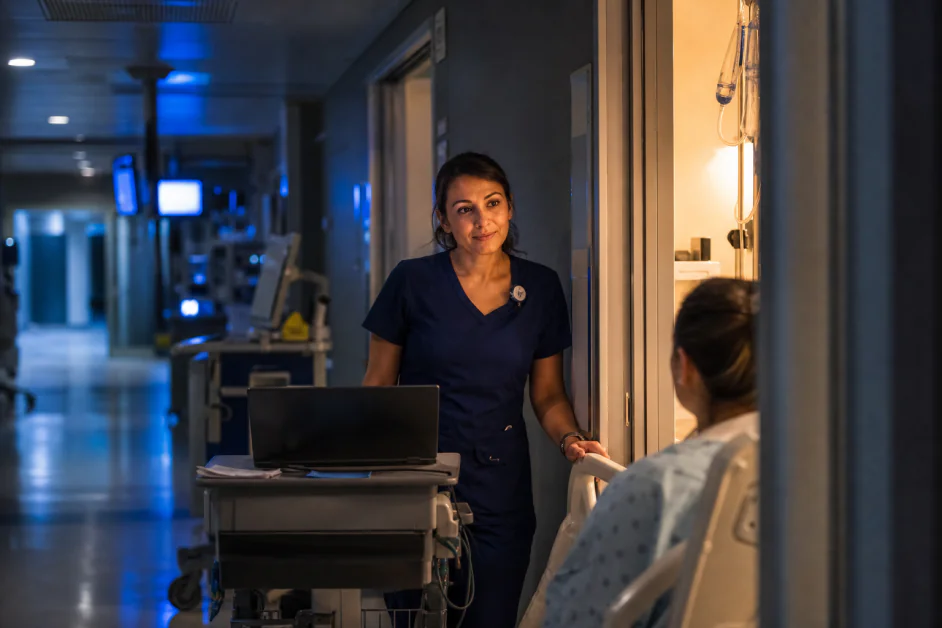
Mount Sinai Medical Center, the independent teaching hospital in Miami Beach, has switched on Epic’s ambient documentation tool for its inpatient nurses. The hospital said on July 28, 2026 that Chart with Art is now available on its inpatient units, with access widening gradually across the medical center. Its physicians have been using the same tool since earlier in 2026.
The feature records the conversation in the room and turns it into draft clinical documentation inside the patient’s chart. Nothing reaches the record until a nurse or provider reviews and approves it, according to Mount Sinai, and patients are told when it is running and can decline. The review step keeps a human in the loop before anything becomes part of the legal record.
It works in English and Spanish, which matters at a hospital where more than 30 percent of patients speak Spanish as their primary language. A tool that handles only English leaves bilingual staff documenting an encounter in a language the conversation never happened in.
Why the physicians went first
Mount Sinai gated the nursing rollout on its own physician deployment. Its doctors spent several months working with Epic on how the tool behaved in live clinical settings, and the hospital says participating physicians cut the time they spend in the chart per encounter by nearly 30 percent, along with the documentation they finish after hours. Wendy Stuart, the medical center’s chief nursing officer, said the point of extending it is to let nurses “step out from behind the keyboard and be fully present at the bedside.”
Running the tool through physicians first gave the health system its own before-and-after measurements rather than a reference customer’s. Documentation load is the metric these deployments are bought on, and charting that spills past the end of a shift is the part of it Mount Sinai singled out.
What Epic has shipped for nurses
Epic released the feature, then called AI Charting, in early February 2026 as part of Art, its clinician-facing AI. It listens during a visit, drafts the note and queues orders based on what was said, and lets clinicians restructure notes by voice. Adoption of the wider Art set has grown quickly by Epic’s own count: its chart-summary Insights feature is now used more than 16 million times a month, close to triple its November 2025 volume.
Nursing gets two different mechanisms under the same name. One drafts the end-of-shift care plan note from data already in the chart, pulling vitals, flowsheets, medication records, orders and prior notes. Epic reports that at Mercy, one of the 15 largest US health systems, average end-of-shift documentation fell from 3.5 minutes per note to about 32 seconds, with the share of notes completed fully and on time up 225 percent.
The other is the ambient capture Mount Sinai has now turned on, which builds documentation from the bedside conversation itself. On its Art product page, Epic credits Mayo Clinic with capturing 70 percent of flowsheet documentation without manual entry and Sanford Health with $31,000 in savings over six months.
Nursing is where the ambient market is competing now
Physician scribing is the established end of this market. Nursing is the newer one, and Epic is selling into it against companies whose products run inside Epic itself. Abridge built its nursing tool with Mayo Clinic nurses and announced that collaboration in May 2026; its drafts land in Epic flowsheet rows for the nurse to verify against the source conversation. KLAS Research, which published a first-look report on Abridge’s nursing deployments in April 2026, describes nursing ambient AI as an emerging category.
For a hospital already licensing Epic, that turns into a procurement question more than a technical one: switch on a feature that arrives with the record system you already pay for, or contract separately with a specialist whose product also lives inside it. The bundled route skips a purchasing cycle and a second integration. Mount Sinai took it, and each decision like it settles how much of the AI layer on top of the EHR the record vendor ends up owning.
What the nursing rollouts will establish is how well ambient capture holds up in an inpatient unit. Outpatient scribing happens in a scheduled exam room with two people in it. A nursing shift involves families, roommates, alarms and interruptions, and documentation that is structured into flowsheet fields rather than written as narrative notes, which is a harder capture problem than the one AI scribes solved in clinics.
Mount Sinai says it is the first health system in Florida and the fourth nationally to put the tool in nurses’ hands, which makes its inpatient units one of a small number of places where the nursing use case is being measured in production. The rollout widens unit by unit from here.