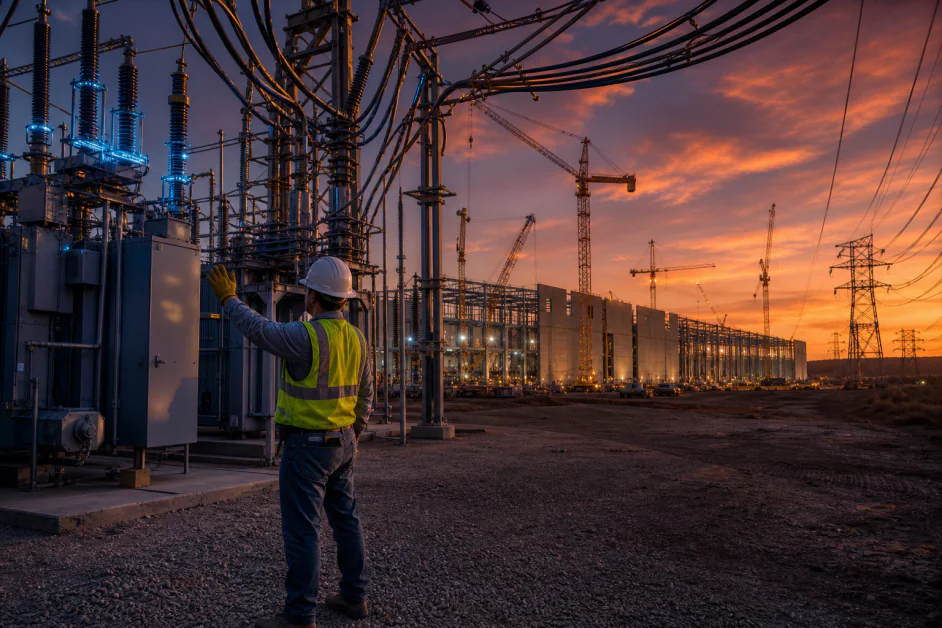
Meta and BlackRock (BLK ) have formed a venture that will own the gigawatt-scale data center campus Meta is building in El Paso, Texas, with funds managed by BlackRock taking an 80% interest and Meta keeping the remaining 20%. The two companies announced the deal on July 28, 2026 and expect it to close within days.
The structure moves the buildings and the long-lived power, cooling and connectivity infrastructure of a 1 gigawatt campus into a jointly owned vehicle, leaving Meta as tenant and operator. Both sides will fund their pro-rata share of roughly $14 billion in total development costs. At financial close:
- Meta hands over the site’s land and the work already built on it, carried at about $2.3 billion
- BlackRock puts in roughly $4.9 billion of cash
- Meta takes a one-time distribution of about $1 billion, trueing the split to 80/20
- A $12.5 billion debt financing supplies part of BlackRock’s contribution
Meta then leases the whole campus back on an initial four-year term with four renewal options, stretching the arrangement across as much as 20 years. It is also writing residual value guarantees against the property, with a combined threshold near $13 billion that steps down over time. If certain conditions are met inside the lease’s first 16 years, Meta would owe at most the gap between the property’s value then and the threshold in force. Meta rents the campus on short renewable terms and stands behind most of what it is worth.
BlackRock is investing through Global Infrastructure Partners and HPS Investment Partners, its infrastructure and private-financing platforms, and Meta said it picked BlackRock after a competitive process as it broadens the funding behind what it now brands Meta Compute. “Building the infrastructure for superintelligence is key to making sure the benefits of this technology are distributed to everyone,” Mark Zuckerberg, Meta’s founder and chief executive, said in the announcement.
What the $14 billion covers
That figure is a buildings-and-power number. Servers and accelerators sit outside it, bought by Meta and carried on Meta’s own books, which is why shifting a campus into a joint venture does little to slow the company’s headline spending. Meta raised its 2026 capital expenditure guidance to $125–145 billion on April 29, 2026, up from $115–135 billion, citing higher component pricing and additional data center costs to support future capacity. First-quarter capital expenditures, including finance-lease principal payments, came to $19.84 billion.
What the venture changes is who owns the concrete and the switchgear. Four-fifths of a $14 billion development bill now sits with outside investors, and Meta’s cost surfaces as rent instead of depreciation. The same arithmetic is squeezing the whole sector, including Google, where data-center spending has outrun operating cash flow.
Meta ran this play once already in Louisiana, where Blue Owl Capital (OWL ) took 80% of the Hyperion campus and the venture sold about $27 billion of bonds, more than $3 billion of which BlackRock bought. In El Paso, BlackRock has crossed from the debt side to the equity side of a nearly identical structure, after marketing the campus’s bond sale earlier in July 2026. Meta will be the campus’s initial sole occupant; the company has separately weighed leasing AI compute to Anthropic.
Where the gigawatt comes from
El Paso sits outside the main Texas grid: ERCOT’s service map excludes the El Paso area, leaving the city on El Paso Electric’s comparatively small system in the Western Interconnection. The utility is building dedicated generation to bridge the gap. It has asked state regulators to approve McCloud Generation, a 366 MW plant assembled from 813 modular gas generators supplied by Houston-based Enchanted Rock at an estimated $473 million, targeted to run in 2027. Under the plan filed with the Public Utility Commission of Texas and first reported by El Paso Matters, the plant stays electrically separate from the utility’s wider transmission network for an initial five-year bridge period, during which Meta takes all of its output and pays all of its costs.
The load ramp explains the hurry. Meta originally requested 220 MW from the utility; projected demand has since climbed past 440 MW by 2027 and potentially to 1 GW by 2029, according to Argus Media’s reading of the filings. McCloud covers roughly a third of the campus’s eventual capacity, with the balance meant to arrive through the utility’s system as it expands.
What comes next in El Paso
Meta confirmed the campus would reach 1 gigawatt and lifted its investment above $10 billion in March 2026, saying it would add enough clean and renewable generation to the El Paso grid to match all of the site’s electricity use. More than 2,300 workers are on the site now, with over 4,000 expected at peak construction and 300 permanent operations jobs once it runs. BlackRock’s foundation is committing nearly $30 million to a Texas program it expects will train more than 12,000 electricians over three years, the trade that gates how fast any of this gets energized.
The city has tightened its own rules in the meantime. El Paso’s council adopted a data center policy framework on July 20, 2026 requiring council-approved special permits for new projects, replacing the by-right permitting available when Meta broke ground under a 2023 tax-rebate agreement. Those rules govern the next campus, not the one already rising in the northeast of the city.
The venture expects to begin bringing capacity online in 2028. Meta reports second-quarter results after the market close on July 29, 2026, the next read on how fast the compute bill underneath all of this is growing.