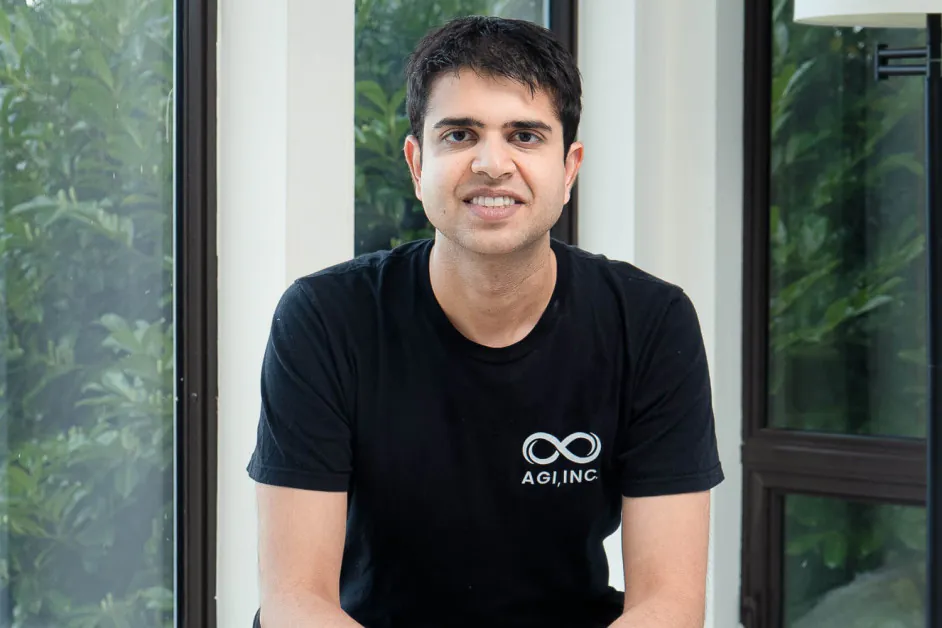
Div Garg, CEO and Co-Founder of AGI, Inc, is an AI researcher and entrepreneur focused on autonomous agents, edge intelligence, computer vision, and robotics. Before founding AGI, Inc., he co-founded and led MultiOn, an early pioneer in computer-use agents, and later served as chairman of its board. Garg also spent nearly four years as an adjunct faculty member at Stanford University, where he created CS 25: Transformers United, the university’s first course dedicated to transformer architectures. His earlier experience includes leading artificial intelligence development at Collaborative Robotics, conducting research at NVIDIA (NVDA ) and Apple (AAPL ), and working on computer vision and autonomous-driving technologies at Google, Uber, and Cornell University, where his research included the influential Pseudo-LiDAR approach to camera-based 3D perception.
AGI, Inc. is an AI research company developing private, secure, and accessible intelligence that operates directly on edge devices. Its flagship technology, AGI-0, is an action-oriented AI system designed to understand user preferences and complete tasks across applications on phones, computers, wearables, and other connected devices, including workflows involving shopping, transportation, scheduling, messaging, and entertainment. The company also offers a platform that allows hardware manufacturers and developers to add screen-aware agents capable of reasoning and acting across existing applications without building separate integrations for each app. AGI, Inc. has demonstrated its technology with Lenovo and is optimizing its agent stack for Qualcomm (QCOM ) Snapdragon-powered devices.
You’ve worked at Apple, Google, Nvidia, and helped pioneer early agent systems at MultiOn before pausing your Stanford PhD to found AGI, Inc. What specific limitation or moment convinced you that existing AI approaches were not enough, and that building an on-device autonomous agent was the right path forward?
This change occurred somewhere between 2023 and 2024 while I was working on web agents. We could make agents to perform actions in browsers, yet only if the website had a proper structure that the agent could work with. As soon as anything went wrong and didn’t behave like an idealized version of the DOM, such as a modal window or an animation effect, the agent stopped functioning. On the other hand, everything that matters when people want to interact with their smartphones is happening within applications. Applications do not provide any kind of API; they present screens instead.
It was this difference that led to our conclusions. The solution to the problem wasn’t going to be more sophisticated APIs or larger models, but rather the agent that would operate the device from a person’s point of view. This meant treating the smartphone like a person would – interacting with its screens.
Many AI assistants today still rely heavily on APIs, integrations, and cloud orchestration. What fundamentally breaks in that model, and why do you believe on-device execution is the missing layer?
There are three problems with that. The first is coverage. APIs necessitate that all developers have to interface with you, which limits your agent’s capabilities to the slowest partner. App Intents from Apple are a great example of such technology that started being worked on back at WWDC 2024. Then there is privacy. Cloud orchestration requires that your screen content, messages, and activities go to a third party’s servers. Finally, there is the problem of cost and latency. All round-trip processing through the cloud makes it slow and expensive.
On-device execution solves all these problems. Your agent does not depend on anyone else and interfaces with the system by interacting with the UI directly.
Your approach shifts AI from answering questions to actually completing tasks across apps. What were the hardest technical challenges in enabling an agent to reliably operate a phone like a human would?
Reliably controlling a phone is more difficult than it may sound. First, an agent must simultaneously perceive the phone screen like a human, make sense of what comes next, and perform the appropriate action. Perception is done by a vision-language model capable of recognizing buttons, text boxes, menus, layouts, etc. Action selection is required to handle ambiguities, partially loaded pages, modal dialogs, and errors. Lastly, the action must be accurate enough for a tap to land in the correct location.
The most significant problem, however, lies in the ability to reliably interact with complex apps over a long period of time. Booking an Uber is one thing, but performing a multi-step process within an application where each step relies on earlier interactions is a completely different ballgame. This is precisely why training models end-to-end was essential to the development of the product.
You’ve described this as moving from assistants to agents. What does that transition really mean in practice for everyday users, and how quickly do you expect behavior to change?
Practical change comes from the interface itself. Where today we have the app and learn how to use the app, tomorrow we’ll have the agent, and the apps become capabilities composed by the agent on our behalf. We stop thinking about apps and start thinking about intent: “Book me a ride home.” “Send the pictures from the weekend to Mom.” “Show me hotels in Lisbon where I can get some peace for the next weekend.” The agent knows which apps to use.
Behavior change starts slowly and gets faster as it goes along. At first, people will try this approach for simple tasks that they trust and then expand as far as they can. The trigger for full-scale acceptance will come when the agent gets the routine tasks right on our phones every time.
With partnerships like Qualcomm and Lenovo, how important is tight hardware and software integration for making agentic AI usable at scale?
This is the difference between a prototype used for research purposes and an application that is actually usable. Devices powered by Snapdragon have neural processing units, which will ensure that the algorithms of the agent can operate on the device with minimal delays and energy consumption. Qualcomm has spent years working towards achieving this optimization, and the partnership we announced at MWC 2026 had this exact goal in mind.
The other end is Lenovo. Lenovo can reach hundreds of millions of users across smartphones, tablets, and PCs, looking to differentiate itself using AI. Going through partners with existing device portfolios and reaching them quickly and transparently beats the alternative route. I know this from experience.
Trust seems like a major barrier. How do you design systems where users feel comfortable letting AI take actions on their behalf, especially when those actions span multiple apps and sensitive data?
Trust is built on the foundation of being upfront about what the agent is and isn’t capable of doing. Any action involving something important, such as making an actual purchase, sending a message, or changing any account settings, needs user approval. The agent has the ability to go all the way to the checkout page on its own accord, but no further until you make it happen. Our partnership with Visa adds authenticated payment rails on top of that.
This is all done based on two simple philosophies. The first being “human in the loop for anything substantial.” The second is that of “reversibility wherever possible.” Furthermore, the agent will only view what is visible on the screen and honor the OS permissions that have been set in place.
There is a growing narrative that the app economy could be disrupted. Do you see agents replacing apps entirely, or reshaping how apps are accessed and monetized?
The apps never go away. The dynamic simply shifts. For today, the app is how the brand communicates with the consumer. Tomorrow, the agent will be, and the app will be the tool used by the agent. App developers are here to stay because there will always be a need for the application behind the service call, text message, or transaction. The difference will be the interface on which those choices are made.
This represents a new frontier for apps and for the brands that use them. This represents no threat at all but rather an amazing opportunity to explore and develop with our partners in development and platforms alike.
Your system avoids relying on APIs. Does that create tension with developers and platforms, or does it ultimately unlock a more open ecosystem?
It’s less contentious than it sounds. There is no competition between the developers and us. The way that an interface works is the same process that a person would use an application, so the agent uses the very same interfaces as anyone else. Developers can employ common technical practices to block access, and we understand their reasoning.
A more intriguing result is the absence of contention. An open system with universal interoperability benefits everyone, as compared to a closed system, where each assistant can be used only on specific apps, because it only supports that kind of bespoke integration. Universality helps the users, but it also helps those apps with actual value.
On-device AI is often framed as a privacy advantage. How do you balance local processing with the need for powerful models that traditionally require large-scale compute?
It is a hybrid system that will continue evolving towards a fully on-device system. Both actions and light reasoning happen on the phone, while heavy reasoning happens in the cloud. With the stack optimization through our work with Qualcomm and the capabilities of NPUs of the phones that are becoming increasingly advanced, there is a shift towards the model being more localized. Currently, most flagship phones that are available on the market have the capability to handle the workload required.
The dichotomy of either having powerful performance and sacrificing localization or vice versa is also outdated. Models are becoming more efficient, and the hardware on the phone is becoming more capable. It can all be achieved when the stack is properly optimized.
Looking ahead three to five years, what does a fully realized AI-native device look like, and what needs to happen technically and culturally before that vision becomes mainstream?
The actual implementation would be a single agent following you around the devices. You tell your PC to find information on gifts, switch to your smartphone to make a purchase, then tell your car to warm up. The intent is the same; the context remains constant, while the surface changes. The phones are the point of insertion since that is where most computing happens right now. Afterwards, it will move to PCs, TVs, cars, and ultimately to smartglasses, and the Qualcomm collaboration makes a huge difference in that respect.
From a technical standpoint, it is continuing on-device reasoning and increasing long-term reliability, as well as proper cross-device transitions. From a cultural perspective, the change would be increasingly trusting agents with increasingly complex tasks, which is based on the agent telling you everything it cannot do without hesitation, and also not breaking any of the simple promises made to you.
Thank you for the great interview, readers who wish to learn more should visit AGI, Inc.