What does Seattle sound like?
Is it Pike Place fishmongers hawking salmon? The roar of hydros and the Blue Angels? The unnerving crinkle of wrinkly Gore-Tex? The thwack, thrum and hiss of an espresso shot? Distorted guitar and grungy angst?
For Chris Mills, the city sounds like sea lions.
From maybe October through June, Mills’ west Ballard home is overcome — overwhelmed? — by barks, bleats, calls, yaps and cries. The sea lions of Shilshole Bay scream at everything, all the time. At boats, at each other, at the wind, the waves, the world.
The wails waft up the hillside, carried by the breeze and by hundreds of pounds of pinniped vocal power.
To some, they’re incessant. To Mills, incandescent.
“I hear them when I go to bed and I hear them when I wake up,” Mills said. “I love the sound.”
How sad, he thought to himself last spring, that the sea lions would soon migrate south, taking the hubbub with them, and leaving his days filled with somber silence.
So Mills, 62, retired after three decades working in tech and with time on his hands, took it upon himself to capture the barking and the brouhaha, to preserve it for himself and any other idiosyncratic souls out there who might miss the cacophony when it’s gone.
And here is SeaLionRadio.org, Mills’ online radio station — born just a few months ago — that broadcasts the sounds of Ballard’s sea lions worldwide, 24/7.
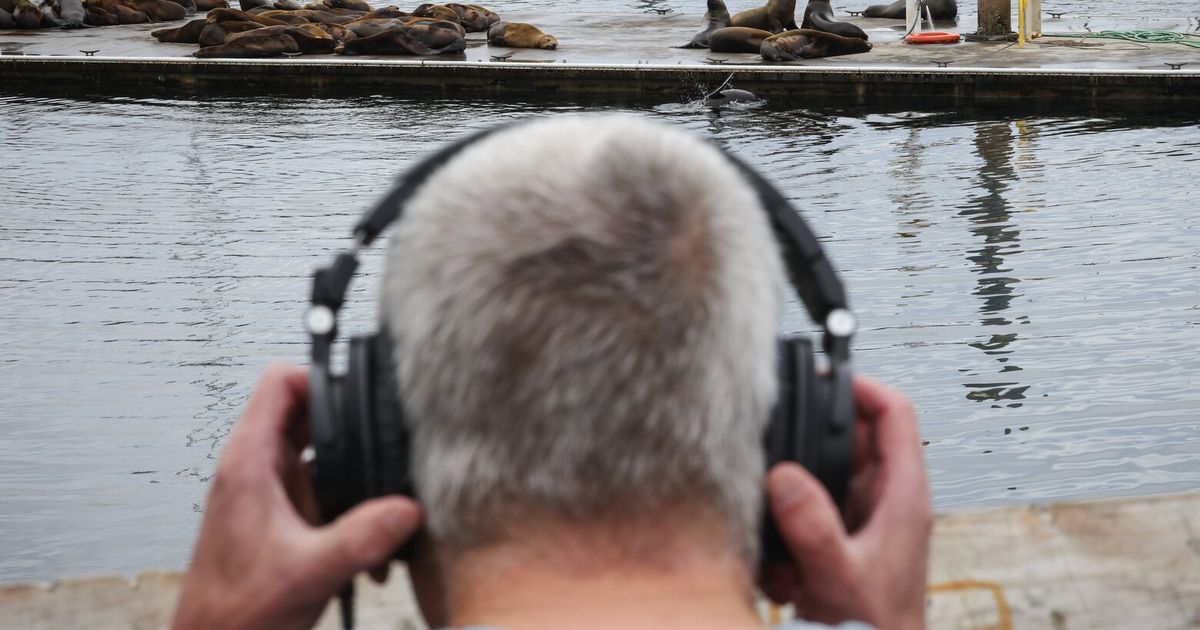
It is, in Mills’ words, “A flipper-powered community service.” It is not a livestream. It is not a research project. It is a continuous loop of sea lion recordings, about six hours’ worth so far, each one captured by Mills, sitting on a Shilshole dock or a bench, microphone and recorder in hand, headphones on.
“I’m not a professional,” he said. “I’m the local crackpot, is more like it.”
On the docks
Like so many ideas — great, dubious, harebrained — this one was hatched at a bar. Mills was sitting around Olaf’s, in Ballard, with a buddy when he blurted it out.
“Somebody should record those sea lions,” Mills said. He had been thinking about it for a while, but had never said it out loud before. He wanted to gauge his friend’s reaction.
“We talked a little about how it’s sort of the background sound of Seattle, or one of them, or at least of Ballard,” he said. “We hear them every day, and then all of a sudden they’re just going to be gone for half a year. So if somebody records them you can tune in whenever you want.”
His friend was encouraging, in the way friends are, especially friends who are a couple beers deep.
Soon after, Mills made his first recording trip to the marina.
He went to Shilshole, where sea lions have been congregating on the docks, amid the sailboats, houseboats and yachts. Some 300,000 California sea lions live on the Pacific Coast, traveling between Mexico and Southeast Alaska following fish, food, their hearts. They’re generally in Puget Sound between fall and spring. They are not without their detractors. A vocal contingent of Congress members, fishers, wildlife regulators and others wants to allow more killing of sea lions to try to boost salmon populations.
This spring, they were hanging out near the Shilshole boat ramp. It took quite a few trips for Mills to get enough tape. The conditions have to be right — not too windy, or the microphone picks up rustle; not too hot, or the sea lions can get a little lazy.
He started wearing headphones and then added a hat and sunglasses to discourage conversation.
He doesn’t want people on the tape. Or construction. Or too much wind. But there’s a line, difficult to define, about what sorts of non-sea-lion sounds are acceptable on sea lion radio. A little outside din offers depth, scene.
“Like when floatplanes come by, I kind of like it,” Mills said. “Or boats. That’s just part of Ballard. It gives it some ambience.”
He doesn’t bring a book or look at his phone. He just holds the microphone and watches. One day in June, three dozen or so sea lions sat, flopped, lounged on the dock, while a dozen more flitted about in the water. Mills sat on a pier, maybe 30 yards from the commotion. There was a fishy, animal funk in the air. He held the microphone and watched.
Two people in neon vests — official marina employees, no doubt — walked down toward the wailing beasts. They carried some kind of plastic barrier. They adjusted some sort of dock mechanism. All the sea lions stood at attention — necks arched, snouts aloft. They didn’t like the interlopers. Or maybe they did? They got louder, more ardent, emphatic.
But just then, a utility truck in the parking lot started doing some work. There was a hose and guys in hard hats and it was pretty noisy. That is not the kind of ambience that Sea Lion Radio is looking for. The recording was scotched.
Quirky, kooky, eccentric
It took a month or so of recording before Mills felt like he had enough to launch the site. He didn’t tell his family — his wife and two grown daughters — about his project until the site was live.
“He came home and said ‘I’ve been down recording the sea lions and now I have Sea Lion Radio and here are my stickers,’ ” said Brenda Savage, Mills’ wife. “I was like ‘Oh my God, what now?’ ”
“Only in the best way,” she’s quick to add. “We’ve been together over 30 years, this isn’t my first rodeo with him. Once a quirky person, always a quirky person.”
There are stickers. A red and black illustration (that Mills got from Chat GPT), with a vaguely Soviet vibe, of a barking sea lion with some raised fists and the tagline “Straight Outta Ballard.” Mills will send you five stickers, if you like, no charge.
“Word of mouth and stickers,” Mills said, asked about promotion for the site. He said he’s spent about $500 so far on web hosting and stickers.
Savage describes her husband as driven by an extreme curiosity about the world.
The sea lion project is cheaper than his other current obsession.
For a few years now, Mills has been fascinated by the Albert, a rusty, graffitied 112-foot retired gunboat that has been illegally moored in Ballard since 2019. He’s been working on a book about it. His research has taken him to Iceland (the Albert, the second steel-hulled ship ever built in Iceland is retired from the Icelandic Coast Guard) and to the United Kingdom (the Albert played a role in the Cod Wars, a midcentury conflict over fishing rights between Iceland and the U.K.). There may be a future trip to the National Archives in Maryland (the Albert helped with the Exxon Valdez cleanup).
“He just finds certain things that really hook his interest,” Savage said. “Anything he can deep-dive into that’s a little bit quirky or kooky or eccentric, he’s all in.”
Sea lion conversations
Mills recommends you listen to Sea Lion Radio for at least 15 minutes to get the breadth of the experience. Any less, he says, and you might miss the variations in tone, the personalities, the camaraderie, the conflicts.
He turns on the radio and we listen for a minute. Arfs, barks, lulls, adagio, crescendo. He turns it off.
“That’s pretty good,” he says. “So, like, what I hear is a bunch of California sea lions sort of barking away.” But then, he says, he hears a few Steller sea lions — they can weigh up to 2,500 pounds, more than three times as much as the California fellas.
“They kind of have these guttural groans and they’re sort of, to me, it sounds like the California sea lions are roughhousing and goofing around and the Steller sea lions are trying to assert their dominance, saying ‘Hey, we just want to chill out here.’ ”
We listen to another snippet. “That was pretty busy,” Mills says. “I don’t know for sure but that was probably in the morning. It seems like their busiest times are in the mornings.”
Full disclosure: I listened to Sea Lion Radio for several hours as I wrote this story. As background noise, it is lovely. There are ebbs, flows, variation, the occasional plane. It drowned out my colleagues and their phone calls. But you may have to listen with more attentiveness (or experience) than I did to grasp the nuance Mills identifies.
Traffic to the site has waxed and waned. In April, somebody mentioned it on Reddit and Mills said it was getting 200 visitors a day. My Ballard wrote about the site in May and traffic jumped to nearly 600 people a day.
These days, with the sea lions gone for the season, it’s getting 10 or so visitors a day. Mills doesn’t mind. All the feedback he’s gotten has been positive.
One person in Las Vegas had it on for a week straight. People play it for their dogs. One person said they wished they could have played it for their father’s memorial service — he was a marine biologist. Someone from South Carolina told him listening made them emotional, they felt like they were right there with the animals.
“It does seem like in the recordings you can hear conversations sometimes,” Mills said. “Maybe I’m imagining it.”
David Gutman: 206-464-2926 or dgutman@seattletimes.com. David Gutman covers local politics and King County government at The Seattle Times, reporting on how leaders and institutions impact the lives of everyday people.