
A couple of undeniable truths become self evident as this list of Top 20 Eagles Deep Cuts unfolds: First off, their landmark 1976 album Hotel California was pretty good.
The 28-times-platinum smash is home, of course, to a pair of U.S. No. 1 singles – "New Kid in Town" and the epic title track – as well as "Life in the Fast Lane," which just missed the Top 10. But other tracks from this LP also make up five out of the 20 featured spots to follow – more than any other Eagles studio project.
They also had some very familiar songs that were never released as singles, including "Saturday Night" and the title track from 1973's Desperado, and "In the City" and "Those Shoes" from 1979's The Long Run. Rock radio loved this band so much, even their deep cuts went into heavy rotation.
What's the Eagles' Best Deep Cut?
The list, as its title indicates, is dedicated to songs that weren't released outside of the album format. So, for every seemingly ubiquitous "Victim of Love" (again, off Hotel California) there are two or three from much further into the track listings. The bulk of them, in keeping, never earned a spin by a late-night DJ.
There were a few outliers, including "James Dean" from 1974's On the Border and "Learn to be Still" from 1994's Hell Freezes Over, that never hit but were released as singles, so didn't qualify. Otherwise, some of these songs may have been forgotten by all but the most ardent Eagles followers.
Here's our ranked look back at the Top 20 Eagles Deep Cuts:
No. 20. "Last Good Time in Town"
From: Long Road Out of Eden (2007)
Joe Walsh wasn't much of a presence on Eagles' long-awaited follow up to 1979's The Long Run, singing on just two tracks. This is actually his only credited co-write; Walsh contributed the verses while longtime Eagles collaborator J.D. Souther crafted the chorus.
Still, "Last Good Time in Town" – with its winking tributes to the joys of home life after giving up the high life – sounds 100% Walsh. It's important in one other way: Walsh said he went into the Long Road Out of Eden sessions with a more rock-focused approach.
"I didn't want us to be too ballad-y here," he told Billboard. "We need some stuff we can play live, so I made sure there was that element in the record."
No. 19. "King of Hollywood"
From: The Long Run (1979)
A prescient take down of sleazy movie moguls from decades before #MeToo, "King of Hollywood" eventually devolves into an appropriately furious guitar workout – with Glenn Frey stepping up first. At one point, a rumor circulated that Don Henley was inspired after being passed over for a movie role in a Western.
Either way, edgy songs like "King of Hollywood" reflected the mood of a band that had become "exhausted, burned-out mentally, physically, spiritually – homesick," Henley told Rolling Stone. "But the Beast needed feeding. Momentum had to be maintained, or so we were fooled into thinking."
In keeping, they had no problem summoning a welcome bit of Walter Becker-style snark, complete with low-voiced foreboding amid the song's Los Angeles environs. The difference is that the Eagles didn't leaven any of it, as Steely Dan might have, with a perverse sense of humor.
No. 18. "Center of the Universe"
From: Long Road Out of Eden (2007)
The sixth and final song featuring credits for both Frey and Henley on the Eagles' long-awaited last studio album, "Center of the Universe" was a quietly effective ballad. Main vocalist Henley's sense of country-road contentment is only elevated by flaxen harmonies.
That was the point. "The first objective, which sort of got us over the hump, was to understand we were making a record for our fans and our fans first and foremost love to hear us sing together," Frey told Billboard at the time.
A very real harmony flowed outward from their rediscovery of vocal harmony. "Melody and lyrics were just as important – maybe more so – than ever," Henley told Rolling Stone. "But there wasn't as much flailing around, trying to find a direction, not as much doubt."
No. 17. "Ol' '55"
From: On the Border (1974)
"Ol' 55" was the first song Frey heard on an early Tom Waits demo – and he loved it. "Still do," Frey later told journalist Cameron Crowe. "It was that car thing – and I loved the idea of driving home at sunrise, thinking about what had happened the night before."
The Eagles proceeded to uncover a heart-filling chorus buried amid Waits' scuffed-up vagabond sensibility, even as they polished the edges off a song that would become the opening track from his 1973 debut album Closing Time. But Waits was, frankly, not a fan.
"It's one of the first songs I wrote, so I felt like it was kind of flattering," Waits said back then, "but at the same time I thought their version was a little antiseptic." Asked about it later, Waits' opinion hadn't changed: "Their albums are good for keeping dust off of your turntable and that's about all."
No. 16. "Train Leaves Here This Morning"
From: Eagles (1972)
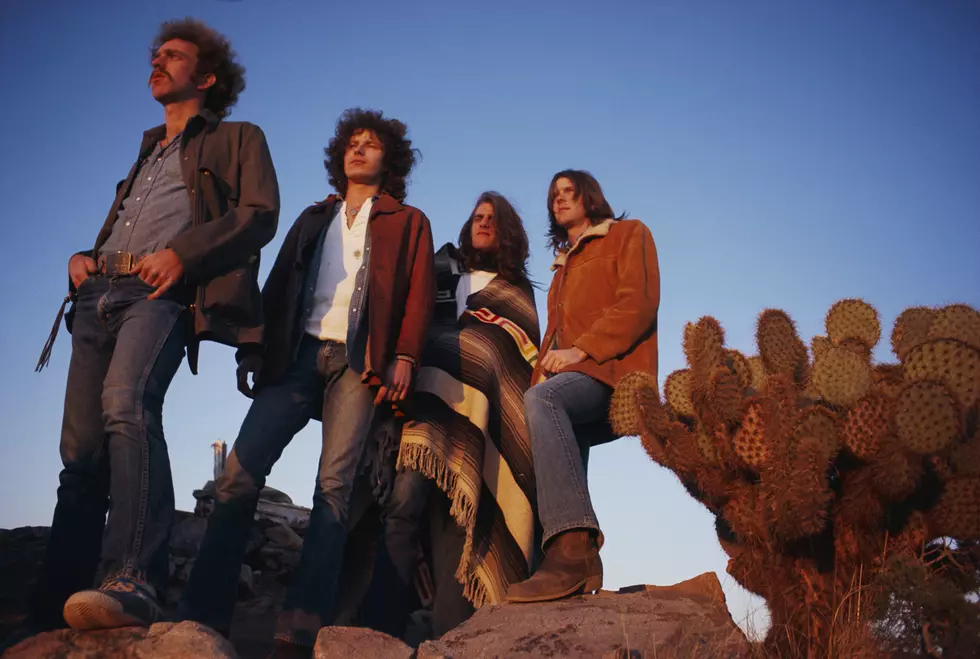
This track eventually became something of a signature moment for Bernie Leadon, who was revisiting a song he co-wrote with Byrds cofounder Gene Clark for 1968's terrific but commercially disappointing Fantastic Expedition of Dillard & Clark.
By the time Leadon became part of Eagles' first lineup, after a similarly ignored detour in Flying Burrito Brothers, country-rock was no longer the outlier it had once been – and "Train Leaves Here This Morning" was born anew. For a while, Leadon's sound was the Eagles sound. Then he was replaced by his former childhood bandmate, Don Felder.
"Bernie was a very country musician. He played a five-string banjo, a bluegrass flat-top guitar, mandolin, pedal steel – his electric guitar playing was second to his country playing," Felder told Classic Rock Revisited. "That is why the early Eagles albums had such a country influence: He was the lead guitar player."
No. 15. "Waiting in the Weeds"
From: Long Road Out of Eden (2007)
"All I can say is that the Eagles are like a volcano," Glenn Frey once told the Boston Herald. "Sometimes we rumble, sometimes we spew, and sometimes we're quiet." The Henley co-written and sung "Waiting in the Weeds" was proof of concept.
He'd long been prone to political harangues and haughty complaints about old girlfriends, going back well before the Eagles imploded in the late-'70s. But there was always another side – and the quietly emotional "Waiting in the Weeds" proved, once again, that nobody does worn-down, middle-aged melancholy so well.
Resonant moments like this convinced Frey that Long Road Out of Eden would stand the test of time – even when compared with their glory days. "I think it's going to stand up," he told Billboard. "I think it's going to be right up there, if you want to know the truth."
No. 14. "Doolin-Dalton"
From: Desperado (1973)
Blame Jackson Browne. Frey's songwriting collaborator on the early Eagles favorite "Take It Easy" had a coffee-table book about famous Old West outlaws – and that sparked "Doolin-Dalton," the first song completed for the Eagles dusty-booted concept album Desperado.
"Doolin-Dalton" was a great scene-setter. Maybe too great. Eagles ended up taking the iffy Old West subject too far, while returning to this song's musical theme an utterly unneeded number of times – including both an instrumental version and an album-closing reprise. Still, Browne loved the results.
"Desperado was a brilliant move, because it gave the Eagles an identity," Browne later told Uncut. "There was something limited about the concept, but it was also very potent ... that projected dream of what freedom could be. Vacate your assigned positions in life and be what you f---ing want!"
No. 13. "No More Cloudy Days"
From: Long Road Out of Eden (2007)
Frey didn't walk in empty-handed as the Eagles gathered for their first studio sessions in ages. "If I heard a song or I started writing a song that I thought was right for the Eagles," he told Billboard, "then I would hang onto it and kind of set it aside and say, 'I think this could go on our record.'"
"No More Cloudy Days" was one of them. Originally released as part of a bonus EP with 2005's Farewell 1 Tour: Live from Melbourne, this track took on an indescribable sadness after Frey's death. At that point, nearly 10 years had passed since its subsequent appearance on Long Road Out of Eden.
"Well, it adds a certain poignancy, doesn't it?" Henley told Rolling Stone. "In looking back at it now, that album contains several songs of foreboding and farewell. It's almost as if we knew that record would be our last."

No. 12. "Bitter Creek"
From: Desperado (1973)
The album-length cowboy-themed Desperado was very much a reaction to the success of the Eagles' self-titled debut. "It's not as if we weren't grateful or excited about it," Henley told Rolling Stone. "But at the same time, we didn't want to become just another Top 40 hit machine."
Just as "Doolin-Dalton" had taken inspiration from Bill Doolin and Bill Dalton, this song references their fellow outlaw gang member George "Bittercreek" Newcomb. Bernie Leadon wrote and sang this final original from Desperado, before the "Doolin-Dalton"/"Desperado" reprise closes out the album.
The track begins just as you'd expect from the Eagles' stalwart traditionalist: reserved country rock – maybe too reserved. Randy Meisner doubles on both bass and the guitarron. But then something happens as the rest of the group joins Leadon's wordless harmonizing on the outro. "Bitter Creek" takes flight.
No. 11. "After the Thrill Is Gone"
From: One of These Nights (1975)
Taking a rueful look back at the wreckage a lost relationship was already becoming old hat for Frey and Henley, even this early on, and that's likely why "After the Thrill Is Gone" hasn't gained wider attention. The idea, Henley said, was to explore what happened after the events of B.B. King's signature song.
Frey sang lead vocals on the verses and chorus, while Henley handled the bridge. This tucked-away gem is made complete, however, by newly christened member Don Felder's solo, which adds a touch of simmering anger. Their sound was already changing, well before Joe Walsh created a new two-guitar tandem.
"When Joe and I joined, we brought another element that really helped propel them into rock and roll, which took them to a level that the previous Eagles were unable to attain," Felder told Classic Rock Revisited. "We all created something far bigger than any of us would have ever been able to accomplish by ourselves."
No. 10. "Victim of Love"
From: Hotel California (1976)
"Victim of Love" begins with a stuttering, snarling guitar, then paints a dim portrait of this desperate search for late-night companionship amid of a series of Don Felder's nasty guitar retorts. He also co-wrote the track, though Don Henley sang it. This was actually a sticking point.
Felder had arrived at the sessions for Hotel California with demos that became the title track and "Victim of Love." J.D. Souther, who eventually earned co-writing credits, was an early fan of this one. All five Eagles completed the instrumental track together, playing live in the studio. Then Felder left to grab a bite.
When he got back, Henley had completed the vocal. At the time, Felder was "really upset because everybody was supposed to have a song on that record ... and I was told I was going to be able to sing that," Felder told the Ultimate Classic Rock Nights radio show. "Of course, "when I listen to it now, Don did a great job on it."
No. 9. "Wasted Time"
From: Hotel California (1976)
Henley sang it, but "Wasted Time" really speaks to Frey's passion for R&B music – in this case, '70s-era Philly soul. They added some distinctly un-country rock-like strings, and then Frey – who once described Henley as "our Teddy Pendergrass" – left his longtime bandmate to his own vocal devices.
"You're not going to find that track on a Crosby, Stills & Nash record or Beach Boys record," Frey said in the liner notes to The Very Best Of compilation album. "Don's singing abilities stretched so many of our boundaries. He could sing the phone book. It didn't matter."
Still, as desperately sad as "Wasted Time" no doubt sounds, it didn't reflect the vibe. "During the making of the Hotel California album, we were ecstatic much of the time," Henley told Rolling Stone. "We knew we were onto something. So, you have the interesting juxtaposition of dark themes being developed and constructed in an atmosphere of excitement and productivity."

No. 8. "In the City"
From: The Long Run (1979)
Joe Walsh recorded his own version of "In the City" as part of the soundtrack to 1979's cult classic The Warriors, then the Eagles approached him about rerecording it to complete the long-delayed follow-up to Hotel California. "I always liked the song and thought it could have been an Eagles record, and so we decided to make it one," Frey told journalist Cameron Crowe.
Musically, the approach was lighter but largely the same; the major difference is their gorgeous vocal blend. As with everything on this LP, the Eagles took their time – sometimes a very, very long time – to get every element locked into place.
"I think all of us in the Eagles are perfectionists and not necessarily by choice," Walsh admitted to the Atlantic City Weekly. "It's like Cirque du Soleil — everything's got to be in place. When you jump from 40 feet, there's got to be somebody down there who's going to catch you."
No. 7. "Those Shoes"
From: The Long Run (1979)
The musical relationship between Don Felder and Joe Walsh, as both foils and friends, helped define the group's sound in the late '70s. Together, they give this Henley-sung track a steely menace.
Felder, who co-wrote "Those Shoes," mixes it up with Walsh to complete one of the decade's most memorable talk-box street fights. (That's saying something.) This song's gnarled vibe also seemed to perfectly encapsulate the era.
"That was the most uncomfortable album I think I ever made. There was a lot of pressure coming off of Hotel California to produce another Hotel California," Felder admitted to Glide magazine. "Glenn used to say, 'We created a monster with Hotel California and it ate us.' That's the best way I've heard it put."
No. 6. "Saturday Night"
From: Desperado (1973)
A true band composition, this Desperado deep cut grew out of a stray thought original band member Randy Meisner had about growing up. "I was sitting there one night, and I came up with the line 'What ever happened to Saturday night?'" he later remembered.
"When I was younger, I would be out partying and with girls and having fun," he added. "And that's what it was about: Whatever happened to it? And the answer was, 'You're older now.'" Everybody chipped in to complete things, as "Saturday Night" eventually collected co-writing credits for all four members of the Eagles.
Henley's main vocal was delicately led along by Bernie Leadon's mandolin, while Meisner handled the bridge ("she said tell me ... oh, tell me"). The result was a moment of deep introspection that grounded an album which might have otherwise gotten bogged down in its Big Concept.
No. 5. "The Last Resort"
From: Hotel California (1976)
Henley would explicitly tie this song to his growing activism over environmental issues – but nothing came easy. "'The Last Resort' was the final piece of the Hotel California puzzle," Frey told Cameron Crowe. "We started the song early in the record, and Don finished seven months later. I called it 'Henley's Opus.'"
There is certainly plenty of righteous anger directly relating to our poor stewardship of the planet – but, in context, "The Last Resort" always felt like something more than another of Henley's political screeds. Instead, an album defined by empty dissolution ends the only way it could: with a lonesome figure, surrounded by wreckage of his own making.
The Eagles finally closed the complex, sharply emotional final chapter of their best-selling album. "I think that we were at the height of our powers," Henley told Rolling Stone. "Every band has a peak, and that was ours."

No. 4. "Desperado"
From: Desperado (1973)
The title song for this Old West-themed project had been rattling around in Henley's head since at least 1968, but Frey was the main proponent of the larger rockers-as-cowboy-outlaws concept. The objective, it seemed, was to make a grand statement so that the Eagles might be taken more seriously.
They read books about tumbleweed antiheroes like Bill Dalton, plugged in some interludes and then updated "Desperado" to make it all fit. Initially, however, the song had what would have been a truly tragic astrological bent. Frey remembered Henley's original lyric as, "Leo, my God, why don't you come to your senses?"
Even with the update, Henley never liked the results. He was only given a few takes to complete his vocals and they were recorded with the intimidating London Symphony Orchestra. "I still have a little trouble with the intonation on the lead vocal," he told CBS Sunday Morning. "To this day, I don't listen to it."
No. 3. "The Sad Cafe"
From: The Long Run (1979)
There was no better way for this LP to end. In many ways, "The Sad Cafe" sets a template for Don Henley's subsequent solo career, as he offers a darkly ruminative examination of love lost. "We could feel an era passing," he told Rolling Stone. "Those remarkable freewheeling times were receding into the distance."
They started with the title, from a book by Carson McCullers "which didn't have anything to do with the song, other than it was a great title," Frey said in The Very Best Of liner notes. "The line that really resonates for me in that song is, 'I don't know why fortune smiles on some and lets the rest go free.'"
That's where the Eagles were at this point. Despite reloading with Timothy B. Schmit, a malaise had clearly crept in. The Long Run was dotted with halfhearted efforts before the Eagles finally righted things with this cinematic finale. Don Felder's elegiac, utterly virtuosic turn on guitar draws it all to close.
No. 2. "Pretty Maids All in a Row"
From: Hotel California (1976)
The Eagles completed their shift from shaggy roots band to full-on rockers as Walsh took over for Leadon. Nobody else could have come up with the riff for "Life in the Fast Lane," his other major contribution to Hotel California. It was classic Joe Walsh.
On the other hand, "Pretty Maids All in a Row" couldn't have been more different. An emotional meditation on regret, the song catches a different gear when his new bandmates join the vocal finale – but not before Walsh tears off a mournful slide solo.
Rock's clown prince has rarely been more revealing. "My writing really blossomed with the input of the other guys, watching them, going 'Holy smokes, look how this works,'" Walsh admitted to Forbes. "It was amazing."
No. 1. "Try and Love Again"
From: Hotel California (1976)
Some days, this criminally undervalued deep cut feels like the best song on the Eagles' most celebrated studio project. A soaring anthem about believing against all odds, "Try and Love Again" had an appropriate theme for the often-forgotten Randy Meisner.
Even now, the others tended to poke fun. "There's one song on the album that we joke about being our Buffalo Chi-Lites track – half the Chi-Lites, half Buffalo Springfield," Henley told Britain's ZigZag magazine in 1976. "It's a track of Randy's, 'Try and Love Again.'"
Ultimately, Meisner couldn't live up to this song's outsized promise. He scored a huge hit with "Take It to the Limit" but then began to struggle with expectations. "Try and Love Again" would become Meisner's final co-writing credit – and his final lead vocal – with the group he co-founded.
Eagles Solo Albums Ranked
Here's a look back at studio projects recorded away from the band.
Gallery Credit: Nick DeRiso