Kobayashi Kiyochika printed a view of Mt. Fuji in 1880, from within the Hakone mountains. Off to the left, drawn just as carefully as the mountain itself, is a telegraph pole.
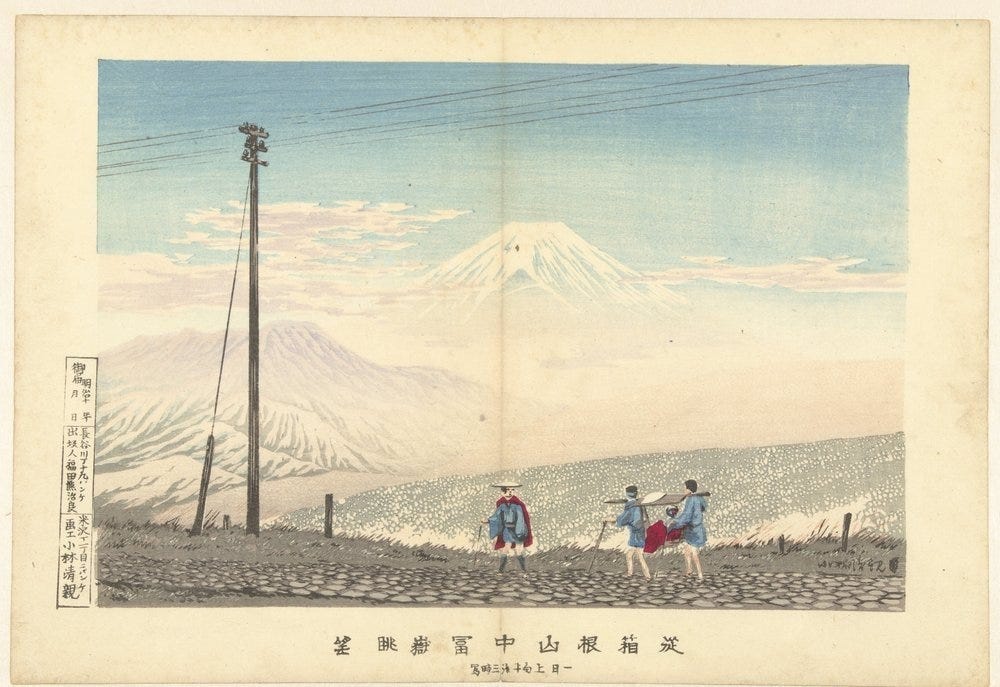
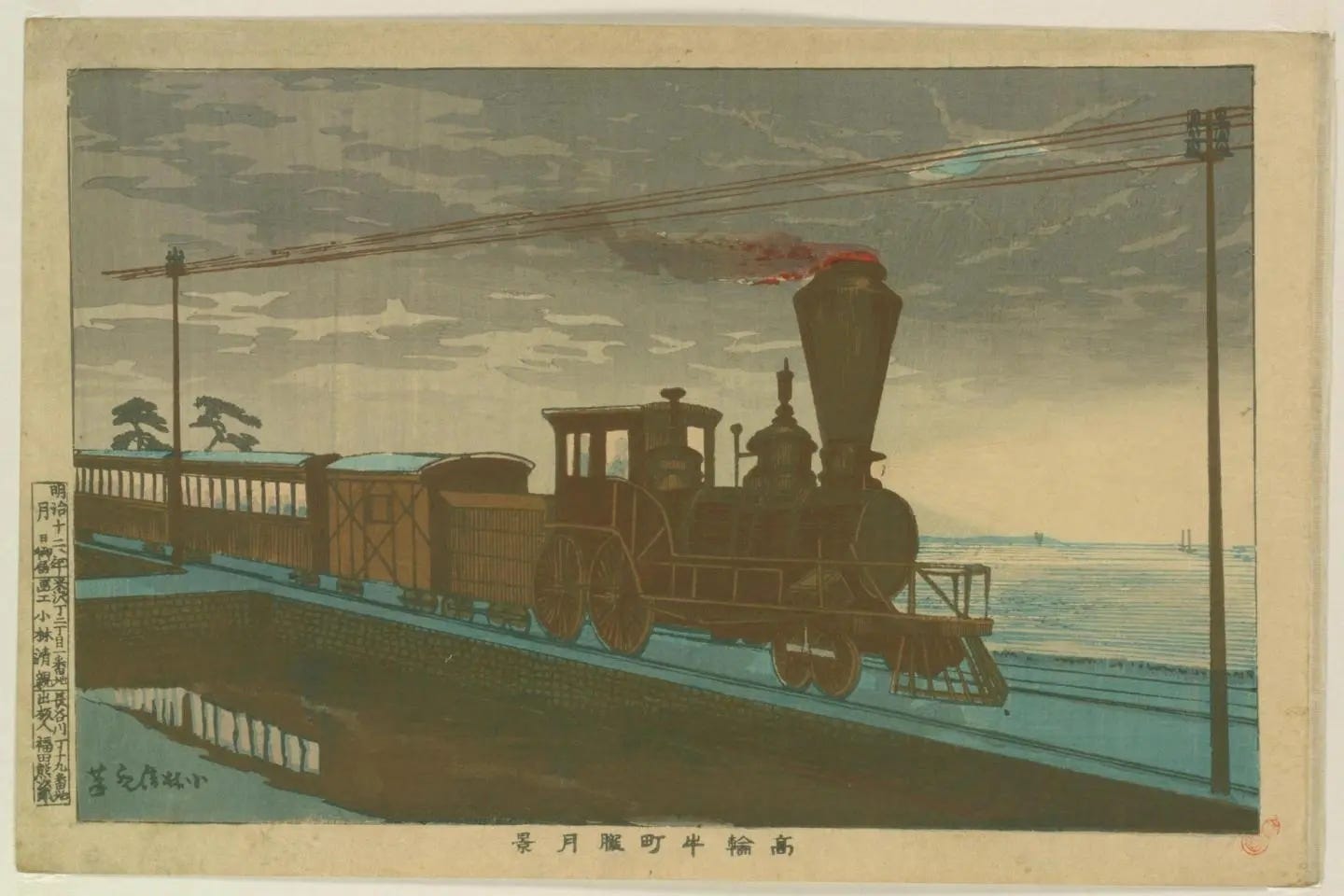
In 1880, the telegraph pole was the newest feature in the Japanese landscape, and printmakers played a central role in creating the hype. Already the medium had taken up the railway, the gaslight, the brick streets. Dozens of kaika-e, enlightenment prints, the woodblock images that sold the modern city back to its own residents, placed the telegraph pole front and centre, upright, the wires disappearing neatly off the page.
A boast
In 2021, the Nerima Art Museum in Tokyo pulled together about 130 of them from the 1850s to the present day, under the banner Densen Kaiga, or roughly, ‘Electric Wire Paintings’. Yosuke Kato was the curator. The exhibition made it clear that the wire had never once disappeared from Japanese picture-making, and that its function within those pictures continued to change.
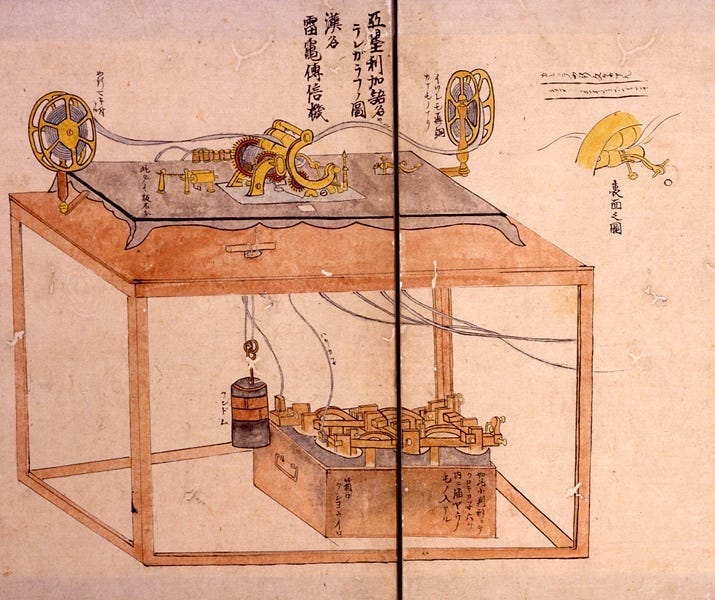
The earliest example pre-dated the poles themselves. In 1854, Perry gave a demonstration of a telegraph set at Yokohama, and a Matsushiro-domain retainer named Osuke Hibata, stationed there as a guard and good with a brush, sketched the apparatus and its wire. The sheet is held by the Postal Museum. It’s the first wire anyone in Japan ever bothered to draw.
Japan wasn’t the only place to represent the wire as a promise. In December 1920, the GOELRO commission presented its electrification plans to the Eighth Congress of Soviets, and Lenin stood before a map of the country speckled with lightbulbs, one for each generating station not yet built. The pylon and bare bulb were staples of Soviet posters for the next 70 years.
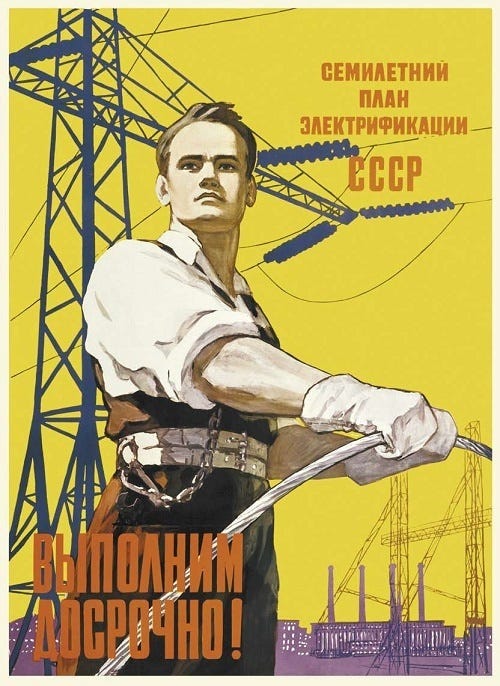
M. Pisarevsky. We will finish the seven-year plan of USSR’s electrification ahead of time. USSR, 1959
From the beginning, the pole had an element of the mundane about it, and, by the time the electric power pole reached Japanese painting, about 20 years after the telegraph pole, any elation had been drained from it. Yet they persist in the frame.
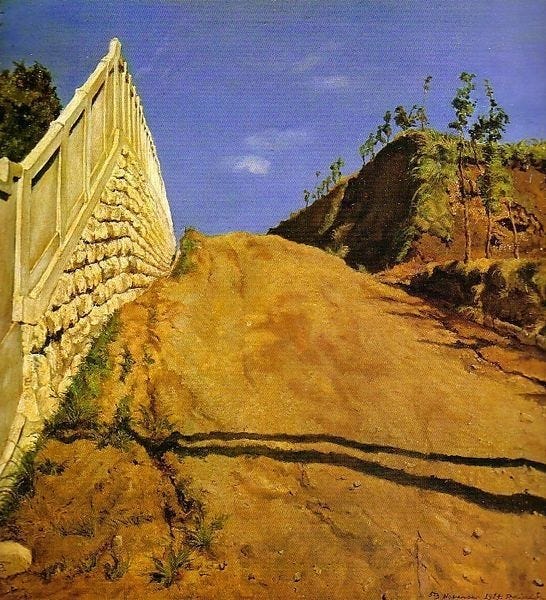
They appear on works by Ryusei Kishida, as the lines’ shadows posed against the red soil of new land-clearings, so that both read as Tokyo expanding westward.
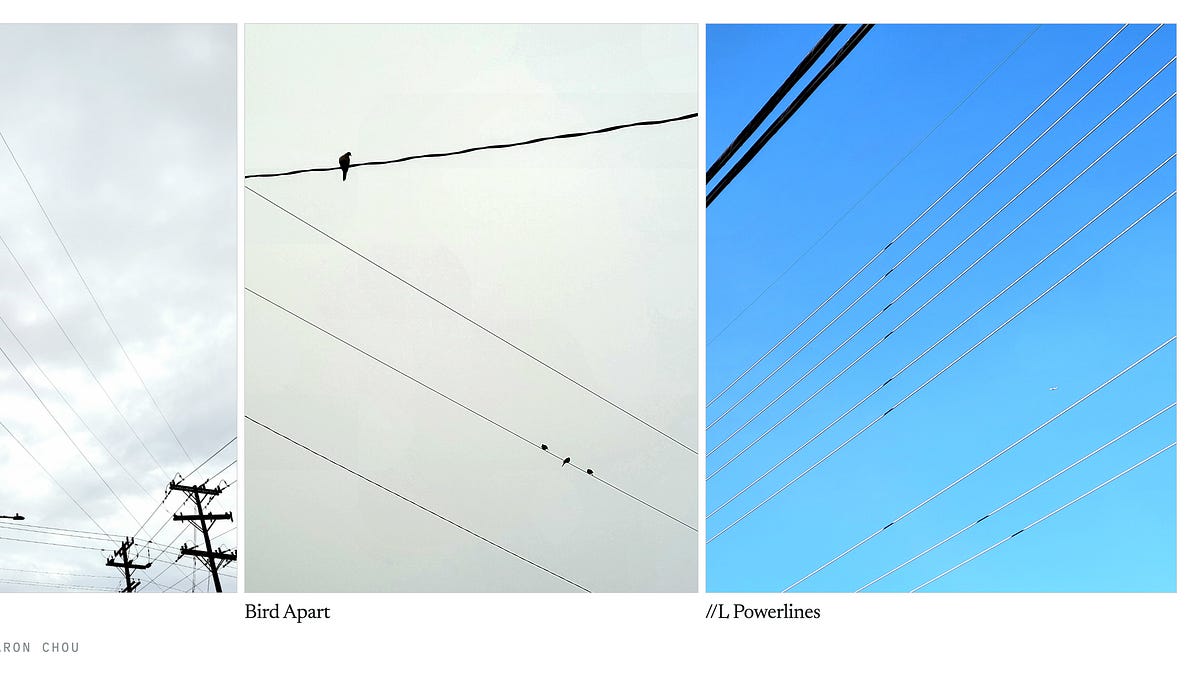
In 1935, Kinosuke Ebihara painted a mass of sparrows sitting on a line, and the show’s catalogue remarks that this is an anomaly. For all the wires in Japanese art, there are very few birds perched on them.
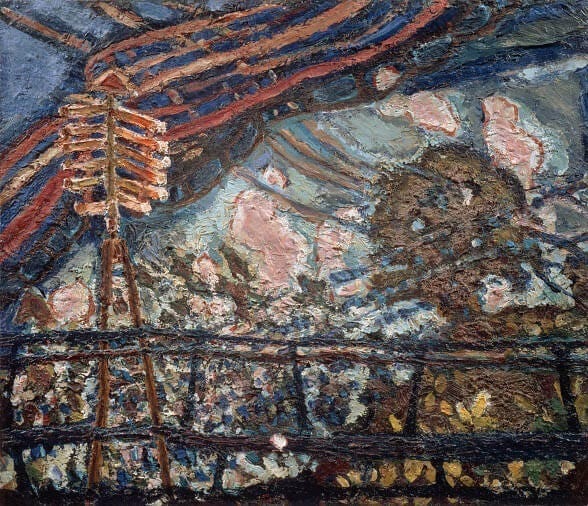
There were some, though. Kan’emon Asai, for instance. He was an oil painter who, from around 1950, worked assiduously and exhaustively on a series titled Densen Fukei, ‘Wire Scenery’. In these paintings, the wires aren’t behind anything; they cover the entire foreground and he produced so many that he was dubbed Mr Wire Scenery.
(The Nerima show dedicated an entire gallery to the ceramic gaishi insulators that keep the line from touching the pole, on the basis that they’re good-looking things. The first Japanese ones were made in Arita in 1870.)
Back to the US, paintings reached wires by a different route. Charles Burchfield created a small watercolour titled Telegraph Music in 1917, but returned to it between 1948 and 1952, making dozens of studies as he tried to expand it into something bigger. His goal was sound. He drew audio-cryptograms, stylised marks representing specific noises, such that a plucked wire produces ripples of sound that travel outward and downward through the wooden poles, accompanied by crow caws and wind-whipped clouds, while a bluebird is silent on a fence post.
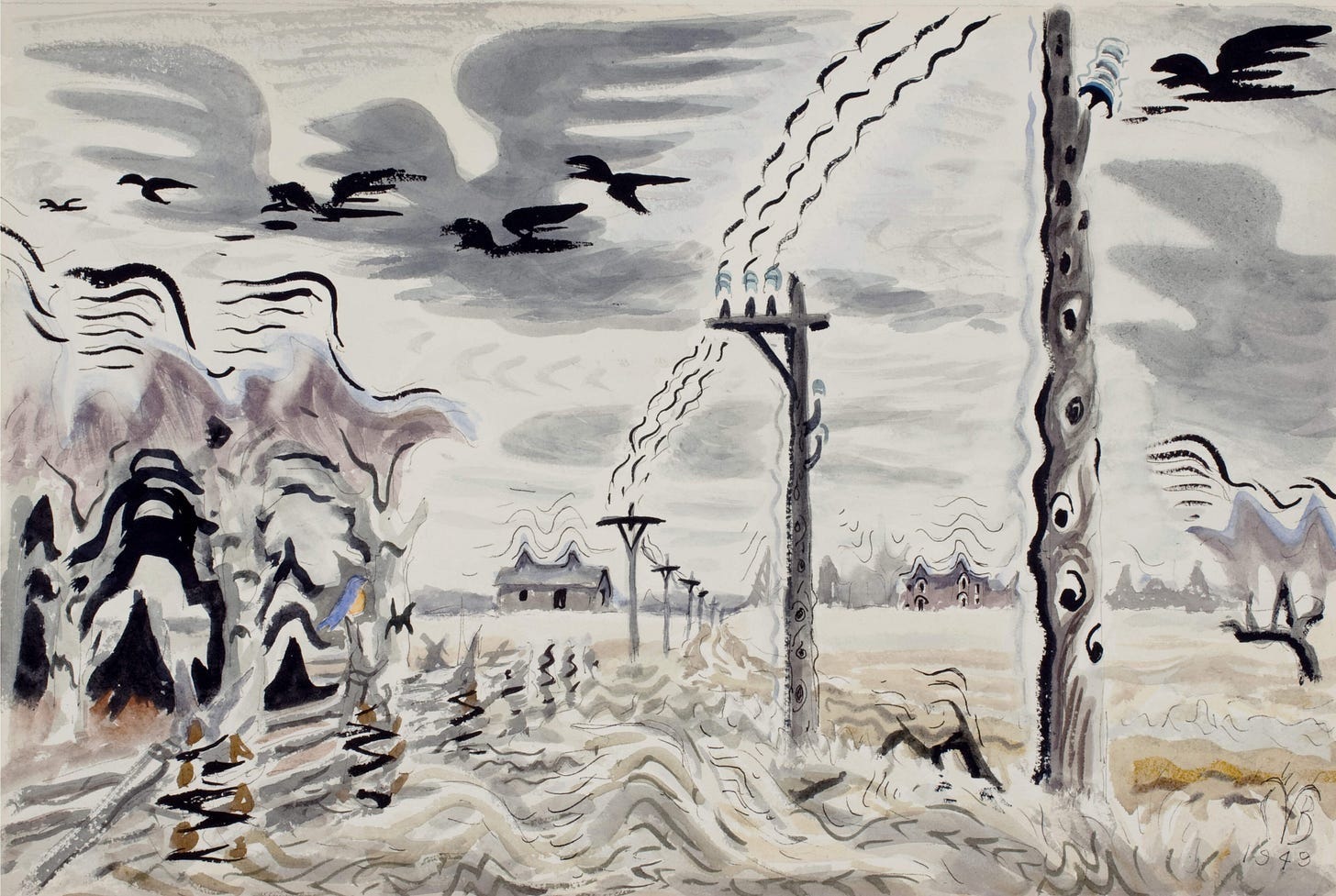
Burchfield retained the title for the 1949 version. The original 1917 painting was placed at the centre of Song of the Telegraph, completed in 1952. In 1963, he wrote that few sounds were ‘as wild and elemental as the “music” of the telegraph wires’.
Which is a neat way to describe an anime series called Serial Experiments Lain, 46 years ahead of time.
Photography came a bit later. The issue with photography, after all, is that the wire enters unbidden. Lee Friedlander made a career of holding his ground. From the 1960s onwards, he permitted telephone poles, traffic signs, shop window reflections and such to enter his images. The dominant reading of his pictures, the version the Museum of Modern Art put forward in its survey of his work, was that he turned ordinary photographic blemishes into enigma: ‘a pole often gets in the way.’ Joel Coen chose 70 Friedlander photos for a monograph in 2022; he writes of these photos as ‘bisected and carved by stop signs and utility poles’.
By 1975, this was the subject of an entire exhibition. New Topographics: Photographs of a Man-Altered Landscape gathered Robert Adams, Lewis Baltz, Stephen Shore, Joe Deal, Frank Gohlke, Henry Wessel and the Bechers in a single gallery. (The title came from the show’s curator, William Jenkins.) Adams’ book The New West, showing suburban developments in middle grey tones near Colorado Springs and Denver, with their attendant utility poles, had come out the year before.
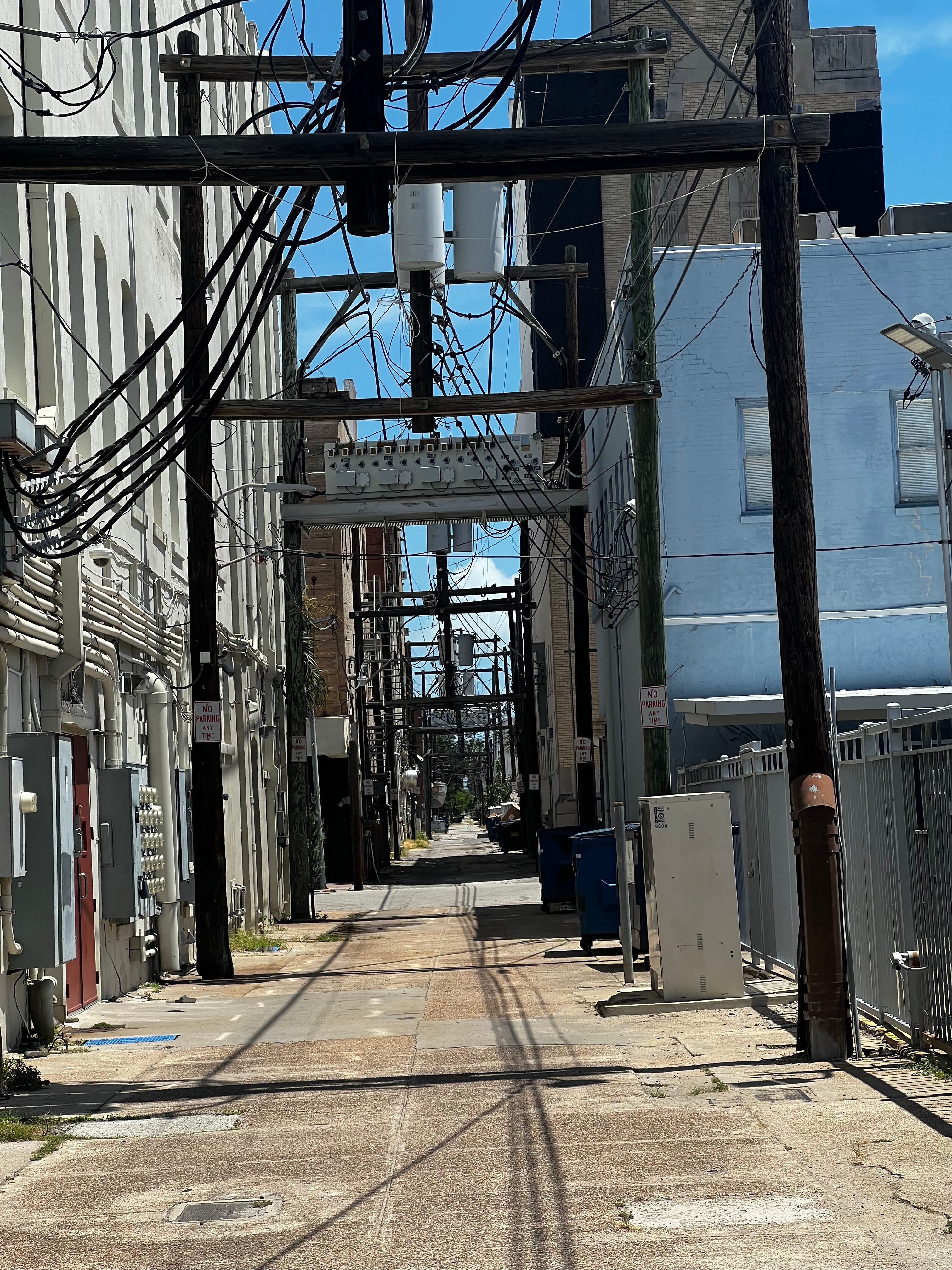
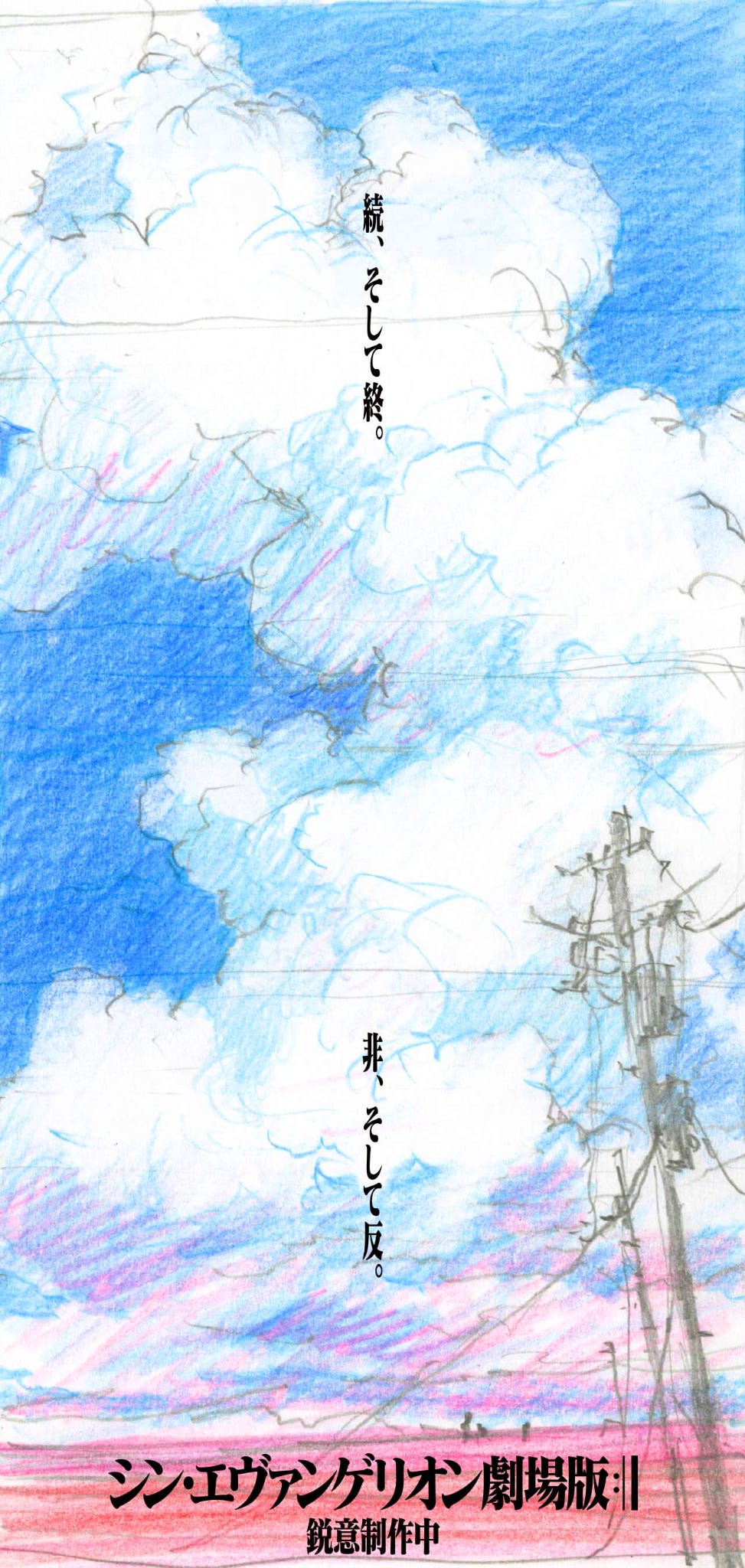
With anime, it’s a matter of someone choosing to include the wire for whatever reason as part of the scenery (and maybe the narrative). The obvious reference point is Neon Genesis Evangelion (1995-96), whose art director was Hiroshi Kato, who would fulfill the same role in the Rebuild films. The wires are a basic component of Evangelion’s visual grammar, such that, when the studio Khara wanted a poster to advertise its final film, it offered a blue sky, some clouds, and just poles and lines. Media scholar Shin’ichi Kinuwa shows how effective this visual shorthand is in other settings, too, using wooden poles to signify a specific time period, poles casting long shadows over a setting sun to evoke a specific kind of sadness, and streets criss-crossed by lines to convey tension.
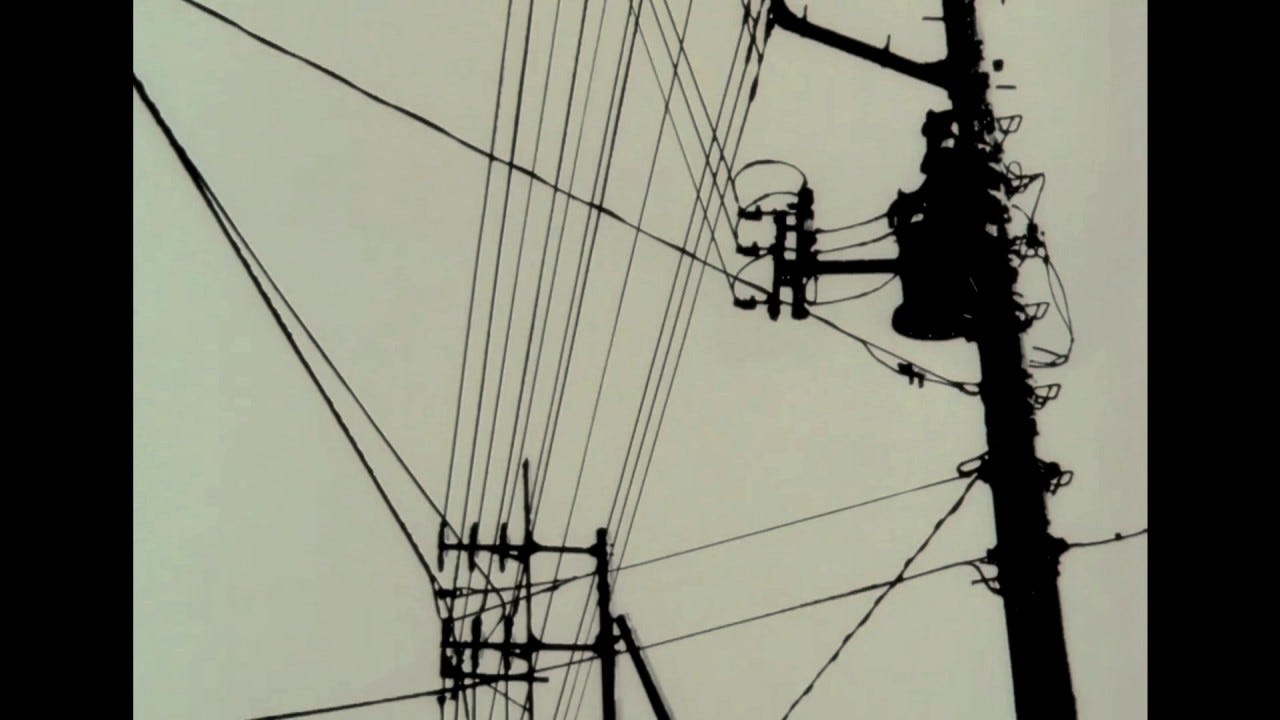
There’s also Serial Experiments Lain (1998), the flip side of the coin: audio. Made by Triangle Staff and directed by Ryutaro Nakamura, with the script written by Chiaki J Konaka, the sound of wires humming under a sky full of empty poles grows louder and louder until the audio becomes as important as the visuals. You can find compilations of those sequences online. Someone uploaded just 12 hours of audio, and it has around 1.7 million views.
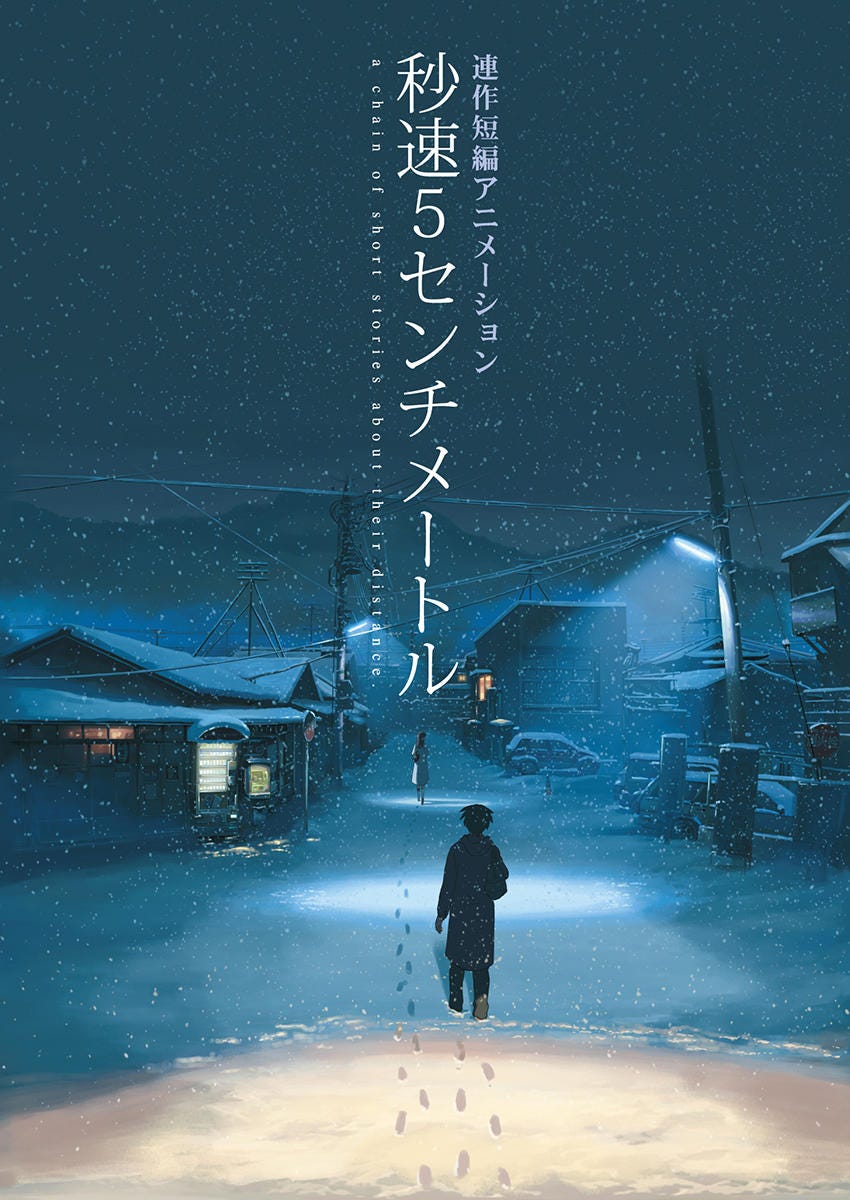
Makoto Shinkai uses the same ingredients to build his landscapes, but for the sake of depth and perspective. His 5 Centimeters per Second (2007), painted by Shinkai along with Takumi Tanji and Akiko Majima, has wires that carry the picture’s composition. They lead our eyes out of frame, divide the sky into random segments and juxtapose a railroad crossing, a schoolhouse rooftop, and the sky.
The live-action movie had already figured this out, though. In Yasujiro Ozu’s Late Spring (1949), Chishu Ryu and Setsuko Hara sit in a train car. A window shows them just the top of each telephone pole and wire as the train passes. Many of these choices were driven by what would be possible to film. But what results seems like emotion.
And now the tables have turned. According to Kinuwa, Japanese Suits, produced by Fuji TV, barely features the wires at all because the American producers were pushing for a more glamorous, stylized look. Wires, on the other hand, make it instantly clear you’re in Japan, a country far from luxury and glamour (I know, I know, I also question the producers’ line of thinking). When directors want to show money, new love, and the possibilities of modernity, they actively avoid poles. Wires are an option that can be discarded, and they are often treated as such, a victory of sorts.
Renge Ishiyama was born in 1992, and the first line on her business card says she loves electric wires. She’d vaguely liked wires since the third grade. What clarified her interest, she said, was getting ahold of reference material from anime, Neon Genesis Evangelion and the Ghost in the Shell movies and series, which steered her toward old buildings, ruins, factories, and back alleys. In high school, she joined the photography club, and her camera began wandering to wires without prompting. She made a doujinshi about them for Comiket in the winter of 2017, and in December 2022, Heibonsha released her book of essays, Densen no Koibito, Electric Wire Lover. By then, she’d taken more than 15,000 photos of wires. Here is how the book opens:
I am the lover of electric wires. I hadn’t yet noticed it when I already liked them.
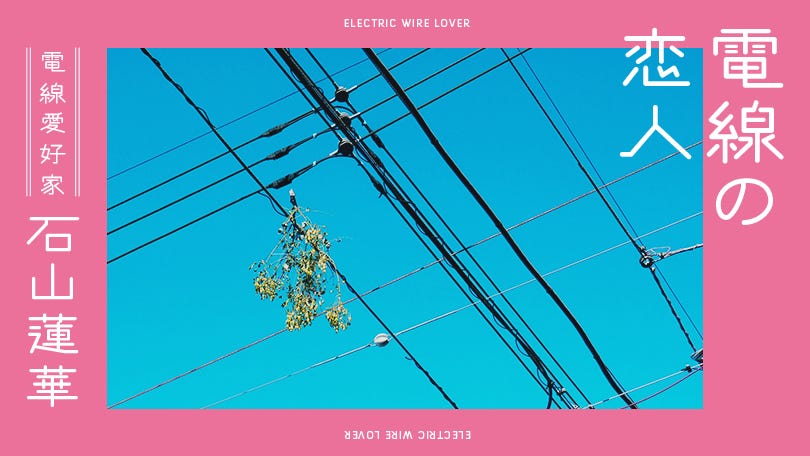
In June 2022, the Japanese Electric Wire and Cable Makers’ Association appointed her its official wire ambassador. And she isn’t the only one. The Nerima show featured six other living artists creating similar work: Chizuru Masumura, whose photos of utility poles are shot in extreme closeup; Hideki Yamaguchi, who makes drawings of the Keio Line in intricate ink; and Akira Yamaguchi, who arranges utility poles like cut flowers, a joke he calls chukado, and who also exhibited a pole-themed comic in his booth at the festival for the first time.
There has been talk in Japan, for a few years now, of what the streets will look like after all the wires go underground. The pictures exist in this weird limbo. Nobody wanted the wires. Kiyochika was trying to depict progress, Friedlander was trying to solve a compositional challenge, Anno was trying to evoke an atmosphere.
What do you think of a place that has never really existed anywhere except as a background? Even the studios aren’t sure. No one is. The affection for the wires is real! Nobody drew them because they were pretty, they drew them because they were present, and they were found to be pretty, even to the point of romance, in the process.