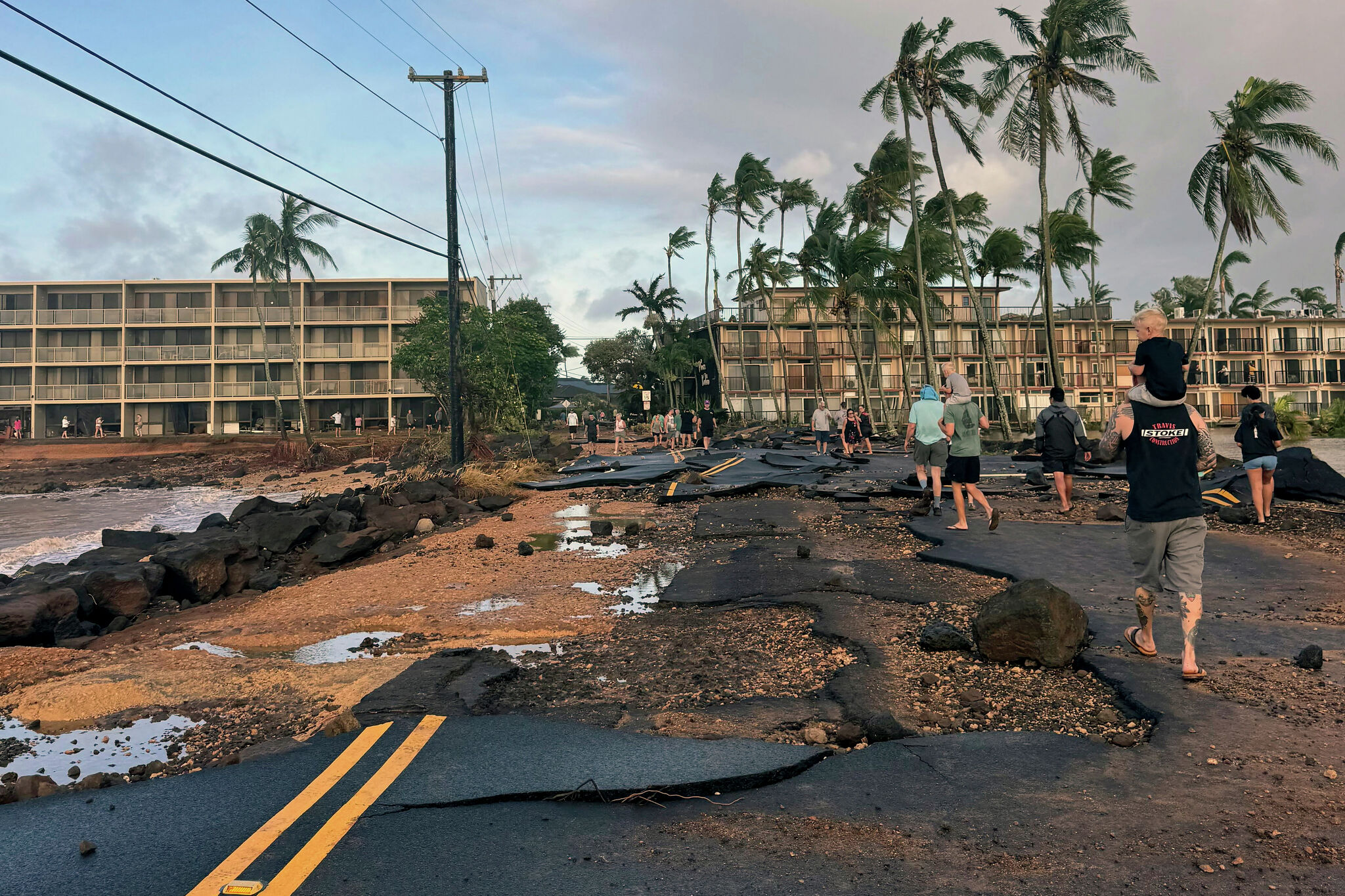
This year, Hawaii residents and businesses have barely had time to recover from one storm before another has appeared on the horizon. The effects of the back-to-back storms are compounding, from growing anxiety to financial strain and layoffs.
First, two kona low storms hit the Islands in March. Then, Hurricane Lala and Tropical Storm Moke swept through in August. Hurricane Lowell followed in September. Residents have cleaned up flooded homes, businesses have made repairs and communities have tried to return to normal, only to watch another storm form in the Pacific Ocean. For some, the next threat arrived before recovery could take hold.
Daedrie Kai’s family has already had to start over more than once.
Article continues below this ad
Her family owns Wong Yuen Store, a longtime convenience store in Naalehu on Hawaii Island, and lives on properties nearby. The kona lows in March badly damaged one of the family’s homes and appliances. The family cleaned up and replaced what had been lost.
Then Hurricane Lala came.
“We replaced it. We cleared our property again, and it just happened all over [again],” Kai told SFGATE.
This time, the destruction was more widespread. The roof of one house was damaged, two sheds were wiped out and some animals died. The store sustained structural damage, lost inventory and damage again to appliances. They were without electricity and water for about two weeks, she added. A month later, recovery isn’t finished.
Article continues below this ad


The Wong Yuen Store, a longtime convenience store in Naalehu on Hawaii Island, suffered damage in the wake of Hurricane Lala.
Courtesy Daedrie KaiThe Wong Yuen Store, a longtime convenience store in Naalehu on Hawaii Island, suffered damage in the wake of Hurricane Lala.
Courtesy Daedrie KaiNow, whenever another storm appears in the Pacific, it feels different. “It kind of gives us anxiety, like a lot of worry,” Kai said.
Before, the family would take mild precautions, she said, like adding sandbags, when a storm approached. Now, they fill their water jugs, make sure they have gas and keep a generator. “We’re extra prepared, you know,” Kai said.
Their experience isn’t isolated, and neither is the anxiety that can come from seeing another storm form.
Article continues below this ad
“It’s called a cumulative stress effect,” J.C. Hodges, an assistant professor at the University of Hawaii at Manoa’s Department of Social Work, told SFGATE. He is a licensed clinical social worker and researcher who specializes in disaster mental health.
When people haven’t had enough time to recover from the first event, both in their lives and emotionally, another period of intense stress can make the impact worse, Hodges said. That stress can also last longer when people are dealing with challenges like major home repairs, lost work or difficulty getting the proper resources to recover.
It can also lead to “anticipatory anxiety,” he said. “It’s not just about memories of the past event, but it becomes a lot of concern about what could happen in the future.” In his previous work with hurricane survivors, Hodges saw people become anxious when it started raining. To cope with the stress, he recommends talking with friends and family, getting enough sleep and continuing hobbies when possible.
This year’s active hurricane season has fueled the cycle.
Article continues below this ad

A home damaged by Hurricane Lowell is seen in Poipu on Kauai on Sept. 10, 2026.
Nathan Eagle/Honolulu Civil Beat via AP
Damage caused by Hurricane Lowell is seen in Poipu on Kauai’s south shore on Sept. 8, 2026.
Guy Miller/Honolulu Civil Beat via AP
Damage caused by Hurricane Lowell is seen in Poipu on Kauai’s south shore on Sept. 8, 2026.
Kevin Fujii/Honolulu Civil Beat via AP“The strengthening El Nino has made the central and eastern Pacific more conducive to tropical storm and hurricane formation this year,” Matthew Rosencrans, a meteorologist with the National Oceanic and Atmospheric Administration’s Weather Prediction Center, told SFGATE in an email. He said sea surface temperatures are above average, wind shear is lower and “steering winds have set up to push storms west, toward Hawaii.”
Article continues below this ad
Three tropical depressions or stronger have passed within 3 degrees of the Hawaiian Islands in 2026, according to Lindsey Long, also a meteorologist at the Weather Prediction Center. That’s above the annual average of 1.2 tropical depressions or stronger.
From 1971 through 2026, only three years saw more: 1982 and 2015 with four each, and 2016 with six. “Both 1982 and 2015 were El Nino years, while 2016 was coming out of an El Nino event in the spring,” she told SFGATE in an email.
Six other years have recorded three storms, tying 2026 so far. So, this season isn’t unprecedented. But for people still putting their lives back together, the numbers don’t necessarily capture what it feels like to have crisis follow crisis.

Damage was spread across the Punaluu Bake Shop’s three buildings on the island of Hawaii when Hurricane Lala struck in August 2026.
Zachary Kennedy
Debris inside the Punaluu Bake Shop’s retail building on the island of Hawaii, following Hurricane Lala in August 2026.
Zachary KennedyAt the Punaluu Bake Shop, also in Naalehu, employees are still rebuilding after severe damage. Chief Operating Officer Connie Koi told SFGATE that seeing more storm systems in the Pacific brings “a sense of anxiety.”
Article continues below this ad
“It’s like, oh no, we don’t want to go backwards here,” she said. “We’re making so much progress.”
On Oahu, Seguin Family Farms in Waiahole has also faced repeated flooding, starting with the kona lows. Then, they had to clean up and rebuild after Hurricane Lala, only to face another round of damaging weather with Hurricane Lowell.

A kona low flooded Oahu, heavily impacting the communities of Waialua and Haleiwa, on March 20, 2026.
J. Matt/TNS“When we think things are getting better after recovering from previous floods this year, it breaks our hearts to see all our hard work get washed away,” farmer and owner Jordan Seguin wrote in a fundraiser.
Article continues below this ad
For businesses, repeated disasters create another kind of cumulative pressure. The damage has to be repaired and employees have to be paid, while lost days of business can mean little or no revenue.
“How do you continue to pay bills when there’s no revenue or limited revenue coming in?” Sherry Menor, the president and CEO of the Chamber of Commerce Hawaii, told SFGATE.
This month, the state launched a roughly $3 million program to provide financial assistance to businesses affected by the March kona lows, and Menor said it’s likely that a similar program will be introduced for the storms that have since hit. Nearly six months after the kona lows, some businesses are still feeling its financial effects, she said, and the full economic impact of the storms remains unknown.
“Many of these businesses, even though some of them may have been able to open their doors, you know, it’s still a slow recovery process,” she said.
Article continues below this ad
The series of natural disasters also exposes Hawaii’s economic vulnerability. Tourism remains a dominant industry, meaning a disaster that keeps visitors away will result in economic consequences beyond physical damage.

From left, this satellite image shows Hurricane Lowell, Hurricane Karina and Tropical Storm Marie in the Pacific Ocean on Sept. 2, 2026.
CIRA/NOAA via APMenor said the repeated storms underscore the need to make Hawaii’s economy more resilient by diversifying and investing in other industries. “That’s why it’s even more important to look at our economy through a different lens,” she said.
While the state considers how to become more economically resilient, Hawaii’s reliance on tourism means residents and businesses are feeling an immediate impact in a drop in visitors. This was seen following the Kilauea eruption in 2018 and the Lahaina fires in 2023.
Article continues below this ad
Lowell has already had an impact on tourism and small businesses in Kauai. Java Kai Coffee laid off 45 employees. Hawaii News Now reported that with the tourism slowdown, Kauai Fresh Fish has lost about 70% of its sales, while the Musubi Truck Kauai said it has laid off more than half of its employees and closed one location.

Severe erosion is seen in a field after Hurricane Lala struck the island of Hawaii in August 2026.
Alla KostenkoAnd for the residents and businesses caught in the cycle, recovery means rebuilding while preparing for uncertainties about what comes next.
The Kais in Naalehu are still doing both.
Article continues below this ad
Asked when she thought her family might have a chance to breathe, Daedrie Kai said it would most likely be after hurricane season. Then comes preparing for the next storm, whether that be this year or next hurricane season.
“We just have to game plan everything and get prepared for next year,” she said.
We have a newsletter all about Hawaii, with news, tips and in-depth features from the Aloha state. Sign up here.