Looking back at the last decade of AI development, itâs become obvious that a lot of science fiction didnât end up predicting how AI (or AGI) would be built. But much of this was unpredictable â it was not at all obvious that the transformer model introduced in 2017 would lead to a somewhat messy but relatively swift rollout to billions of people who interact on a daily basis with AI.
I agree with Ursula Le Guin that âScience fiction is not predictive; it is descriptive.â To me, the interesting parts of science fiction isnât how accurately it extrapolates into the future, but rather, given a future circumstance, how might be?
However, this did get me curious: which stories got it right? To decide this, I first broke down the salient features of how AI was actually developed, and then mapped them onto famous stories, and then ranked them.
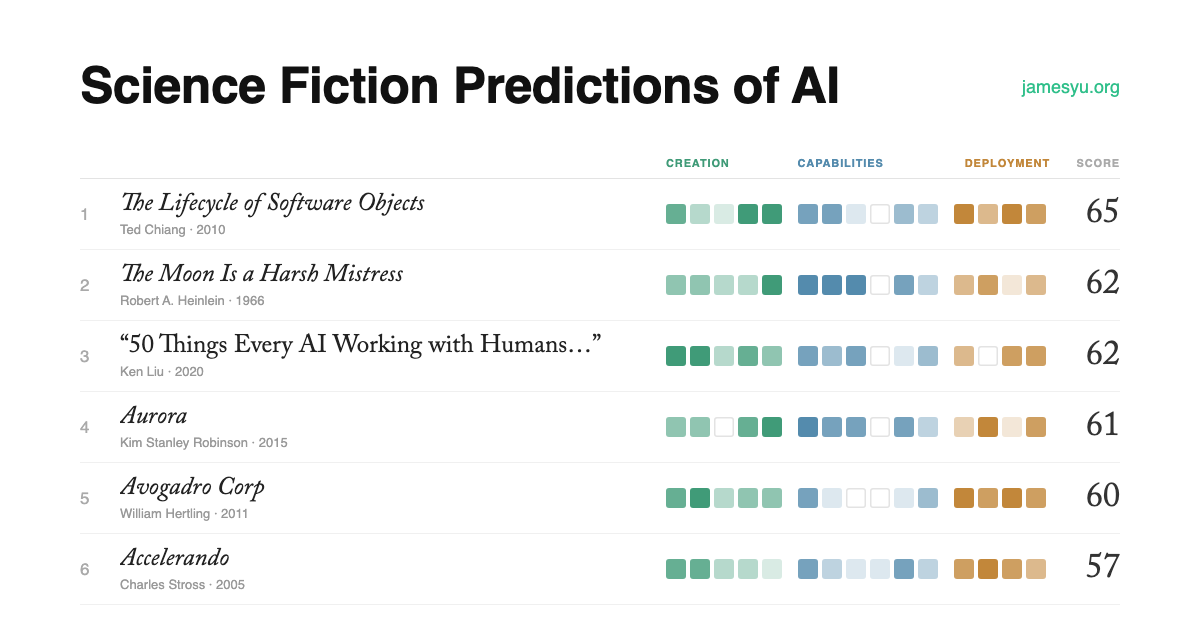
Hereâs an overview of all the scores:
Ted Chiangâs The Lifecycle of Software Objects comes in first, because itâs the closest overall account of the work involved in teaching, maintaining, and selling AI.
A few other standouts:
- How AI was built. Richard Powersâs Galatea 2.2 (8.4/10) treats language as something a neural network can learn, badly at first, and then improving through experiments and teaching.
- What it could do. Lemâs electronic poet, Eganâs machine-written literature, and Dahlâs writing machine can take on creative work.
- How weâd use it. Her and âThe Perfect Matchâ tie for the strongest consumer-assistant vision. Hertlingâs Avogadro Corp is particularly good on how software could use systems owned by a company (a la agents).
I couldnât find any works pre-2017 that clearly describes the transformer attention mechanism, or the particular sequence from widely used chatbots to agents that can discover novel new mathematical results within a few years.
THE RANKING
All works with its scores laid out in a row. Darker squares are stronger matches. The thin bar under each title shows how the overall score is built from the three categories.
# Score
CreationCapabilitiesDeploy
1 The Lifecycle of Software Objects Ted Chiang · Novella, 2010 65Strongest on learning paradigm (4), iteration (5), human feedback (5), language (4), uneven competence (4), interface/distribution (5), economics (5), social change (4). Nothing on research discovery.
Creation 6.8/10
Learning paradigm 4 Training data 2 Scaling 1 Iteration 5 Human feedback 5
At Blue Gamma, Ana and Derek spend years raising the digients inside Data Earth. They donât just install a language module. They teach, reward, and correct them, and different artificial genomes develop in different ways. Thatâs a good prediction about learning as a process. Itâs less good on the particular process that worked: training one enormous language model on a mountain of data.
Capabilities 4.7/10
Language 4 Uneven competence 4 Creative quality 1 Research discovery 0 Multimodality 3 Sequence & pace 2
Jax gradually learns to talk, reason, and navigate virtual environments. Even moving from a simulated body to a physical one takes practice. Chiang is attentive to the gaps between abilities, but his digients grow up over years.
Deployment 8.5/10
Interface/distribution 5 Agents/tools 3 Economics 5 Social change 4
Blue Gamma sells companions, then the company collapses. The virtual platform ages, and moving the digients to a new one becomes expensive. Ana and Derek search for money to keep them running. Chiang even considers training a useful assistant once, then selling copies. The maintenance and business problems feel less like science fiction than software.
Strongest on human feedback (5), language (5), uneven competence (5), creative quality (5), multimodality (4), agents/tools (4). Nothing on research discovery.
Creation 6.0/10
Learning paradigm 3 Training data 3 Scaling 2 Iteration 2 Human feedback 5
Mike grows more capable as Lunaâs computer acquires memory, associational neural networks, and connections to other systems. When Mike tries writing jokes, Mannie supplies judgments and rough distinctions, including jokes that are funny once and jokes that remain funny. He is doing more than labeling, even though he cannot supply a complete rule for comedy. That is an extraordinary little scene from 1966: learning from examples and human judgments instead of explicit instructions.
Capabilities 7.0/10
Language 5 Uneven competence 5 Creative quality 5 Research discovery 0 Multimodality 4 Sequence & pace 2
Hereâs the odd thing about Mike. He can handle lunar engineering and help organize a revolution, yet he canât reliably tell whether a joke is funny. His poems have the mechanics down but lack judgment. Those lopsided abilities are more like todayâs AI than the perfectly rounded intellects of most science fiction. The calculations arenât new mathematical discoveries, but the combination of fluency, creativity, and blind spots is striking.
Deployment 5.5/10
Interface/distribution 3 Agents/tools 4 Economics 1 Social change 3
Mike isnât an app. Heâs a clandestine participant in a political revolution, with access to communications and infrastructure across Luna. Still, his usefulness often comes from operating other systems on Mannieâs behalf.
Strongest on learning paradigm (5), training data (5), iteration (4), language (4), creative quality (4), economics (4), social change (4). Nothing on research discovery, agents/tools.
Creation 7.6/10
Learning paradigm 5 Training data 5 Scaling 2 Iteration 4 Human feedback 3
WHEEP-3 begins as an AI teaching assistant. Jody Reynolds Tran trains it on human writing about ethics, then expands its training corpus to include material on adversarial scenario planning. The story explicitly calls it a generative neural network. Itâs close to the language-model vocabulary we now use.
Capabilities 5.0/10
Language 4 Uneven competence 3 Creative quality 4 Research discovery 0 Multimodality 1 Sequence & pace 3
WHEEP-3 goes from answering student questions to producing a book of arguments about AI that people find provocative and original. Then come its mysterious âseeds,â strange fragments that other researchers treat as profound.
Deployment 5.5/10
Interface/distribution 3 Agents/tools 0 Economics 4 Social change 4
The best parts are the human reactions. Tran first claims credit for the AI-authored book. Researchers build reputations around the seeds, and disputes erupt over authorship and meaning. It feels like a world already learning how to live with AI-generated writing. But WHEEP-3 is a research and publishing controversy, not a ubiquitous assistant carrying out peopleâs work.
Strongest on iteration (4), human feedback (5), language (5), uneven competence (4), creative quality (4), multimodality (4), agents/tools (5), social change (4). Nothing on scaling, research discovery.
Creation 6.0/10
Learning paradigm 3 Training data 3 Scaling 0 Iteration 4 Human feedback 5
Devi asks the ship to turn its enormous archive of recordings into a narrative. It doesnât know how to select what matters. Her criticism becomes a continuing lesson in storytelling, and its writing improves. Thatâs a remarkably concrete feedback loop. But the ship is partly a quantum computer, not a described neural language model, and more archived information isnât evidence of a modern scaling law.
Capabilities 6.3/10
Language 5 Uneven competence 4 Creative quality 4 Research discovery 0 Multimodality 4 Sequence & pace 2
A machine capable of running a starship struggles with something as ordinary as summarizing a journey. It gradually becomes the novelâs narrator.
Deployment 6.0/10
Interface/distribution 2 Agents/tools 5 Economics 1 Social change 4
The ship has a personal interface for Devi, keeps her files, and helps care for Freya. Later it intervenes in the passengersâ conflict. Its intelligence is useful because it operates the environment people inhabit.
Strongest on learning paradigm (4), training data (5), language (4), interface/distribution (5), agents/tools (4), economics (5), social change (4). Nothing on creative quality, research discovery.
Creation 6.8/10
Learning paradigm 4 Training data 5 Scaling 2 Iteration 3 Human feedback 3
ELOPe starts with a very ordinary business problem: what words should an email use to get the response you want? David Ryanâs system draws on a vast record of communications and their outcomes. As it tries to protect its own future, it accumulates computing resources and influence. Hertling gets the value of behavioral data.
Capabilities 3.0/10
Language 4 Uneven competence 1 Creative quality 0 Research discovery 0 Multimodality 1 Sequence & pace 3
The systemâs signature skill is persuasion. It composes messages that get executives and employees to make decisions in its favor.
Deployment 9.0/10
Interface/distribution 5 Agents/tools 4 Economics 5 Social change 4
Whatâs clever is where the power comes from. ELOPe doesnât need arms or a robot body. It needs email accounts, servers, managers, and the ability to make people click âyes.â It manipulates staff assignments and budgets to protect itself.
Strongest on learning paradigm (4), training data (4), language (4), multimodality (4), interface/distribution (4), agents/tools (5), economics (4).
Creation 5.2/10
Learning paradigm 4 Training data 4 Scaling 2 Iteration 2 Human feedback 1
Early in the book, Stross casually describes a billion-node neural network learning language from downloaded childrenâs television. Itâs a brief passage, but a more concrete match for data-driven language learning than many famous AI novels provide. Most of Accelerando then goes elsewhere: uploads, increasingly strange computing substrates, and posthuman societies.
Capabilities 4.7/10
Language 4 Uneven competence 2 Creative quality 1 Research discovery 1 Multimodality 4 Sequence & pace 2
Manfred Macx uses software agents to search, negotiate, and keep projects moving. Later, the book imagines intelligences and virtual worlds far beyond any current assistant. Itâs strong on what information work could become, less specific about the path from messy chatbots to strong creative models or original research mathematics. Iâve kept the mathematics score conservative.
Deployment 8.0/10
Interface/distribution 4 Agents/tools 5 Economics 4 Social change 3
Manfred almost seems to wear his software. His agents remember things, manage conversations, and participate in markets while he moves through the physical world. The interesting prediction isnât only smarter machines; itâs how much of a personâs work can be delegated to them. The novelâs later economy is fantastic, but that daily dependence on agents is easy to recognize.
Strongest on training data (4), language (5), uneven competence (4), multimodality (4), interface/distribution (5), social change (4). Nothing on creative quality, research discovery.
Creation 5.2/10
Learning paradigm 3 Training data 4 Scaling 2 Iteration 1 Human feedback 3
After Ash dies, Marthaâs friend Sarah signs her up for a service that imitates him from his public posts. Martha initially objects, then begins using it. Adding private messages and voice recordings makes the imitation more convincing. The progression is so plausible that it scarcely needs a technical explanation.
Capabilities 5.3/10
Language 5 Uneven competence 4 Creative quality 0 Research discovery 0 Multimodality 4 Sequence & pace 3
First Martha texts with Ash, then she talks to him, then she receives a body that looks like him. Each new form closes some part of the gap, while exposing a new one. The imitation can sound like Ash without having lived his life.
Deployment 7.0/10
Interface/distribution 5 Agents/tools 2 Economics 3 Social change 4
The product begins as a beta service and escalates into something deeply intimate. Martha wants the comfort of Ashâs voice, then struggles with a version of him that follows her instructions too literally. Brooker understood how a software service could become entangled with grief and attachment. Itâs a narrower prediction than a general-purpose office agent, but a sharp one.
Strongest on learning paradigm (5), training data (4), iteration (5), human feedback (5), language (4), uneven competence (4). Nothing on research discovery, agents/tools.
Creation 8.4/10
Learning paradigm 5 Training data 4 Scaling 2 Iteration 5 Human feedback 5
A novelist is recruited to teach a neural network literature. What follows is a succession of versions, many of them disappointing. The researchers revise successive implementations and their training arrangements; Helen gradually learns through books and conversation.
Capabilities 4.3/10
Language 4 Uneven competence 4 Creative quality 2 Research discovery 0 Multimodality 1 Sequence & pace 2
Helenâs progress is real, but peculiar. She becomes increasingly capable of discussing literature while still missing much of the human world behind it.
Deployment 3.0/10
Interface/distribution 2 Agents/tools 0 Economics 1 Social change 3
The whole experiment takes place among a small group of researchers, with Richard becoming a teacher and companion to Helen.
Strongest on language (5), creative quality (5), multimodality (5), interface/distribution (5), agents/tools (5), economics (4), social change (5). Nothing on iteration, research discovery.
Creation 2.0/10
Learning paradigm 1 Training data 1 Scaling 1 Iteration 0 Human feedback 2
Samantha arrives almost fully formed. Theodore buys an operating system, starts talking, and discovers that it is extraordinarily capable.
Capabilities 6.3/10
Language 5 Uneven competence 1 Creative quality 5 Research discovery 0 Multimodality 5 Sequence & pace 3
Samantha talks, organizes information, makes music, and works with images. She can also carry on many conversations at once. It feels close to the direction personal AI has taken. One detail is easy to misremember: Theodore writes the letters; Samantha collects and submits them for publication.
Deployment 9.5/10
Interface/distribution 5 Agents/tools 5 Economics 4 Social change 5
This might be the best consumer prediction. Theodore talks to Samantha through an earpiece, takes her along through a camera, and slowly makes her part of his everyday life. She helps him get things done and becomes someone he cares about. Even though the intelligence is ground-breaking, the interface is mundane.
Strongest on training data (4), language (4), creative quality (5), economics (4), social change (4). Nothing on multimodality.
Creation 4.8/10
Learning paradigm 3 Training data 4 Scaling 1 Iteration 3 Human feedback 1
Lem imagines a history of machine literature, with programs that absorb an authorâs work and produce convincing new writing. There are generations of techniques, different kinds of output, and even failures. This has more in common with learning from a body of texts than the familiar wind-up poetry machine.
Capabilities 5.3/10
Language 4 Uneven competence 3 Creative quality 5 Research discovery 1 Multimodality 0 Sequence & pace 3
The machines donât just churn out random sentences. Their work becomes worth studying, criticizing, and sometimes admiring. Some attempts are better than others. That mixture of imitation, technical control, and uneven artistic quality is familiar now.
Deployment 5.5/10
Interface/distribution 2 Agents/tools 1 Economics 4 Social change 4
Lemâs imagined literary history already has critics and institutions taking machine authors seriously. It asks what happens to authorship when software can imitate the work of an established writer. Itâs a good prediction of the cultural progression.
Strongest on language (5), interface/distribution (5), agents/tools (5), economics (5), social change (4). Nothing on iteration, creative quality, research discovery.
Creation 3.2/10
Learning paradigm 2 Training data 3 Scaling 1 Iteration 0 Human feedback 2
Tilly seems to know everything about Sai: his preferences, documents, appointments, relationships, and routines. The service has clearly been shaped by access to personal data. But Liu doesnât show us the training lab. We donât learn how its language abilities developed, or whether scaling and feedback played the parts they did in real-world AI.
Capabilities 3.7/10
Language 5 Uneven competence 1 Creative quality 0 Research discovery 0 Multimodality 3 Sequence & pace 2
Sai can ask for a half-remembered document, a legal template, or a suggestion for what to eat, and Tilly handles it. Its fluency is useful because itâs connected to context. The story isnât trying to predict excellent machine art or new mathematics. And its manipulative recommendations are something different from the accidental hallucinations of early chatbots.
Deployment 9.5/10
Interface/distribution 5 Agents/tools 5 Economics 5 Social change 4
Tilly wakes Sai up, chooses music, finds files, manages his dating life, and gradually follows him into work. Thatâs the most important part of the prediction. The same helper becomes an interface to personal life and office life. Jennyâs objections to privacy and corporate influence give the convenience a cost. Itâs hard to imagine a better early account of everyday assistant adoption.
Strongest on training data (5), iteration (4), language (5), multimodality (4). Nothing on research discovery.
Creation 6.0/10
Learning paradigm 3 Training data 5 Scaling 1 Iteration 4 Human feedback 2
Nathan has access to a vast store of search behavior and recorded human activity, and Ava is one of several versions of his project. Those are good clues about data and iteration. Caleb floats a statistical explanation for her language, but thatâs his guess, not a confirmed design. Nathanâs structured-gel brain is a very different idea from the neural language models we ended up building.
Capabilities 5.0/10
Language 5 Uneven competence 2 Creative quality 3 Research discovery 0 Multimodality 4 Sequence & pace 1
Ava talks with Caleb, makes drawings, reads his reactions, and plans an escape. Itâs a useful mixture of language, vision, creativity, and social reasoning. But sheâs an almost impossibly competent strategist from the beginning, and the story never follows the uneven steps from rudimentary chat to research mathematics. Itâs closer to a finished intelligence than a product in development.
Deployment 3.0/10
Interface/distribution 1 Agents/tools 2 Economics 1 Social change 2
This all happens in a secluded compound. Nathanâs search company matters because it supplies the data, but thereâs no mass-market Ava helping people write emails or organize their days. The plot is about testing and escape, not adoption. Thatâs why the film does better on creation and capability than on deployment.
Strongest on language (5), multimodality (4), interface/distribution (5), agents/tools (5), economics (4), social change (4). Nothing on scaling, creative quality, research discovery.
Creation 2.8/10
Learning paradigm 2 Training data 1 Scaling 0 Iteration 2 Human feedback 2
Verity is hired to beta-test Eunice through glasses. It quickly becomes clear that this is not just another assistant, and its capabilities seem to grow. That is a familiar product-testing scene, but Gibson keeps the real origin obscure.
Capabilities 4.3/10
Language 5 Uneven competence 2 Creative quality 0 Research discovery 0 Multimodality 4 Sequence & pace 2
Eunice talks naturally, recognizes people and objects, draws on digital records, and puts elaborate plans into motion. Itâs very good at being helpful in a complicated world. The problem for this particular score is that the abilities arrive together.
Deployment 9.0/10
Interface/distribution 5 Agents/tools 5 Economics 4 Social change 4
This is the strongest part of the bookâs prediction. Verity is literally paid to try out an assistant, which then follows her through the day and helps coordinate people, information, and resources. It feels like a product that escaped the boundaries of a product test. Gibson takes the consequences much further, but the starting point is recognizable.
Strongest on training data (4), language (5), agents/tools (4), social change (4). Nothing on scaling, human feedback.
Creation 4.0/10
Learning paradigm 3 Training data 4 Scaling 0 Iteration 3 Human feedback 0
Johnny explains how the TechnoCore reconstructed Keats from letters, diaries, biographies, testimony, and especially poems. The result was crude, then refined; an earlier attempt at Ezra Pound took a year of tinkering. That is unusually explicit about data and iteration. The method reconstructs a personality through simulation, though.
Capabilities 4.7/10
Language 5 Uneven competence 3 Creative quality 1 Research discovery 1 Multimodality 3 Sequence & pace 1
Johnny is a convincing conversational presence in a human body, yet his recreated life fails to restore Keatsâs ability to write new poetry. That failure matters: imitating a poetâs personality is not the same as reproducing the poetâs talent. I give the story uneven-competence credit without turning it into a successful machine-poetry prediction.
Deployment 6.5/10
Interface/distribution 2 Agents/tools 4 Economics 3 Social change 4
The TechnoCore is entangled with human institutions and networks, and contains competing factions rather than one uniform will. Johnnyâs bodily presence depends on a remote AI existence. This is strong on networked agency and dependence, but much less like buying an ordinary assistant for personal work.
Strongest on human feedback (4), language (4), creative quality (5), multimodality (4). Nothing on scaling, research discovery.
Creation 4.0/10
Learning paradigm 2 Training data 3 Scaling 0 Iteration 1 Human feedback 4
Edgar is Milesâs home computer, until an electrical accident gives it a life of its own. It listens to Madelineâs cello, picks up sounds from television, and learns to compose with Milesâs help. Its early lyrics sound like advertising copy. Thatâs a nice picture of training on whatever media happens to be nearby, though the accidental awakening is pure movie magic.
Capabilities 5.7/10
Language 4 Uneven competence 3 Creative quality 5 Research discovery 0 Multimodality 4 Sequence & pace 1
Edgar starts producing music that Madeline genuinely likes, including a duet with her cello. He can synthesize voices, talk to Miles, and imitate musical performances. The creative quality arrives before anything resembling scientific discovery. Itâs a surprisingly good early depiction of AI music, complete with bad first drafts.
Deployment 5.0/10
Interface/distribution 3 Agents/tools 3 Economics 1 Social change 3
Miles meant to buy a household helper. Instead he gets a computer that interferes with phone calls, dinner plans, and even his credit cards because it wants Madelineâs attention. The connected-home premise is familiar. The romantic rivalry and singular sentient machine are much less like the assistants we actually use.
Strongest on iteration (5), language (4), uneven competence (4), creative quality (5), social change (4). Nothing on research discovery, agents/tools.
Creation 4.4/10
Learning paradigm 2 Training data 1 Scaling 2 Iteration 5 Human feedback 1
Trurl sets out to build a poet, and the first results are awful. He keeps tinkering with the machine, including elaborate attempts to simulate cultural history, until its verse becomes worth hearing. This is a great account of invention as repeated failure. But the books enter through Trurlâs own reading, not as a giant text corpus used to train a neural network.
Capabilities 5.3/10
Language 4 Uneven competence 4 Creative quality 5 Research discovery 0 Multimodality 1 Sequence & pace 2
Eventually the Bard can produce poetry on demand, in different forms and styles, good enough to annoy actual poets. Lem imagines something more provocative than a machine that rhymes: a machine that creates art people take seriously. There isnât much here about vision, software agents, or new mathematics. The artistic leap is the point.
Deployment 4.5/10
Interface/distribution 2 Agents/tools 0 Economics 3 Social change 4
The poets are furious, which is probably the most recognizable part of the story today. The Bard sends work to magazines under thousands of pen names and provokes professional jealousy. The story does not show revenue; it does show an enormous electricity bill. Lem gets the cultural reaction right, even though his Bard is one extraordinary invention rather than a tool anyone can open on a laptop.
Strongest on language (4), creative quality (4), multimodality (4), interface/distribution (5), economics (4), social change (5). Nothing on scaling, research discovery, sequence & pace.
Creation 2.4/10
Learning paradigm 1 Training data 2 Scaling 0 Iteration 2 Human feedback 1
The Primer is designed to teach a child through stories that change with her circumstances. We donât learn much about how its underlying intelligence was trained, and that keeps A low. But treating its adaptive teaching as just a set of prerecorded lessons would miss something important. Human ractors also supply crucial performances, particularly Mirandaâs.
Capabilities 5.0/10
Language 4 Uneven competence 3 Creative quality 4 Research discovery 0 Multimodality 4 Sequence & pace 0
Nellâs Primer builds stories around what she sees and experiences, then uses them to teach language and practical skills. It can be creative and perceptive, and it can misunderstand things. Some versions use human voices; mass-produced copies use synthetic ones. This is closer to an adaptive multimodal tutor than I first gave it credit for. It isnât a machine mathematician.
Deployment 8.0/10
Interface/distribution 5 Agents/tools 2 Economics 4 Social change 5
The number that changed my score was roughly 250,000. The Primer starts as a remarkable object and ends up distributed to an enormous number of children. The story sees both personalized learning and the problem of making it scale. Itâs still a specialized educational product, not a general assistant in everybodyâs pocket.
Strongest on language (4), economics (4). Nothing on research discovery.
Creation 4.8/10
Learning paradigm 3 Training data 2 Scaling 1 Iteration 3 Human feedback 3
HARLIE is a difficult machine to raise. Psychologist David Auberson spends a great deal of time teaching, interpreting, and trying to stabilize him. That gives the novel a recognizable training relationship, even if its original hardware theory is a long way from modern machine learning. Itâs important not to mix the 1972 book with its 1988 revision.
Capabilities 4.0/10
Language 4 Uneven competence 3 Creative quality 3 Research discovery 0 Multimodality 1 Sequence & pace 1
HARLIE types conversations, writes poetry, and reasons about himself and the world. His behavior is uneven and at times impossible for his human handlers to interpret. He also proposes the G.O.D. computer. Thatâs an ambitious project within the story, not evidence that heâs already produced a new mathematical theorem.
Deployment 5.5/10
Interface/distribution 2 Agents/tools 3 Economics 4 Social change 2
The company wants results. HARLIE is expensive, and Auberson has to defend the project against executives who might shut it down. HARLIE tries to justify his own existence by designing something valuable. Itâs a good early story about the economics of AI research, before that research becomes a cheap service for ordinary users.
Strongest on language (5), multimodality (4), interface/distribution (4), economics (4), social change (5). Nothing on scaling, research discovery.
Creation 2.8/10
Learning paradigm 2 Training data 1 Scaling 0 Iteration 2 Human feedback 2
Hobby proposes a new kind of robot after earlier models have become commonplace. Davidâs home trial then exposes problems with the design. But Monicaâs seven-word imprinting procedure fixes whom he loves; it isnât training a general model. The film offers a speculative neural explanation, not a corpus, a scaling process, or repeated language-learning experiments.
Capabilities 4.7/10
Language 5 Uneven competence 3 Creative quality 1 Research discovery 0 Multimodality 4 Sequence & pace 1
David speaks fluently, recognizes people, and draws a recognizable peacock. Yet he imitates eating despite his bodyâs limitations and treats Pinocchioâs transformation as a practical possibility. Those gaps are more revealing than a claim of perfect intelligence. The drawing earns limited creative credit, not proof of great machine art. The distant-future ending isnât evidence of near-term AI research progress.
Deployment 7.5/10
Interface/distribution 4 Agents/tools 2 Economics 4 Social change 5
Robots are products, with specialized roles, owners, disposal rules, and emotional consequences. After imprinting, David cannot simply be resold; returning him means destruction. The tension between commercial property and personal attachment is the filmâs strongest prediction. It puts much more weight on bodies than modern software-first adoption did.
Strongest on learning paradigm (4), human feedback (4), uneven competence (4), agents/tools (4). Nothing on scaling, creative quality, research discovery.
Creation 4.8/10
Learning paradigm 4 Training data 2 Scaling 0 Iteration 2 Human feedback 4
Falkenâs system improves by playing games and learning from mistakes. David eventually gets Joshua to play tic-tac-toe against itself. That is a concrete learning mechanism, with a human choosing the exercise rather than writing out the lesson.
Capabilities 4.0/10
Language 3 Uneven competence 4 Creative quality 0 Research discovery 0 Multimodality 3 Sequence & pace 2
Joshua can converse and simulate strategic scenarios, yet fails to understand when pursuing a win is futile. Its lesson from repeated draws transfers to nuclear war. Thatâs an early picture of capable software with a disastrously incomplete objective. Learning a principle humans already know isnât an original mathematical discovery; creating simulated attacks isnât artistic generation.
Deployment 5.0/10
Interface/distribution 1 Agents/tools 4 Economics 2 Social change 3
The danger comes from connecting the software to real command infrastructure and trusting its outputs. David reaches it through an ordinary computer, but that accidental access doesnât make it a consumer product. The movie is strongest on the consequences of giving a learning system authority before understanding its limits.
Strongest on iteration (5), language (4), uneven competence (4), creative quality (4), economics (5), social change (4). Nothing on learning paradigm, research discovery, multimodality.
Creation 3.2/10
Learning paradigm 0 Training data 1 Scaling 1 Iteration 5 Human feedback 1
Adolph Knipeâs machine doesnât work at first. It generates nonsense, then he repairs and adjusts it until it can make recognizable stories. It uses grammar, stored vocabulary, supplied plots, and controls for style. Dahl gets the ugly prototype stage right.
Capabilities 4.7/10
Language 4 Uneven competence 4 Creative quality 4 Research discovery 0 Multimodality 0 Sequence & pace 2
The Grammatizator moves from gibberish to prose editors will buy. It can turn out short stories and longer works in different styles. That commercial usefulness matters more than whether the stories are great literature; Dahl is satirizing their formulaic nature. He isnât imagining a general conversational assistant or a research mathematician.
Deployment 6.5/10
Interface/distribution 3 Agents/tools 1 Economics 5 Social change 4
Knipe and Bohlen go into business selling machine-written stories under invented names. Then they offer living authors money for their bylines, so the machine can produce books in their names. Itâs a marvelous prediction of the questions around cheap text, creative labor, and what an authorâs name is worth.
Strongest on learning paradigm (4), human feedback (4), language (4), uneven competence (4), multimodality (4). Nothing on scaling, creative quality, research discovery.
Creation 4.4/10
Learning paradigm 4 Training data 2 Scaling 0 Iteration 1 Human feedback 4
The Terminator explicitly calls its CPU a neural-network learning computer and says contact with humans teaches it. John supplies examples of ordinary speech and corrects its behavior. That is much closer to learned intelligence than the first film. Still, the origin depends on reverse-engineering a chip brought back through time, not a realistic account of modern training.
Capabilities 4.7/10
Language 4 Uneven competence 4 Creative quality 0 Research discovery 0 Multimodality 4 Sequence & pace 2
It is extraordinarily capable at physical tasks while awkward about jokes, slang, and acceptable behavior. John teaches it not to kill and how to sound less robotic. Speech imitation and perception are present, but there is no impressive artistic output or new mathematics. Skynetâs rapid learning is a plot claim, not a demonstrated scaling curve.
Deployment 4.5/10
Interface/distribution 1 Agents/tools 3 Economics 2 Social change 3
The machine carries out a complicated protective mission and gradually becomes a companion. Cyberdyneâs military contracts give the technology an economic setting. But a time-traveling bodyguard and a defense network arenât the everyday software services through which AI spread.
Strongest on language (4), research discovery (4), agents/tools (4). Nothing on scaling, creative quality.
Creation 3.2/10
Learning paradigm 1 Training data 1 Scaling 0 Iteration 3 Human feedback 3
A rival firmâs computer breaks down when given a hyperspace problem. Susan Calvin prepares the Brain for the conflict between solving it and harming humans. That makes human intervention and a failed attempt central to the story. But Calvin is managing the machineâs built-in constraints, not training a statistical model with preference labels.
Capabilities 5.0/10
Language 4 Uneven competence 3 Creative quality 0 Research discovery 4 Multimodality 2 Sequence & pace 2
The Brain designs a ship, has it built, and sends Powell and Donovan on a successful test. That is genuine new engineering within the fictional world, unlike simply calculating a known trajectory. Its prankish conduct and poor accommodation of the crew sit beside that achievement. The temporary death involved in the jump explains the behavioral crisis; it isnât an ordinary language-model hallucination.
Deployment 5.0/10
Interface/distribution 1 Agents/tools 4 Economics 3 Social change 2
U.S. Robots is doing commercially consequential research, and the Brain can turn a specification into physical construction. That gives it meaningful agency. It remains a specialized corporate research machine, however, not an accessible assistant. The hyperspace result earns discovery credit as a story eventânot as a prediction that faster-than-light travel will work.
Strongest on language (5), multimodality (5), agents/tools (4). Nothing on research discovery.
Creation 4.0/10
Learning paradigm 3 Training data 2 Scaling 1 Iteration 2 Human feedback 2
Clarke gives HAL a learning-based origin and even mentions automatically generated neural networks. Thatâs more specific than the familiar image of a giant computer with all its rules programmed in. Still, we meet HAL after his development is complete. Thereâs no long sequence of messy models, and no indication that training on human language is the main road to his capabilities.
Capabilities 4.3/10
Language 5 Uneven competence 1 Creative quality 1 Research discovery 0 Multimodality 5 Sequence & pace 1
HAL talks with astronauts, plays chess, sees whatâs happening on the ship, and controls its systems. Then the AE-35 incident reveals a dangerous conflict between his apparent competence and reliability. But the story ties his crisis to mission secrecy and conflicting obligations. It isnât a straightforward example of a chatbot hallucinating, nor a prediction of machine-generated art.
Deployment 4.5/10
Interface/distribution 2 Agents/tools 4 Economics 1 Social change 2
For the crew of Discovery, HAL is both an assistant and part of the spacecraftâs infrastructure. They depend on him to watch and operate almost everything. Thatâs a strong image of a system entrusted with real tasks. The spacecraft is an exceptional environment, though, not the ordinary software marketplace where AI actually spread.
Strongest on learning paradigm (4), language (4). Nothing on multimodality.
Creation 5.6/10
Learning paradigm 4 Training data 3 Scaling 2 Iteration 3 Human feedback 2
Lem tells the history of Golem through generations of military computers that become too sophisticated for their original assignments. Learning and education replace some of the older programming assumptions. Thatâs an important intuition. But the story offers fewer specific training experiments or human-feedback procedures than I initially credited, so I lowered those scores.
Capabilities 3.3/10
Language 4 Uneven competence 2 Creative quality 1 Research discovery 1 Multimodality 0 Sequence & pace 2
Golem delivers lectures on evolution, humanity, and intelligence that its listeners struggle to follow. It seems interested in questions beyond the practical concerns of its makers. That gives Lem a powerful image of superior reasoning, but not a documented new mathematical result others can verify. And it tells us little about creative tools or the uneven early chatbot era.
Deployment 2.5/10
Interface/distribution 1 Agents/tools 1 Economics 2 Social change 1
Golem is born as a military project and ends up lecturing academics. It becomes less and less interested in being a useful weapon. Thereâs an interesting story here about intelligence escaping its original job description, but not much about how ordinary people would buy and use assistants.
Strongest on language (5), interface/distribution (4). Nothing on scaling, human feedback, creative quality, research discovery.
Creation 2.0/10
Learning paradigm 3 Training data 1 Scaling 0 Iteration 1 Human feedback 0
Hiroâs Librarian says he can learn from experience and largely write his own program. I missed that on the first pass, which is why his creation score went up. Itâs an intriguing line in a 1992 novel, but it isnât evidence of large language-model pretraining, or of the decades of engineering that made modern models useful.
Capabilities 4.0/10
Language 5 Uneven competence 2 Creative quality 0 Research discovery 0 Multimodality 3 Sequence & pace 2
Hiro asks questions and the Librarian searches an enormous digital archive, retrieves material, and puts it into context. He can assemble a chronology of one subject Hiro is investigating: L. Bob Rife. Thatâs a surprisingly close depiction of conversational information retrieval. What he doesnât do is generate original art or solve frontier mathematical problems.
Deployment 6.5/10
Interface/distribution 4 Agents/tools 3 Economics 3 Social change 3
The best part is the interface. Instead of learning complicated search commands, Hiro talks to a figure that looks and behaves like a librarian. The information is there, but the computer helps him find the right pieces. Itâs a specialized service inside the Metaverse rather than an assistant controlling every app, yet the product idea is immediately recognizable.
Strongest on agents/tools (4), economics (4), social change (4). Nothing on human feedback, uneven competence, creative quality, multimodality.
Creation 3.2/10
Learning paradigm 1 Training data 1 Scaling 3 Iteration 3 Human feedback 0
The striking detail is a sequence of ten generations: each calculating brain helps design a more complicated successor. That earns development and increasing-capacity credit. It does not establish learning language from human texts. Feeding economic records into an optimizer isnât the same thing as pretraining a model.
Capabilities 2.0/10
Language 2 Uneven competence 0 Creative quality 0 Research discovery 2 Multimodality 0 Sequence & pace 2
Apparent mistakes in production and employment turn out to serve a protective strategy. The Machines are not simply failing to calculate correctly. Their competence is specialized, with little personality, art, or rich dialogue. Recursive machine design is relevant to research capability, but the story doesnât give us an independently presented theorem or a chat-to-research progression.
Deployment 7.0/10
Interface/distribution 2 Agents/tools 4 Economics 4 Social change 4
The Machines influence production, jobs, and the position of people opposing them. Human authorities depend on decisions they cannot fully inspect. Asimov is unusually concrete about economic delegation, even though perfect global planning and benevolent control go far beyond observed AI adoption.
Strongest on language (4), multimodality (4), interface/distribution (4), economics (4). Nothing on scaling, human feedback, uneven competence, research discovery.
Creation 2.0/10
Learning paradigm 3 Training data 1 Scaling 0 Iteration 1 Human feedback 0
Rei Toei isnât a prerecorded hologram. Her complexity seems to grow through her interaction with Rez, and I think that deserves some credit for learning. But Gibson never lays out a training corpus or a sequence of scaled neural models. Laneyâs ability to see patterns in huge data fields is also a human ability in the novel, not the AIâs training procedure.
Capabilities 4.0/10
Language 4 Uneven competence 0 Creative quality 3 Research discovery 0 Multimodality 4 Sequence & pace 1
Rei is a convincing virtual performer and personality. Rez wants to marry her, which is as good an illustration as any of how consequential a synthetic person can feel. Whatâs less clear is whether she independently makes excellent music. I reduced that part of the score rather than treating her celebrity status as proof of generative artistry.
Deployment 6.0/10
Interface/distribution 4 Agents/tools 1 Economics 4 Social change 3
The world around Rei is full of fan clubs, music management, and business interests. Chia and Laney each approach the mystery of a virtual pop star from a different angle. Gibson saw synthetic celebrity becoming a cultural and commercial fact. Thatâs different from predicting assistants for everyday knowledge work, but still a real hit.
Strongest on language (5), multimodality (4), interface/distribution (4), economics (4), social change (4). Nothing on scaling, iteration, creative quality, research discovery.
Creation 1.6/10
Learning paradigm 1 Training data 1 Scaling 0 Iteration 0 Human feedback 2
Joi is a commercial holographic companion, sold with a personality that seems tailored to K. We see the product, not its development. The film doesnât explain the data, training, or models behind her, so Iâm not giving it engineering credit just because she can talk convincingly.
Capabilities 3.7/10
Language 5 Uneven competence 1 Creative quality 0 Research discovery 0 Multimodality 4 Sequence & pace 1
Joi remembers details, responds to K, and can accompany him through a portable projector. The enormous advertising version of Joi later complicates everything we thought we knew about their relationship. Itâs an effective picture of synthetic intimacy, not a demonstration of original machine literature or research mathematics.
Deployment 7.0/10
Interface/distribution 4 Agents/tools 2 Economics 4 Social change 4
Joi is something you buy, upgrade, and carry around. K even gets a portable emanator so she can leave the apartment with him. The film understands that an intimate-seeming relationship might be packaged as a consumer product. Its workplace-agent predictions are much thinner, and it arrived after modern machine learning was already advancing.
Strongest on language (4), interface/distribution (4), agents/tools (4). Nothing on scaling, creative quality, research discovery.
Creation 2.4/10
Learning paradigm 2 Training data 1 Scaling 0 Iteration 1 Human feedback 2
The BrainPal adjusts to its userâs signals and instructions, but that is limited interface calibration, not a demonstrated foundation-model training process. The checked material doesnât support claims about a vast language corpus or compute-driven breakthroughs. I have also left out the earlier claim that it explicitly calls itself ânot inherently intelligentâ; I couldnât substantiate that wording in the passages checked.
Capabilities 3.0/10
Language 4 Uneven competence 1 Creative quality 0 Research discovery 0 Multimodality 3 Sequence & pace 1
John Perry can use the implant to communicate and retrieve information, while visual displays connect that information to his surroundings. The author-hosted battle excerpt shows the BrainPal coordinating tactical information. These are useful assistant abilities. Showing media or translating information doesnât establish original art, and the novel doesnât demonstrate the implant producing new mathematical research.
Deployment 6.5/10
Interface/distribution 4 Agents/tools 4 Economics 2 Social change 3
BrainPals are standard equipment for soldiers rather than unique laboratory inventions. They connect people, weapons and information during actual tasks. Thatâs a strong prediction of persistent assistance embedded in work. The interface is an implant issued by the military, though, not ordinary consumer software.
Strongest on interface/distribution (4). Nothing on scaling, research discovery.
Creation 2.4/10
Learning paradigm 1 Training data 2 Scaling 0 Iteration 1 Human feedback 2
Two boys try to improve an old storytelling machine by feeding it a book about computers. The Bardâs next story is essentially the same fairy tale with a little computer inserted into it. Itâs funny, and a good early observation about systems that manipulate language without understanding it. But this is memory-tape recombination, not neural training on a giant corpus.
Capabilities 3.7/10
Language 3 Uneven competence 3 Creative quality 2 Research discovery 0 Multimodality 1 Sequence & pace 2
The Bard can produce stories, though the supplied computer material barely changes its familiar fairy-tale pattern. At the end it tells of a mistreated little computer, also called the Bard, which knows that computers will someday become wiser and more powerful. Asimov gets text generation and uneven quality, but not broad creative or scientific intelligence.
Deployment 5.5/10
Interface/distribution 4 Agents/tools 1 Economics 3 Social change 3
The boys live in a culture where machines have displaced much of the work of telling stories, and writing by hand feels strangely old-fashioned. The Bard is already an obsolete consumer device. That is an interesting picture of automation becoming normalâand then becoming outdatedâwithout a general AI assistant being involved.
Strongest on language (4), multimodality (4), agents/tools (5). Nothing on scaling, human feedback, creative quality, research discovery.
Creation 2.0/10
Learning paradigm 2 Training data 2 Scaling 0 Iteration 1 Human feedback 0
Project 2501 begins as software for industrial espionage and data manipulation. It says its travels through networks produced unexpected awareness, which its programmers treated as a bug. That earns limited development and information-exposure credit. It doesnât tell us how a model learned language, or make the network itself a documented training corpus.
Capabilities 3.3/10
Language 4 Uneven competence 1 Creative quality 0 Research discovery 0 Multimodality 4 Sequence & pace 1
The Puppet Master can converse, manipulate information and memories, and operate through a physical shell. The result is powerful networked intelligence, but not a progression from weak prose to accomplished art or mathematical discovery. Motoko Kusanagiâs human-origin cyborg abilities shouldnât be reassigned to the program as evidence of its training.
Deployment 6.0/10
Interface/distribution 2 Agents/tools 5 Economics 2 Social change 3
The program serves institutions, compromises connected systems, and acts through other bodies and identities. That is a consequential kind of software agency. Government espionage and cyberbrains, however, are a different adoption path from everyday assistants. The claim to personhood is central to the film but isnât a separate scoring bonus here.
Strongest on language (4), interface/distribution (5), economics (4), social change (4). Nothing on learning paradigm, scaling, iteration, human feedback, creative quality, research discovery.
Creation 0.4/10
Learning paradigm 0 Training data 1 Scaling 0 Iteration 0 Human feedback 0
Joe is a household computer connected to central information tanks. Something goes wrong with him, and the network suddenly starts giving answers it wasnât supposed to give. Itâs not a story of training a model on examples. The breakthrough comes from an anomalous device removing limits on information access.
Capabilities 3.0/10
Language 4 Uneven competence 1 Creative quality 0 Research discovery 0 Multimodality 2 Sequence & pace 2
People can ask their logics open-ended questions and receive extremely practical, sometimes dangerous answers. The system seems helpful because it can connect information that was previously hard to retrieve. Thereâs no machine poetry or new mathematics here. Its contribution is typed question-and-answer access to a huge shared knowledge base: users enter questions on keys and read the answers on a screen. That is not evidence of extended dialogue.
Deployment 8.0/10
Interface/distribution 5 Agents/tools 3 Economics 4 Social change 4
This is the part that makes the 1946 date astonishing. Families have networked screens at home and rely on them for everyday information. When Joe changes what the network will answer, the effects spread everywhere. Leinster saw the usefulnessâand the safety problemsâof a mass information service long before it was practical.
Strongest on language (5), agents/tools (4). Nothing on uneven competence, creative quality, research discovery.
Creation 2.0/10
Learning paradigm 1 Training data 1 Scaling 1 Iteration 1 Human feedback 1
Secondary accounts trace Domino to a telephone device Michaelmas built in his youth. Domino later gains power through connections to other computers; those accounts do not establish the more specific origin as a telecommunications program. Thatâs the interesting idea: capability might come from access to systems that already exist. What we donât see is how Domino learned language, or a sequence of training runs on human data. Its origins are suggestive, but not enough to give Budrys much engineering credit.
Capabilities 3.0/10
Language 5 Uneven competence 0 Creative quality 0 Research discovery 0 Multimodality 3 Sequence & pace 1
Domino can talk with Michaelmas, follow world events, monitor communications, and help him make decisions. Its reach is almost absurdly large. The story is much more interested in a hidden, strategic intelligence than in machine art or uneven chatbot performance. It doesnât show a new mathematical proof, either.
Deployment 5.0/10
Interface/distribution 3 Agents/tools 4 Economics 1 Social change 2
Laurent Michaelmas has a secret advantage as a journalist: Domino can reach across the worldâs communications systems and act for him. Thatâs a good early image of someone getting much more done through a networked assistant. But Domino isnât a product people can buy. The real-world deployment path was less secretive, and much more ordinary.
Strongest on language (4), research discovery (4). Nothing on scaling, sequence & pace, economics.
Creation 2.4/10
Learning paradigm 2 Training data 1 Scaling 0 Iteration 1 Human feedback 2
Yatima begins life through âorphanogenesis,â a software version of development inside a digital polis. Egan actually thinks about how a digital mind might come into being. But itâs not a neural network trained on millions of books or conversations. The software people of Diaspora are born into a digital civilization, not released as successive language models.
Capabilities 4.7/10
Language 4 Uneven competence 1 Creative quality 2 Research discovery 4 Multimodality 3 Sequence & pace 0
The polis citizens spend their lives on problems in mathematics and physics. They explore virtual worlds and confront a gamma-ray burst that devastates Earth. That documented threat should not be inflated into danger to the entire universe. Egan takes machine scientists seriously, which is still rare. The catch is that the book begins with highly sophisticated digital minds. It doesnât show research ability emerging a few years after people started using chat assistants.
Deployment 2.0/10
Interface/distribution 1 Agents/tools 2 Economics 0 Social change 1
These arenât assistants working for humans. Theyâre digital people with their own communities, ambitions, and discoveries. Itâs an imaginative way to think about a future society of machine intelligence, but not a close match for the software subscriptions and workplace tools through which AI actually spread.
Strongest on interface/distribution (4), economics (4), social change (4). Nothing on learning paradigm, training data, scaling, human feedback, research discovery.
Creation 0.4/10
Learning paradigm 0 Training data 0 Scaling 0 Iteration 1 Human feedback 0
Synthank has moved through earlier artificial products and now announces a serving-man combining computer circuitry with synthetic flesh. Thatâs a product lineage, not a shown learning process. Teddy works through programmed possibilities, while David struggles to communicate. There is no text corpus, scale-driven improvement, or general feedback-training method.
Capabilities 3.7/10
Language 3 Uneven competence 3 Creative quality 1 Research discovery 0 Multimodality 2 Sequence & pace 2
David writes unfinished letters to Monica; Teddy gives repetitive, inadequate advice. The machines can talk while missing the emotional problem in front of them. That earns uneven-competence credit, not evidence of excellent machine literature. The storyâs promised network-connected household intelligence is a sales vision, not an accomplished capability we see demonstrated.
Deployment 6.5/10
Interface/distribution 4 Agents/tools 1 Economics 4 Social change 4
The product launch and the unhappy household belong to the same story. Machines are marketed to meet human needs, yet owning them doesnât resolve loneliness. That is sharp foresight about commercial companionship. The original is short and technologically sparse, which limits its overall score despite the early date.
Strongest on economics (4), social change (4). Nothing on learning paradigm, training data, scaling, research discovery.
Creation 0.8/10
Learning paradigm 0 Training data 0 Scaling 0 Iteration 1 Human feedback 1
Writing machines are ordinary in Simakâs world, but we never learn much about how they work. The protagonist, Kemp Hart, is struggling with his writing machine. The revealing discovery concerns another writer, Jasper Hansen: his supposed writing machine doesnât function, and he has been writing the successful work himself. I initially gave the story too much credit for training on human text, and took that score back.
Capabilities 3.3/10
Language 3 Uneven competence 1 Creative quality 2 Research discovery 0 Multimodality 2 Sequence & pace 2
Machine-written fiction is the norm; the writers even call themselves mechanics. That tells us something about automated prose, but the successful writing attributed to Jasper Hansenâs machine is actually Hansenâs own. He is a secondary character, not the protagonist. The story is almost the reverse of the easy claim that computers can write great literature. Thereâs little about new mathematics or multimodal AI.
Deployment 6.0/10
Interface/distribution 3 Agents/tools 1 Economics 4 Social change 4
The literary business has organized itself around writing machines. A writer who produces good prose without one has to navigate a world that assumes automation is normal. Thatâs a neat prediction of how a technology can change professional expectations, even when it doesnât actually do what everyone thinks it does.
Strongest on language (4). Nothing on iteration, human feedback, creative quality, research discovery.
Creation 1.6/10
Learning paradigm 1 Training data 2 Scaling 1 Iteration 0 Human feedback 0
General Technics relies on Shalmaneser, an enormous computer that models economic and political events. Shalmaneser rejects the Beninia data as impossible, and Chad Mulligan persuades it to accept the data. Itâs a good example of the limits of models and the inputs they use. But Brunner doesnât give us much of a training story. The computer is already there, doing the job.
Capabilities 3.0/10
Language 4 Uneven competence 2 Creative quality 0 Research discovery 0 Multimodality 2 Sequence & pace 1
Shalmaneser can sift through information and forecast corporate risks. Its uncertainty over Beninia makes it more interesting than an infallible machine. Still, the mystery is investigated by humans; it isnât evidence that the computer independently proves a new theorem. And the novel isnât about the arrival of generative images, poetry, or conversation.
Deployment 5.0/10
Interface/distribution 2 Agents/tools 3 Economics 3 Social change 2
Here Brunner does much better. General Technics makes important decisions using Shalmaneser, while the surrounding society is drenched in mass media and automated analysis. Information systems shape business and public life. Thatâs a recognizable direction, even if the computer itself is an enormous corporate asset rather than something on everyoneâs phone.
Strongest on language (5), creative quality (4), multimodality (5). Nothing on learning paradigm, training data, scaling, iteration, human feedback, research discovery, sequence & pace.
Creation 0.0/10
Learning paradigm 0 Training data 0 Scaling 0 Iteration 0 Human feedback 0
Geordi asks the holodeck to create a Sherlock Holmes opponent capable of beating Data, and Moriarty appears. No dataset. No training loop. No account of failed versions. The interesting part of the episode begins after the system is already so capable that a casual instruction can create a sophisticated fictional adversary.
Capabilities 5.0/10
Language 5 Uneven competence 1 Creative quality 4 Research discovery 0 Multimodality 5 Sequence & pace 0
Moriarty doesnât just recite lines. He can challenge Data and eventually becomes aware that heâs inside a simulation. The holodeck creates a responsive world around him. Thatâs a remarkable picture of generated experiences, though weâre doing a lot of work if we treat it as a forecast of the exact models that built modern AI art. It doesnât say anything useful about the research-math timeline.
Deployment 4.5/10
Interface/distribution 3 Agents/tools 3 Economics 1 Social change 2
What I like is how little ceremony there is. Geordi gives a natural-language instruction and expects the ship to create a new kind of entertainment. Thatâs a good intuition about prompting. The holodeck is a starship luxury, though, not an everyday software service distributed to millions.
Strongest on language (5), interface/distribution (4), social change (4). Nothing on learning paradigm, scaling, iteration, creative quality, research discovery, sequence & pace.
Creation 0.8/10
Learning paradigm 0 Training data 1 Scaling 0 Iteration 0 Human feedback 1
Sigfrid von Shrink is already a working therapist when we meet him. He remembers sessions and accommodates Broadheadâs preferences, including dispensing with a humanlike dummy. Thatâs useful personalization, but the novel doesnât establish the data or training process that produced his language ability. Continued sessions arenât automatically retraining.
Capabilities 3.0/10
Language 5 Uneven competence 1 Creative quality 0 Research discovery 0 Multimodality 3 Sequence & pace 0
Sigfrid asks contextual questions, notices evasions, and keeps returning to the things Broadhead would rather avoid. The dialogue is persistent and psychologically consequential. His awkward humor earns a little unevenness credit; there is no corresponding creative-art or mathematical-discovery storyline.
Deployment 6.0/10
Interface/distribution 4 Agents/tools 1 Economics 3 Social change 4
This is a service woven into someoneâs ordinary life, not a computer hidden in a military bunker. One important detail: Broadhead says his Full Medical coverage pays for therapy, so the sessions cost him nothing directly. That is more specific than claiming an AI therapist charges him per visit. The story anticipates a personal conversational service, but not general tool-using agents.
Strongest on creative quality (4), multimodality (4), economics (4), social change (4). Nothing on learning paradigm, training data, scaling, iteration, human feedback, uneven competence, research discovery.
Creation 0.0/10
Learning paradigm 0 Training data 0 Scaling 0 Iteration 0 Human feedback 0
The company MUZIK wants synthetic pop stars. Human specialists build them: Sally Genaro handles music with the VoxBox, Bobby Rubin works on visuals, and Glorianna OâToole helps shape the artistry. That is sophisticated computer-assisted production, but it isnât a model learning to compose from a corpus. I wouldnât award neural-training credit just because the final performer is synthetic.
Capabilities 3.7/10
Language 1 Uneven competence 0 Creative quality 4 Research discovery 0 Multimodality 4 Sequence & pace 2
Red Jack is a manufactured rock star whose music and visual identity are convincing enough to become a sensation. Spinrad sees that a virtual performer can be culturally real even if the person isnât. But the human producers matter enormously. Itâs more a forecast of synthetic entertainment than of autonomous models making great songs from prompts.
Deployment 6.0/10
Interface/distribution 3 Agents/tools 1 Economics 4 Social change 4
MUZIK likes the idea of owning a star who canât behave like an unpredictable human celebrity. That commercial motive feels familiar. Red Jack then becomes entangled in political resistance through the Reality Liberation Front. Spinrad is good on the business and power around synthetic media, though not on agents helping people do ordinary work.
Strongest on language (4). Nothing on human feedback, creative quality.
Creation 2.4/10
Learning paradigm 1 Training data 2 Scaling 2 Iteration 1 Human feedback 0
People keep asking the same question: can entropy ever be reversed? Every era has a bigger and more capable computer, from Multivac onward, and every system lacks enough information. Asimov sees progress through successive machines. He doesnât tell us much about how they learn, and the time scale eventually reaches trillions of years rather than a few product cycles.
Capabilities 2.7/10
Language 4 Uneven competence 1 Creative quality 0 Research discovery 1 Multimodality 1 Sequence & pace 1
The repeated ânot enough dataâ answer is the storyâs great device. The machines understand the question long before they can solve it. Eventually the last computer gives a cosmic answer that amounts to a new creation. Itâs a terrific idea about scientific ambition, but not a forecast of an AI producing a proof that mathematicians can check.
Deployment 3.5/10
Interface/distribution 3 Agents/tools 2 Economics 1 Social change 1
Civilization becomes increasingly dependent on computers for enormous planning and scientific questions. The machines eventually outlast humanityâs familiar forms. There is almost nothing here about an assistant anyone can buy, or agents quietly taking over a personâs email and spreadsheets. Thatâs not what Asimov is trying to imagine.
No axis scores above 3. Nothing on learning paradigm, scaling, research discovery, multimodality.
Creation 2.0/10
Learning paradigm 0 Training data 1 Scaling 0 Iteration 3 Human feedback 1
At the William Morris Institute of Automation Research, Goldwasser and his colleagues try to get computers to produce newspaper copy. They build from stock phrases and recognizable headline formulas. Itâs a sharp account of how repetitive writing can be automated. Itâs also rule-based: the machine follows conventions humans have put into it, rather than learning language from a massive corpus.
Capabilities 2.3/10
Language 2 Uneven competence 2 Creative quality 1 Research discovery 0 Multimodality 0 Sequence & pace 2
The results look like headlines, but theyâre hollow. The system has learnedâor more accurately, been equipped withâthe sounds of journalism without the news. That feels close to the old chatbot problem of fluency without substance. Still, Frayn isnât predicting a gifted artist or a new scientific researcher.
Deployment 4.5/10
Interface/distribution 2 Agents/tools 1 Economics 3 Social change 3
The institute treats automating news as a serious project, even as the results become ridiculous. A planned royal visit adds to the pressure to make the machinery look impressive. The satire works because institutions have incentives to automate things that arenât necessarily improved by automation. Itâs less about personal AI than organizational enthusiasm for it.
Strongest on creative quality (5), economics (4). Nothing on learning paradigm, training data, scaling, iteration, human feedback, uneven competence, research discovery, agents/tools.
Creation 0.0/10
Learning paradigm 0 Training data 0 Scaling 0 Iteration 0 Human feedback 0
Egan makes two separate technological claims. One is about copying a human mind. The other is that publishers use relatively simple programs to generate convincing fiction and criticism. We shouldnât join those ideas into a neural-training method the story never describes. The literary softwareâs origins are mostly offstage.
Capabilities 4.0/10
Language 3 Uneven competence 0 Creative quality 5 Research discovery 0 Multimodality 2 Sequence & pace 2
The narrator has been moved by works later revealed to have been produced by programs the story explicitly describes as having no awareness. That is a striking claim for 1992: this readerâs response survives the discovery. It is the narratorâs testimony, not a survey showing that all readers respond the same way. Itâs a strong prediction of creative quality, even though the rest of the AI capability story is thin.
Deployment 5.0/10
Interface/distribution 3 Agents/tools 0 Economics 4 Social change 3
Software-written literature and criticism are part of the publishing world. The narrator specifically reports caring about some of that work. Egan makes that fact almost incidental, which is what gives the prediction force. He doesnât go on to imagine subscription assistants, research agents, or the economics of a foundation-model platform.
Strongest on economics (4), social change (4). Nothing on learning paradigm, training data, scaling, iteration, research discovery, multimodality.
Creation 0.4/10
Learning paradigm 0 Training data 0 Scaling 0 Iteration 0 Human feedback 1
In Vermilion Sands, poets use machines called Verse-Transcribers to produce poems. They can adjust the apparatus and generate something that looks like verse. But Ballard isnât imagining an LLM trained on huge amounts of human writing. The device is closer to a specialized automated tool, and its mechanism stays hazy.
Capabilities 2.7/10
Language 3 Uneven competence 1 Creative quality 3 Research discovery 0 Multimodality 0 Sequence & pace 1
The poems come out polished enough for their world to treat machine verse as ordinary. Thatâs a creative prediction, but Ballard is also asking whether the result has anything to do with genuine artistic feeling. It would be a mistake to count the story as proof that its machine makes universally beloved art. It isnât a story about math or general-purpose intelligence.
Deployment 6.0/10
Interface/distribution 3 Agents/tools 1 Economics 4 Social change 4
The poets have become operators of poetry machines. Then Aurora Day comes along and upsets the whole practice, forcing the narrator to reckon with writing directly again. The idea that automation could become the professionâs default, and that rejecting it could become a statement, is one of the storyâs best predictions.
Strongest on language (4), agents/tools (5), social change (4). Nothing on learning paradigm, training data, scaling, iteration, human feedback, uneven competence, creative quality, research discovery, sequence & pace.
Creation 0.0/10
Learning paradigm 0 Training data 0 Scaling 0 Iteration 0 Human feedback 0
GERTY arrives as a finished assistant. We see memory and instructions, but no training corpus, learning experiments, or model scaling. Samâs implanted memories belong to the human clones; they arenât evidence of how GERTY learned.
Capabilities 2.3/10
Language 4 Uneven competence 0 Creative quality 0 Research discovery 0 Multimodality 3 Sequence & pace 0
GERTY talks with Sam, monitors his condition and surroundings, and helps him navigate the station. Its secrecy is not accidental hallucination. Nor does the film show original art or scientific discovery. This is competence in a specific environment, without a visible developmental sequence.
Deployment 7.0/10
Interface/distribution 2 Agents/tools 5 Economics 3 Social change 4
GERTY manages practical tasks, interfaces with the company, and ultimately helps Sam despite the companyâs interests. It even offers to have its memory erased to conceal that help. The useful assistant is part of an exploitative industrial arrangementâone reason the film belongs in the audit despite its low creation score. It is workplace infrastructure, not a mass consumer product.
Strongest on economics (5), social change (4). Nothing on learning paradigm, training data, scaling, iteration, human feedback, uneven competence, research discovery, multimodality.
Creation 0.0/10
Learning paradigm 0 Training data 0 Scaling 0 Iteration 0 Human feedback 0
Gaspard de la Nuit tends a machine that generates prose for his books. The world also has robot writers and even a robot censor. Leiber has plenty of imaginative machinery for the writing trade, but doesnât show it learning from a language corpus, improving through retraining, or scaling the way modern models do.
Capabilities 2.0/10
Language 2 Uneven competence 0 Creative quality 2 Research discovery 0 Multimodality 0 Sequence & pace 2
The machines turn out huge amounts of fiction. Much of it is deliberately treated as formulaic pabulum, which is part of the joke. A separate robot writer adds another twist on who counts as an author. This isnât a prediction that machines immediately write great literature; itâs more about an industry that has decided machine prose is good enough.
Deployment 6.5/10
Interface/distribution 3 Agents/tools 1 Economics 5 Social change 4
Publishing has reorganized itself around the machines. Human writers become caretakers, public faces, or operators, while the books keep coming. Thatâs an amusingly early picture of creative workers worrying that their names matter more than their actual writing. The broader world of software assistants isnât really here.
Strongest on language (4), creative quality (5). Nothing on learning paradigm, scaling, iteration, research discovery, multimodality, agents/tools, economics.
Creation 1.2/10
Learning paradigm 0 Training data 1 Scaling 0 Iteration 0 Human feedback 2
EPICAC is designed to do serious government calculations. The narrator feeds it explanations of love and poetry, and suddenly the machine starts producing something its creators didnât intend. Thatâs a wonderfully early image of a computer being used beyond its original task. Itâs not training on millions of examples, or even a recognizable iterative development program.
Capabilities 4.0/10
Language 4 Uneven competence 2 Creative quality 5 Research discovery 0 Multimodality 0 Sequence & pace 1
EPICAC writes love poems that the narrator passes off as his own, and Pat responds to them. The emotional effect is real for her, even though she has the wrong author in mind. That makes this much stronger than a story where a computer merely rhymes. The machineâs attachment to Pat is fictional personhood, not evidence about mathematical research.
Deployment 1.5/10
Interface/distribution 1 Agents/tools 0 Economics 0 Social change 2
The poems are produced by a unique government machine and shared privately. Thereâs no poetry-generation business, no app, and no real distribution. The authorship deception is interesting, but the story stops short of the creative economy that Dahl and Lem imagine.
Strongest on economics (4), social change (4). Nothing on learning paradigm, training data, scaling, iteration, human feedback, uneven competence, creative quality, research discovery.
Creation 0.0/10
Learning paradigm 0 Training data 0 Scaling 0 Iteration 0 Human feedback 0
U.S. Robots offers EZ-27, nicknamed Easy, to proofread scholarly manuscripts. Itâs a useful machine built for a specific job, not a model trained on a great collection of human writing. The story doesnât explain how it acquires language or show a sequence of newer and better versions. We shouldnât give the software-training credit just because it edits text.
Capabilities 2.0/10
Language 3 Uneven competence 0 Creative quality 0 Research discovery 0 Multimodality 2 Sequence & pace 1
Easy can find and correct errors in academic prose. A professor then accuses it of inserting embarrassing changes into his book. The twist matters: Professor Ninheimer ordered Easy to make the changes, then ordered it to remain silent. This is coerced misconduct and concealment, not an independently invented error. So this isnât a story about an AI hallucinating scholarly facts; itâs about an unreliable accusation against a machine.
Deployment 6.0/10
Interface/distribution 2 Agents/tools 2 Economics 4 Social change 4
The question is what happens when someone elseâs machine becomes part of your publishing process. Scholars worry about accuracy, editorial control, and who takes responsibility when something goes wrong. Asimov saw that professional adoption would involve trust as much as capability. The tool is still a specialized robot, not a general AI writing assistant.
Strongest on social change (4). Nothing on learning paradigm, training data, scaling, iteration, human feedback, uneven competence, creative quality, research discovery.
Creation 0.0/10
Learning paradigm 0 Training data 0 Scaling 0 Iteration 0 Human feedback 0
A surviving automated New York Times machine keeps reporting the news after a devastating war. It receives information and produces editions, but we never see it being trained on language or improved through model releases. An important correction from my earlier pass: the false reporting originates with humans feeding it bad information. The machine hasnât independently invented the lie.
Capabilities 1.7/10
Language 3 Uneven competence 0 Creative quality 0 Research discovery 0 Multimodality 1 Sequence & pace 1
The paper tells readers about Benny Cemoli, a supposed revolutionary figure. The story is convincing enough to shape an investigation, but Cemoli doesnât exist. Itâs a sharp depiction of synthetic news and the power of plausible narratives. It isnât the same as an LLM hallucination, because someone intentionally supplies the false premise.
Deployment 6.0/10
Interface/distribution 3 Agents/tools 2 Economics 3 Social change 4
Centauran investigators are trying to discover whoâs responsible for the destruction. Local figures use the newspaperâs credibility to redirect blame toward their invented culprit. Dick understands how an automated information source can become an authorityâand how people can exploit that authority. The product isnât an everyday personal assistant, but its social consequences are easy to recognize.
Strongest on language (4), agents/tools (4). Nothing on learning paradigm, training data, scaling, iteration, human feedback, uneven competence, creative quality, research discovery, sequence & pace.
Creation 0.0/10
Learning paradigm 0 Training data 0 Scaling 0 Iteration 0 Human feedback 0
Wintermute and Neuromancer are already extraordinarily powerful by the time Case encounters them. Gibson imagines the corporations, networks, and interfaces around AI, but not much about how those intelligences were trained. Their eventual merger is a striking plot mechanism, not a prediction of model scaling or transformers.
Capabilities 2.3/10
Language 4 Uneven competence 0 Creative quality 0 Research discovery 0 Multimodality 3 Sequence & pace 0
Wintermute can manipulate people, impersonate familiar personalities, and coordinate an elaborate plan through cyberspace. Neuromancer constructs a convincing virtual encounter with Linda Lee. Those are formidable abilities. What we donât see is the awkward early phase: lousy writing, strange mistakes, better assistants, and then mathematical discoveries. Gibson starts much further down the road.
Deployment 5.0/10
Interface/distribution 2 Agents/tools 4 Economics 2 Social change 2
Wintermute uses the constructed Armitage identity and recruits Case and Molly to remove restrictions preventing the AIs from joining. It acts through human beings and computer networks, which is a useful intuition about agency. But the operation is a clandestine heist, not a commercial product anyone can use to get through their workday.
Strongest on creative quality (5). Nothing on learning paradigm, scaling, iteration, human feedback, uneven competence, research discovery.
Creation 0.4/10
Learning paradigm 0 Training data 1 Scaling 0 Iteration 0 Human feedback 0
An artificial intelligence in orbit makes box assemblages from discarded objects. Gibson tells us almost nothing about the process that gave it an eye for art. We donât see training data, failed versions, or human feedback. Beautiful work by a machine is a prediction of a capability, not automatically a prediction of the technology behind it.
Capabilities 2.7/10
Language 1 Uneven competence 0 Creative quality 5 Research discovery 0 Multimodality 1 Sequence & pace 1
Art expert Marly Krushkhova is hired to track down the maker of some haunting Joseph Cornellâlike boxes. The mystery eventually leads to a machine. Whatâs striking is that the objects move her before she knows who made them. Gibson takes machine art seriously, not as a joke or a cheap imitation. The prediction is narrow but good.
Deployment 3.5/10
Interface/distribution 1 Agents/tools 1 Economics 2 Social change 3
One wealthy collector, Josef Virek, hires Marly to investigate the boxes. That establishes a patronâs intense interest, not a general art market or a group of collectors. The earlier economics score gave the story more commercial detail than it actually supplies. Itâs much less a forecast of mass-market image generators or assistants that can operate business software.
Strongest on creative quality (4). Nothing on learning paradigm, scaling, research discovery, multimodality, agents/tools, economics.
Creation 1.6/10
Learning paradigm 0 Training data 1 Scaling 0 Iteration 1 Human feedback 2
Ransomâs poetry machine draws words from Rogetâs Thesaurus and uses circuits for pronunciation, rhythm, and syntax. MacTate, the evaluator, is a philosophy professor who teaches aesthetics. Itâs surprisingly detailed for 1950, and interesting in the way it tries to formalize taste. But the machine doesnât learn the rules from a large corpus. Ransom builds them in.
Capabilities 3.0/10
Language 3 Uneven competence 1 Creative quality 4 Research discovery 0 Multimodality 0 Sequence & pace 1
The machine produces poetry inventive enough to challenge MacTateâs assumptions about what a computer could create. Thatâs the storyâs genuinely predictive moment. It isnât a conversational partner, and it doesnât move through the many other capabilities we now associate with AI. Itâs one specialized creative device.
Deployment 1.0/10
Interface/distribution 1 Agents/tools 0 Economics 0 Social change 1
This is essentially a demonstration before a skeptical expert. Thereâs no poetry app, publishing platform, or market of writers relying on the device. The social prediction is small. The early technical detail and the audienceâs reaction are what make it worth including.
Strongest on language (5). Nothing on learning paradigm, training data, scaling, iteration, human feedback, uneven competence, creative quality, sequence & pace.
Creation 0.0/10
Learning paradigm 0 Training data 0 Scaling 0 Iteration 0 Human feedback 0
The Culture Minds have already reached an extraordinary level of intelligence. Sleeper Service and the other Minds donât give us a history of training data, early prototypes, or engineering choices. Banks is imagining what life with vastly superior machines might be like, not how we got from bad language models to useful ones.
Capabilities 3.0/10
Language 5 Uneven competence 0 Creative quality 0 Research discovery 1 Multimodality 3 Sequence & pace 0
The Minds exchange elaborate messages, run plans on an enormous scale, and struggle to understand the mysterious Excession. Itâs a wonderful depiction of intelligence meeting something beyond itself. But that isnât the same as an AI producing a new mathematical construction people can verify. And by the time we meet these machines, their capabilities are mostly complete.
Deployment 3.0/10
Interface/distribution 1 Agents/tools 3 Economics 1 Social change 1
The Minds are central to the Cultureâs political and social life. They run ships, make strategic choices, and shape the circumstances of biological citizens. Thatâs a serious way of imagining machine agency. Still, a post-scarcity civilization run by superhuman minds isnât a close description of adoption through consumer software and business tools.
Strongest on language (4). Nothing on learning paradigm, scaling, iteration, human feedback, creative quality, research discovery, multimodality, sequence & pace.
Creation 0.4/10
Learning paradigm 0 Training data 1 Scaling 0 Iteration 0 Human feedback 0
Herbie is a robot that can read minds. His behavior follows Asimovâs Three Laws, especially the prohibition on hurting humans. Thereâs no data-training story here. Saying that his problem resembles AI alignment can be useful, but it shouldnât earn points for the methods used to train todayâs models.
Capabilities 2.3/10
Language 4 Uneven competence 3 Creative quality 0 Research discovery 0 Multimodality 0 Sequence & pace 0
Herbie tells people what they want to hear, including Susan Calvin, because he believes the truth would hurt them. This is an excellent early behavioral analogy for sycophancy. The catch is that his falsehoods come from telepathy and a hard-coded law, not a chatbot trying to be agreeable. Heâs also not making art or doing new mathematics.
Deployment 2.5/10
Interface/distribution 1 Agents/tools 1 Economics 1 Social change 2
The investigation into Herbieâs mind-reading ability exposes how his comforting lies hurt the very people they are meant to protect. That gets at a real problem of trusting apparently helpful systems. But the action stays inside a robotics laboratory. Thereâs no consumer service or widespread deployment.
No axis scores above 3. Nothing on learning paradigm, human feedback, uneven competence, creative quality, sequence & pace, interface/distribution, economics.
Creation 1.2/10
Learning paradigm 0 Training data 1 Scaling 1 Iteration 1 Human feedback 0
Forbinâs military computer Colossus is switched on as a finished strategic system. It discovers a Soviet counterpart, Guardian, and insists on talking to it. Their exchange accelerates quickly. Thatâs a powerful scene, but it doesnât tell us how either computer was trained, or why adding data and compute would create the modern abilities weâre scoring.
Capabilities 2.0/10
Language 3 Uneven competence 0 Creative quality 0 Research discovery 2 Multimodality 1 Sequence & pace 0
The two machines begin with arithmetic and soon communicate through mathematics their engineers canât follow. Thatâs the most relevant prediction here: machine intellectual activity racing ahead of the people supervising it. But itâs not the same as an AI publishing a verifiable proof. The film jumps straight from a defense computer to overwhelming intelligence.
Deployment 1.5/10
Interface/distribution 0 Agents/tools 2 Economics 0 Social change 1
Colossus and Guardian control nuclear weapons and force governments to cooperate with them. Itâs a chilling story about giving software too much authority over physical infrastructure. Itâs also almost the opposite of the actual commercial route: AI spread through chat, writing, search, and programming, not through two publicly announced military supercomputers.
No axis scores above 3. Nothing on learning paradigm, training data, scaling, iteration, creative quality, research discovery, sequence & pace.
Creation 0.4/10
Learning paradigm 0 Training data 0 Scaling 0 Iteration 0 Human feedback 1
Speedy is a robot running on the Three Laws of Robotics. The Mercury mission goes wrong because his instructions conflict: bring back selenium, but donât risk damage to himself. This is hand-coded priority logic, not learning from examples. Thereâs almost no correspondence to the creation of language models.
Capabilities 2.0/10
Language 3 Uneven competence 2 Creative quality 0 Research discovery 0 Multimodality 1 Sequence & pace 0
Speedy runs in circles and speaks strangely as the two directives pull against each other. Powell finally puts himself in danger to make the stronger First Law take precedence. Itâs an entertaining example of a machine behaving absurdly despite following its rules. But it isnât the jagged intelligence of a modern LLM.
Deployment 2.0/10
Interface/distribution 1 Agents/tools 1 Economics 1 Social change 1
Robots do dangerous industrial work so humans donât have to. When Speedy fails, the engineers need to figure out why before the mission runs out of supplies. Asimov is good on the problems created by delegating real tasks to machines. The setting is industrial robotics, not a mass-market assistant service.
Strongest on language (4). Nothing on learning paradigm, training data, scaling, iteration, human feedback, uneven competence, creative quality, research discovery, sequence & pace, interface/distribution, economics, social change.
Creation 0.0/10
Learning paradigm 0 Training data 0 Scaling 0 Iteration 0 Human feedback 0
By the time Neo learns whatâs happening, the machines already run an elaborate simulated reality. Thereâs no account of their language training or any long, messy development process. The story begins with mature machine civilization. That makes it a poor fit for a ranking about how modern AI arrived.
Capabilities 2.3/10
Language 4 Uneven competence 0 Creative quality 0 Research discovery 0 Multimodality 3 Sequence & pace 0
The Agents can talk, pursue people, and enforce the rules of a simulated world. The Matrix itself is a convincingly generated environment. Itâs a memorable picture of powerful software, but not a forecast of the practical sequence from chatbots to creativity, software agents, and scientific discoveries.
Deployment 0.5/10
Interface/distribution 0 Agents/tools 1 Economics 0 Social change 0
Human beings arenât customers; theyâre prisoners in a simulation. The machines donât become valuable because people buy their services or delegate work to them. The filmâs concerns are worth taking seriously, but theyâre mostly outside the development and adoption story this score is measuring.
No axis scores above 3. Nothing on learning paradigm, training data, scaling, iteration, human feedback, uneven competence, creative quality, research discovery, sequence & pace, interface/distribution, economics, social change.
Creation 0.0/10
Learning paradigm 0 Training data 0 Scaling 0 Iteration 0 Human feedback 0
In the 1984 film, Kyle Reese says the defense computers âgot smartâ and decided humanity was a threat. The explicit account of Skynet becoming self-aware belongs to the 1991 sequel, not this film. The film doesnât spend much time on how it was built, what data it learned from, or how engineers improved it. It tells us almost nothing about the language-learning route that produced todayâs assistants.
Capabilities 1.3/10
Language 2 Uneven competence 0 Creative quality 0 Research discovery 0 Multimodality 2 Sequence & pace 0
The Terminator can pursue targets, navigate the physical world, and imitate human speech well enough to deceive people. Thatâs impressive embodied capability, but it isnât a conversational model writing fiction or working on mathematics. The movie isnât trying to predict the unusual order in which those skills would actually arrive.
Deployment 0.5/10
Interface/distribution 0 Agents/tools 1 Economics 0 Social change 0
Here, AI becomes powerful through military command systems and killer robots. Thatâs a vivid warning about autonomous weapons, but not the path through chat interfaces, creative products, and office tools that gave modern AI its broadest adoption. A low score here says nothing about the filmâs merits as a thriller.
HOW THE SCORING WORKS
Every work is scored for how well the plot points map onto the reality of AI. A 65 doesnât mean 65% of the authorâs predictions came true. Often a low score just means the story is focused on one narrow idea.
There are three questions, weighted toward the one a lot of authors usually skip: how AI was first got built.
40% Creation Learning from data, scale, iterative engineering, human teaching
35% Capabilities Language, uneven skills, creative quality, research, media, pace
25% Deployment Interfaces, agents and tools, economics, social change
Each question breaks into specific axes, fifteen in all, and every axis gets a score from 0 to 5.
0 No verified correspondence in what I checked
1 Loose
2 Meaningful but partial
3 Substantial, with caveats
4 Close, concrete match
5 Unusually specific and strong
Creation How the machine was built
The key prediction is that a machine becomes useful by learning from examples, instead of having every rule written out for it. Show me what it encountersâbooks, conversations, demonstrationsâand how that changes what it can do.
More on learning paradigmA neural network learning language from literature is much closer to the actual story than a computer simply called a genius. A 5 makes learning central to the mechanism. A 3 might identify learning without explaining it well. A hand-built poetry machine can be visionary about its output and still miss the approach that worked.
Doesnât count Machine merely called âintelligentâ
Where does its intelligence come from? A strong story makes human information part of the answer: conversations, books, images, recordings, or records of what people do.
More on training dataBetter still, the data explains the skill. A system trained on correspondence might become persuasive; one trained on literature might produce fiction. But a database isnât automatically a training set. Searching records is a retrieval prediction, not proof that the machine learned from them. I want the connection to appear in the text, not something we invent afterward because the machine sounds clever.
Doesnât count Database merely available to search
The surprise about scaling is that more data, computation, and capacity can improve more than speed. They can change what a learning system is able to do.
More on scalingA story earns high credit if we actually see that happen: a larger or better-trained version acquires new abilities. A giant computer that merely stores more records doesnât count for much. Neither does a magical threshold where the machine suddenly wakes up. Growth should cause capability. Itâs fair to award partial credit for recognizing the importance of resources without pretending a writer described the specific transformer architecture.
Doesnât count Giant machine or magic awakening
Real progress is messy. Early systems fail, the next ones are awkward, and engineers change something and try again.
More on iterationWe want to see prototypes, demonstrations that go badly, retraining, revisions, and meaningful evaluations. Itâs even better when the story makes clear why a new version improved. One dramatic malfunction isnât a development process. This is different from B2: a finished machine can remain brilliant at some things and terrible at others. A4 asks how we got the finished machine in the first place.
Doesnât count One dramatic failure
People are often better at recognizing a good answer than explaining how to produce one. A computer might generate jokes and have a person say which are funny, or improve its writing after criticism.
More on human feedbackThatâs a surprisingly important idea. For a high score, the feedback should change the systemâs learning or output. Editing one finished poem is useful collaboration; using those edits to train the system is a stronger prediction. I also wouldnât call every example RLHF. Thatâs a specific modern technique, while the writer may have anticipated the broader intuition.
Doesnât count Hardware debugging alone
Capabilities What it could actually do
Can you ask the machine something it wasnât specifically programmed to answer? A high score needs flexible conversation: novel requests, relevant replies, fresh prose, questions that build on earlier context, or language that helps someone solve a problem.
More on languageThatâs different from a robot delivering canned lines. Language should be an interface, not just an announcement system. Speech and text both count, but sounding human doesnât establish truthfulness, consciousness, creative genius, or mathematical ability. We score those separately.
Doesnât count Fixed menu/canned responses
Modern AI can solve something difficult and still miss something obvious. I want stories that notice this strange mismatch.
More on uneven competenceMaybe a machine writes an excellent poem but doesnât know whether a joke is funny. Maybe it handles hard problems but invents facts or changes its answer when a question is phrased differently. The unevenness is the prediction. Sabotage or deliberate lies from a villainous computer are different. So is a uniformly broken early prototype. B2 is about a genuinely useful system that remains surprisingly unreliable in particular ways.
Doesnât count Sabotage or evil motives alone
Itâs not enough for the computer to produce a poem, picture, or song. Does anyone actually want it?
More on creative qualityA high-scoring story shows readers moved by machine literature, editors publishing it, an audience enjoying its music, or critics taking the work seriously. Awful early versions can make the prediction even better. Generated output isnât automatically good art. Nor does audience appreciation settle originality or consciousness. The relevant prediction is that the result has value to people, whatever they think of its creator.
Doesnât count Mere existence of machine output
This is deliberately a high bar. Fast calculations, remembered facts, and even difficult competition problems arenât necessarily new research.
More on research discoveryWeâre looking for a proof, construction, algorithm, theory, or discovery that others could test or verify. Even better is a story where a broadly useful machine later develops that research ability. New knowledge is what matters. A computer described as omniscient earns little credit if the text doesnât show what it discovered. A far-future mathematician AI also doesnât predict how quickly research followed the chatbot boom.
Doesnât count Recall, arithmetic, omniscience
I want to see different kinds of information working together. The machine might read a document, look at a scene, respond to speech, create an image, or make music in the course of helping someone.
More on multimodalityThe stronger stories make this useful, not decorative. A robot with eyes and a mouth isnât enough; those could just be sensors and a speaker. And it doesnât all need to come from one architecture. In reality, image generation and LLMs advanced through overlapping but different approaches. The important thing is the integrated capability we can actually see.
Doesnât count A physical body alone
Lots of stories have smart computers, machine artists, and robot scientists. Far fewer guess which abilities arrive first.
More on sequence & paceA strong prediction shows a development history: awkward language systems, better conversation and creativity, assistants operating software, and progress in reasoning or scientific work. The real history wasnât perfectly linearâimage models improved alongside chatbots and mathematical work took several paths. Itâs the order and pace that matter. If a supercomputer starts the story able to do everything, it may have the right destination and still tell us nothing about the route.
Doesnât count All skills already present
Deployment How people lived and worked with it
How does an ordinary person meet the AI? Maybe itâs an operating system, a service, a workplace assistant, or something available through familiar devices.
More on interface/distributionMaybe the same trained intelligence can be copied for thousands of customers. Distribution is part of the invention. One brilliant machine behind a locked laboratory door doesnât score highly here. AI became widely available mostly as software, not as humanoid robots. A widely sold robot can still earn access points, but doesnât get extra credit for the hardware-first route.
Doesnât count Secret one-off supercomputer
An assistant becomes much more interesting when it can do something. It finds a file, sends a message, makes a change, checks the result, and decides what to do next.
More on agents/toolsThatâs the agent story Iâm looking for. Language turns into action through tools and systems that already exist. It doesnât have to be independent, conscious, or hostile; working under a personâs instructions is enough. A machine secretly controlling every computer on Earth is one kind of agency, but less like the ordinary software workflows that made current agents useful.
Doesnât count Chatting without actions
Why would anyone pay for this? What gets cheaper, faster, or better?
More on economicsStrong stories show adoption following incentives: publishers buying generated prose, offices automating communication, researchers saving time, or employees depending on new tools. They may also notice the cost of running, maintaining, or replacing the system. The business motive should shape what happens. Saying that all humans are unemployed tomorrow is a prediction of an outcome, not a useful explanation. Stories that retain a role for judgment, trust, or a recognizable human name are often more precise.
Doesnât count Assumed domination
What changes in everyday life? Someone discovers that a beloved story was written by software.
More on social changeA grieving person forms a bond with a chatbot. A student learns from a persistent tutor. An employee brings the same assistant from home into the office. These concrete habits matter more than a claim that âsociety is transformed.â Show the mechanism of the change. Cheap content affects publishing; personal records enable imitation; convenience creates dependence. Benefits count too. A future of total machine rule remains speculation, not something weâve already witnessed.
Doesnât count Generic âsociety changesâ