
Music publishers have never been especially comfortable in the spotlight. Theirs has traditionally been the business of the back room: the contract, the copyright, the co-write, the collection.
The Music Industry Trusts Award, by contrast, has spent more than three decades celebrating those who stand closest to the spotlight: superstar artists, label chiefs, promoters, agents, broadcasters â and, in one memorable year, Sir Elton John alongside his lyricist, Bernie Taupin.
What the MITS has never done, until now, is honor a music publisher.
This coming Monday (November 9), at Londonâs Grosvenor House Hotel, Guy Moot, Chair and CEO of Warner Chappell Music, will become the first, with proceeds going to The BRIT Trust and music therapy charity Nordoff & Robbins.
Moot started out in record shops before rising to UK Managing Director of EMI Music Publishing, signing the likes of Amy Winehouse, Arctic Monkeys, Calvin Harris, Lana Del Rey, and Mark Ronson along the way.
Later, as President of Worldwide Creative at what is now Sony Music Publishing, he oversaw deals with Ed Sheeran, Drake, and Sam Smith.
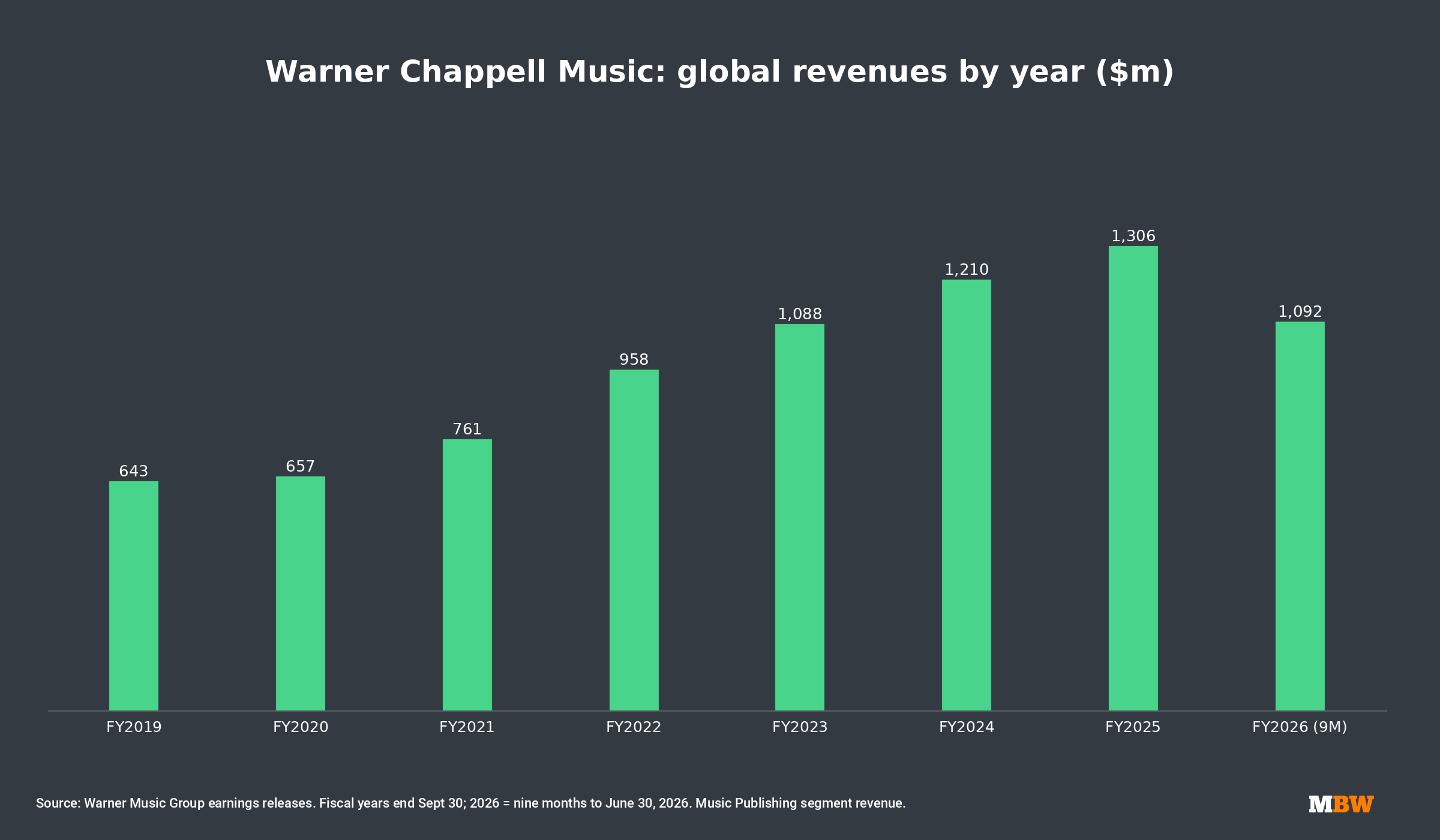
In April 2019, Moot arrived at Warner Chappell as Co-Chair and CEO alongside Carianne Marshall, and the pair have since doubled the companyâs annual revenues.
Banner signings on their watch include Dua Lipa, Amy Allen, Zach Bryan, Laufey, and ROSÃ, alongside major catalog deals for David Bowie (acquisition), George Michael (renewal), and Tom Petty (admin).
The past couple of months have been eventful, even by Mootâs standards. In September, Warner Music Group (WMG) announced Marshallâs exit, making Moot sole Chair from October 1; a week later, he joined the board of the US National Music Publishersâ Association (NMPA).
On October 15, Warner Chappell signed My Chemical Romance to a worldwide administration deal covering the bandâs entire catalog and future works. And in the past week or so, the 20th anniversary edition of The Black Parade has given them their first-ever No. 1 albums in the UK and the US.
All of this plays out against a backdrop that would test any publishing chief. Warner has gone from suing AI music generators Suno and Udio to licensing them.
Meanwhile, in a fresh US Copyright Royalty Board (CRB) battle, Amazon is proposing to cut songwritersâ headline streaming rate for 2028â2032.
Yet Moot remains a publishing optimist. Heâs also refreshingly candid â about the industry talking in too many voices on AI, and about the moment, some 30 years ago, when a record company figure told him exactly what labels thought of publishers.
Ahead of Mondayâs ceremony, MBW speaks with Moot about publishingâs new place in the pecking order, AI, the CRB, catalog, My Chemical Romance, and why he believes some PROs need to be held to account…
Congratulations on the MITS. Youâre the first music publisher to receive the award. What does that tell us about where publishing now sits in the music business?
Music publishing has come a long way since I started. I remember [someone] saying, âI saw the publishers at [an event]. They were all relaxed, suntanned, and smoking cigars.â
Well, as the business has evolved, weâve had to work much harder for the rights we represent. Weâre constantly being judged on reputation [and] the services we perform. We donât smoke cigars anymore!
I remember one label executive saying to me around 30 years ago that publishers were the âleeches on the record companyâs back.â Weâre [far past] that â weâre now clearly the sexy part of the business!
âI remember one label executive saying to me around 30 years ago that publishers were the âleeches on the record companyâs back.â Weâre [far past] that â weâre now clearly the sexy part of the business!â
Most importantly, the songwriter is finally getting the recognition they deserve.
To be the first publisher to receive the MITS Award is truly an honor. Weâre not very good at being the center of attention, publishers. Weâre more in the background.
Itâs for two incredible charities, which Iâm thrilled about. The BRIT School is one of the UKâs greatest resources. It levels the playing field.
As for Nordoff & Robbins, itâs just so incredibly moving, what they do â seeing the power of what music does.
Youâve just become Warner Chappellâs sole Chair. What are your personal priorities for the company over the next 12 months?
Obviously, Carianne [Marshall] and I have done some incredible things together. We were together for seven years. For me, itâs now really about building the future.
Weâve got a very ambitious growth plan. Weâre aiming for well above market [growth] when you look at the Goldman Sachs predictions. Iâm a bit down on market share as a metric anyway; I donât think itâs all about market share. [Itâs about whether] youâre growing faster than market.
Weâre making a few changes: we just promoted Ali Brickman â she keeps me on the rails, and she pushes me every day. Weâre about to make some other moves as well.
âWeâve got a very ambitious growth plan.â
Look, weâve doubled revenue, but I always say I think weâve doubled our reputation, and that is so important. Weâre far more accountable now than we ever were.
A lot of deals in publishing are rolling three-year deals or administration deals, and youâre judged by your performance. Thereâs no hiding.
Becoming a superstar is getting increasingly difficult for any artist, and listenership is more atomized than itâs ever been. How does that change the publishing business, the superstar business, and how you approach A&R?
A&R is definitely more of a team effort. There were once these singular egos of âI signed this person,â which I never really subscribed to.
I hate using this word in a way, but A&R people have to think more like a portfolio. So you might sign a great touring act that streams solidly; you might get the next big thing.
You canât just wait for the one big thing, especially as those big things take a long time to come through. So while youâre doing solid business, something could just be developing, and maybe it takes six years to âpop.â
RAYE is a great example of patience and investment. Itâs a footnote in history now, but the recorded side of her career has not been a straight line. The commitment from the publishing side must have been a great source of stability…
Amber Davis signed her very early on â sometimes thatâs a curse and sometimes itâs a blessing!
What weâve tried to do with RAYE is facilitate her career, and grow with her.
When you first start off as a songwriter, itâs sessions, sessions, sessions. Some of that can become a bit of a treadmill at times, particularly when youâre trying to define your own artistry â and that treadmill is exactly what she then broke away from.
Weâre not taking credit for RAYEâs metamorphosis and her artistry, which has been amazing. But hopefully weâve played a part in supporting and facilitating it, and doing what we should be doing.
Professionally, whatâs the industry getting wrong about its view of AI?
I think, as usual, the industry is talking in many different voices. Weâre talking as individuals rather than collectively.
Warner Music Group has a policy of licensing the people who are good actors â and obviously thereâs some debate [over] whoâs a good actor or not. But at the same time, we staunchly defend our copyrights.
If we donât license these people at scale with the right deals, they will go rogue and claim safe harbor.
âNot everybody using AI is creating music to put out 50,000 tracks a week and push it to a bot farm.â
Then there are the alarmist headlines. Not everybody using AI is creating music to put out 50,000 tracks a week and push it to a bot farm.
More positively, the music industry has never really monetized or harnessed the hobbyist. There are people who want to make music recreationally, or make a song about their daughterâs birthday, or somebody just wants to experiment. These people will all be paying for subscriptions as well.
I said at the very beginning of AI: if youâre making average music, you might be in trouble. But if you are an incredible songwriter and artist, if you touch the human soul, you could be more in demand than ever.
That moment you sit at a festival or a concert, when the [hairs are up] on the back of your neck and youâre just like, âOh my God!â I just cannot see that being replaced. Who wants to see a robot emote?
Itâs that magical time again: the CRB process over in the US, setting streaming rates for the next few years. What are your hopes, fears, and aspirations?
We all want to see rates higher. We want to see songwriters paid more. But everything is a bundle these days â to quote David Israelite. So a lot of what weâre going to be talking about is protecting the value [of music] inside these bundles.
Music is front and center in helping sell those bundles.
âI cannot fathom how someone thinks they should be paying less for songwriters. Itâs crazy.â
I cannot fathom how someone thinks they should be paying less for songwriters. Itâs crazy.
David [Israelite] â I mean, Iâm on the [NMPA] board, itâs an honor â heâs fantastic.
Iâm not saying I want people to be angry or vocal, but we need the support of a songwriting community as well as the NMPA to really understand whatâs at stake here.
Catalog is taking up a larger share of what we might call âmainstreamâ listening than ever before. In publishing, youâre arguably in a good place to deal with that new reality…
Yes, because we have great catalogs. But Iâve often said to my [frontline] A&R teams over the years: weâre also competing with catalog.
You think youâre competing with that next artist whoâs going to break, or your rival companies or whatever â youâre competing with catalog. Thatâs the standard; thatâs the bar.
Whatâs your take on the financialization of catalogs over the past five to ten years? Itâs the maturation of a business youâre at the center of â with backing from the likes of Bain…
On one hand, Iâm really happy about it. The fact that people put such a value on songs and publishing is fantastic.
But itâs like growing a garden. [Owning a catalog] comes with a responsibility. Youâve got to grow the garden, tend to that garden, and protect it.
I think our partnership with Bain has been really good, because itâs been very much about owning. They are super-smart guys. [Weâve] learned a lot from them. Weâre very aligned in how we look at stuff, and itâs been a really good relationship. And we want to do more.
How do you currently rate the efficiency of the global PRO network? What are your hopes for the next few years in terms of admin commissions, cultural deductions, and all of the money that gets stuck in the pipe?
No oneâs saying that PROs shouldnât exist; they provide a very important service. But that service originated in local jurisdictions, when music wasnât traveling and wasnât licensed digitally across multiple territories.
Some, Iâd give 10/10. Others, Iâd give far less. Weâre having significant conversations with those ones. And, unashamedly, Warner Chappellâs going to hold them to account.
After we negotiate a deal with a songwriter, if [their royalty statements] arenât clear, we get audited, and rightly so. I just donât know why [the PRO world] isnât clearer and more transparent â particularly in the digital era.
âSome, Iâd give 10/10. Others, Iâd give far less. Weâre having significant conversations with those ones. And, unashamedly, Warner Chappellâs going to hold them to account.â
I like a lot of [PRO heads]; I regard a number of them as friends. But as a whole, itâs just so lacking in visibility; itâs just so opaque.
Sometimes, we see [individual PROs] investing a lot of songwritersâ money in systems that maybe donât work so well, or systems that are duplicative [of] somebody elseâs system.
Look around the world â how much commission youâre paying when you take it all into account. I donât know why [the industry] doesnât ask that question more, in a way. Iâd love to have one complete database.
Letâs talk about My Chemical Romance. To see a publisher sign a band at this point in their career is really interesting. Whatâs the understanding between you?
Well, I used to look after them at EMI. I remember going to The Black Parade and going, âOh wow, this is like theater.â
They create a whole world. Itâs theatrical performance, but with a kick-ass rock group. I actually saw them two weeks ago at the Hollywood Bowl.
Itâs great to have [their publishing and records] in one place with Warner Music Group. We can really, really focus on this group. When they put new music out, weâll work around connecting that to the back catalog.
They feel very, very relevant. And I saw a lot of â I talk about the âdouble demographicâ â fathers and daughters, and fathers and sons, at their shows, singing every word.
Ticket prices are now meeting market reality, and Live Nation is booming. But other than 360-type ancillary deals, the only part of the music industry that directly benefits from live is publishing. Is that one of the engines of the growth you were talking about?
Itâs huge in Europe for us… and very inefficiently collected. Thereâs very high commissions, we feel.
Still, in certain countries, itâs very lucrative. In some markets, as a publisher, Iâm more interested in whether someoneâs going on tour than whether theyâre releasing an album.
Thereâs been a lot of change at Warner Music Group in the past few years, including structural redesigns and headcount reduction.
Yeah, not just at WMG, but across our entire industry.
I always try to embrace change. As difficult as it can be in the moment, we often come out better for it.
I can certainly tell you that, from our perspective, weâre putting more [A&R] investment into music. You can see that in our numbers.
The question we always ask: if you could change one thing about the music business â tap the table, itâs changed â what would it be and why?
This question!
Today, it would be not having 25 different trade bodies or spokespeople. And if we do, at least having one place where we can bring it together and actually speak as an industry.
And obviously getting songwriters paid more â and fairly â and protecting that.
The bundle issue in streaming is huge, the discount [royalty rates coveted by certain streaming services]. Weâve really got to hold the line on our value.Music Business Worldwide