Based on the previous results, the stopper was made from dolomite and presumably sealed with bitumen. However, because some of the bands may be due to other organic substances present in the sample from the unguentarium contents, the use of bitumen to seal the vessel required confirmation with another technique: GC−MS.
Based on the previous results, the carbon compound detected by SEM−EDS and µ-Raman spectroscopy was probably used to seal the. As stated above, Roman vessels were typically sealed with lime mortar, pozzolanic materials or resins [ 23 ]. No mortar or pozzolanic material was obviously present, so the sealing material used might be a resin. However, the absence of other bands in the Raman spectrum was suggestive of an essentially carbon-based material. A comprehensive literature search revealed that bitumen had also been used as a sealing and waterproofing agent for various types of vessels since ancient times [ 28 ]. Thus, bitumen was frequently used in Roman amphorae for storage and transport [ 29 ]. The Raman spectrum for bitumen exhibits two bands in the 1000−1800 cmregion that appeared at 1587 (band D) and 1342 cm(band G) in our spectrum ( Figure 4 b) [ 30 32 ]. These results suggested the use of bitumen to seal thestopper. The presence of this sealant was confirmed by FT-IR spectroscopy. Figure 7 a shows the FT-IR spectrum for a sample of solid stuck to the inner side of theneck. The strong FT-IR band at 1447 cm, together with those at 882 and 732 cm, confirmed the presence of dolomite previously suggested by the XRD and µ-Raman spectra [ 24 ]. However, the FT-IR spectrum included several other, much weaker bands that were assigned to bitumen [ 33 34 ]. In fact, the bands immediately below 3000 cmwere assigned to stretching vibrations of C−H bonds in the CHand CHgroups of a hydrocarbon chain. The additional band at 1751 cm, due to stretching vibrations in C=O bonds, together with those at 1030 and 1132 cm, which are typical of C−O bond stretching, confirmed the presence of carboxylic acid or esters.
The inner side of the stopper only contained carbon, oxygen, calcium and magnesium, whereas the outer side additionally contained silicon, phosphorus, sodium and sulfur, albeit in very small amounts. The fact that the carbon content of the outer side was almost twice higher than that of the inner side suggested the presence of some compound undetectable by XRD. As can be seen in Figure 5 a, the C, Mg and Ca maps for the inner side of the stopper were superimposable; therefore, the only compound present was dolomite. By contrast, the element maps for the outer side of the stopper ( Figure 5 b) revealed that C was more widely distributed across the surface than were Mg and Ca, which was compatible with the presence of an additional carbon compound that required using a different technique for identification. The absence of additional diffraction peaks in the XRD spectrum for the outer side of the stopper ( Figure 4 a) relative to its inner side ( Figure 4 b) and edge ( Figure 4 c) suggested that the additional compound was not crystalline. The compound concerned was identified by µ-Raman spectroscopy, which allows spectra to be obtained from microscopic areas of a surface. Under the Raman microscope, the outer side of the stopper exhibited white, greyish and black zones consistent with those of the edge. On the other hand, the inner zone only exhibited white zones. Whichever the stopper side, the µ-Raman spectra obtained at different points in the white zone were all similar to that of Figure 6 a, which is consistent with that for dolomite [ 24 ]. On the other hand, the spectrum for the dark zones exhibited two strong bands ( Figure 6 b) possibly due to carbon [ 25 ]. However, no graphite was detected from the XRD, so the carbon must be associated with noncrystalline phases. The µ-Raman spectrum for the less dark particles on the outer side of the stopper ( Figure 6 c,d) contained not only the previous bands, but also one at 1008 cmand another at 960 cmthat were assigned to calcium sulfate [ 26 ] and calcium phosphate [ 27 ], respectively, and were consistent with the presence of sulfur and phosphorus, which were detected by SEM–EDS.
As can be from Figure 4 , the XRD patterns for the three stopper parts (viz., inner side, outer side and edge) were all similar and exhibited a strong diffraction peak at 31°. This peak, together with others at 37.4°, 41.2°, 45.0°, 50.6°, 51.1°, 59.0° and 59.9°, was clearly consistent with the presence of dolomite [ 16 ], an anhydrous carbonate mineral composed of calcium magnesium carbonate [JCPDS card number 36-0426, CaMg(CO]. No information about the chemical composition of the materials used in ancientstoppers has seemingly been reported to date. Usually, amphora and ampoule stoppers were made from perishable materials such as cork or wood [ 17 19 ] and frequently covered with ceramic discs for fitting. As noted by Mayer i Olivé [ 19 ], there are very few references to the use of other materials such as clay or mortar in pozzolana stoppers, which have been the subject of some largely speculative studies about their usage [ 20 21 ]. Ceramic stoppers in general, and the one examined here—which was made from dolomite—in particular, were used to seal containers; however, tight, waterproof sealing required using additional means [ 22 ]. Usually, amphorae were sealed with lime mortars, pozzolanic materials or resins [ 23 ]. Therefore, the next step here was to search for a sealing agent and, if found, determine its chemical nature. On removal from the, the stopper zone in contact with its neck was found to contain a dark brown, almost black residue that was also present on theneck (see Figure 3 d,e). This led us to think that the stuck substance might have been used to seal theand to confirm it by analysing the stopper with SEM−EDS and µ-Raman spectroscopy.
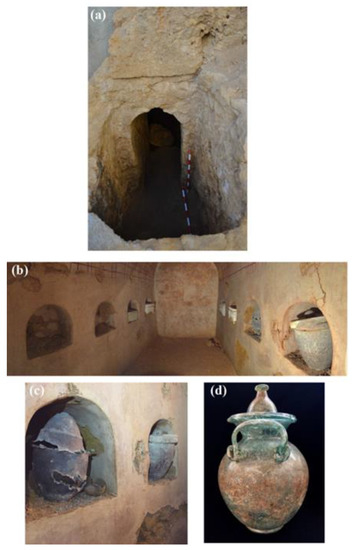
Althoughwere fairly commonly found inRoman burial sites [ 12 ], stoppered specimens are rather exceptional findings. For this reason, the stopper was analysed before thehere in order to ascertain whether the vestiges contained in the latter came from the former. The high archaeological value of the stopper required using non-destructive techniques for this purpose (specifically, XRD, µ-Raman spectroscopy and SEM–EDS). The stopper was about 7 mm thick ( Figure 3 ) and differed markedly inside and outside. Thus, the outer side ( Figure 3 b), which was in contact with the urn contents, showed yellowish ochre zones and darker, nearly black zones. On the other hand, the inner side ( Figure 3 c), which was in contact with thecontents, was largely white. Removing the stopper left more uniform, brown vestiges stuck on theneck ( Figure 3 d,e).
3.2. Analysis of the Unguentarium Contents
unguentarium , which were stuck to its walls, consisted of variably coloured particles ranging from whitish ochre to black ( unguentarium could have come off the stopper over time. These results were confirmed by using FT-IR spectroscopy. −1. On the other hand, the spectrum for the black particles ( unguentarium neck. Such bands were assigned to stretching vibrations of organic compounds consistent with those for bitumen [−1, 1400−1500 cm−1 and above 3000 cm−1, respectively, suggested the presence of aromatic compounds and saturated hydrocarbons. These results seemingly confirm the presence of bitumen as a sealant and waterproofing agent for the unguentarium stopper. However, its presence required further confirmation by searching for specific molecular markers. Obtaining a marker profile for bitumen calls for laboratory work to separate the saturated hydrocarbon, aromatic hydrocarbon, resin and asphaltene fractions [36, unguentarium contents—both the lighter and the darker material—with ethyl acetate to remove compounds typically present in bitumen and others potentially present among the original content. The extract was subsequently analysed by GC−MS. The contents of the, which were stuck to its walls, consisted of variably coloured particles ranging from whitish ochre to black ( Figure 2 a). The chemical composition of the particles was established by µ-Raman and FT-IR spectroscopies. The Raman spectra obtained were similar to those shown in Figure 6 a,b. The white residue was dolomite and the black particles were a carbonaceous material. Therefore, the dolomite vestiges inside thecould have come off the stopper over time. These results were confirmed by using FT-IR spectroscopy. Figure 7 b,c show the spectra for a sample of the white and black particles, respectively. The FT-IR spectrum for the white particles ( Figure 7 b) only exhibited the above-described bands for dolomite at 1447, 882 and 732 cm. On the other hand, the spectrum for the black particles ( Figure 7 c) included some bands that were very weak in the spectrum for theneck. Such bands were assigned to stretching vibrations of organic compounds consistent with those for bitumen [ 33 34 ]. In fact, the presence of strong bands for C=C, C−C and =C-H stretching vibrations at 1580−1700 cm, 1400−1500 cmand above 3000 cm, respectively, suggested the presence of aromatic compounds and saturated hydrocarbons. These results seemingly confirm the presence of bitumen as a sealant and waterproofing agent for thestopper. However, its presence required further confirmation by searching for specific molecular markers. Obtaining a marker profile for bitumen calls for laboratory work to separate the saturated hydrocarbon, aromatic hydrocarbon, resin and asphaltene fractions [ 35 37 ]. We extracted thecontents—both the lighter and the darker material—with ethyl acetate to remove compounds typically present in bitumen and others potentially present among the original content. The extract was subsequently analysed by GC−MS.
The resulting chromatogram ( Figure 8 ) was rather complex but the mass spectra allowed a number of compounds to be identified that were classified into three groups: hydrocarbons associated with bitumen (heavy alkanes, terpanes, steranes and some polyaromatic compounds) [ 38 39 ], sesquiterpenes associated with the presence of an essence and, finally, a third group of compounds associated with the presence of a lipid of vegetable origin. The presence of this fat was confirmed by transesterification with methanol and GC–MS analysis of the product ( Figure 9 ). The chromatogram was consistent with the presence of oleic, stearic and linolenic methyl esters, among others.
45, trans -carveol, carvone, (S)- cis -verbenol and caryophyllene oxide, none of which was found in our sample. Pine pitch contains other major components such as norabietatrienes and guaicols, which were also absent. Based on these results, we can rule out the use of pine pitch or pine resin as the ungentarium sealant. The right side of the chromatogram of unguentarium . A chromatographic analysis of the bitumen-related compounds ( Table 2 ) allowed long-chain linear alkanes to be identified. As previously found by other authors in archaeological bitumens [ 40 41 ], such alkanes were relatively regularly distributed. We additionally identified some branched alkanes and the hydrocarbon retene—a bitumen biomarker—in small amounts [ 42 43 ]. This compound is also a marker for pine resin and pitch [ 44 46 ]. However, the major terpenes are limonene,-carveol, carvone, (S)--verbenol and caryophyllene oxide, none of which was found in our sample. Pine pitch contains other major components such as norabietatrienes and guaicols, which were also absent. Based on these results, we can rule out the use of pine pitch or pine resin as thesealant. The right side of the chromatogram of Figure 8 contained some signals associated with the presence of polycyclic aromatic hydrocarbons that could not be unequivocally identified but are typical components of bitumen [ 47 ]. However, the definitive proof of the presence of bitumen has been the identification of some typical biomarkers of this material, such as terpanes and steranes, as well as other compounds related to retene that are also markers of bitumen ( Figure S1 ). The identification of these compounds has been carried out in a similar way as described in the literature by Hauck et al. [ 48 ] and Connan and Nissenbaum [ 49 ]. Therefore, the combination of these results and the previous ones suggests that bitumen was used as a sealing and waterproofing agent for the
unguentarium can be ascribed to ready adsorption of terpenes by some carbonaceous material such as bitumen [ unguentarium must have been partially adsorbed in the bitumen used to seal it with the stopper. With time, this carbonaceous material, and the adsorbed compounds it contained, decomposed and deposited, together with dolomite particles from the stopper, on the inner walls of the unguentarium . Deposited bitumen must have continued to adsorb perfume components after it came into contact with them inside the unguentarium . The sesquiterpenes identified from their mass spectra included seychellene, patchoulenol (patchouli alcohol), β- and α-patchoulene, α-copaene-8-ol, alloaromadendrene, α-cubenene or cariophyllene, among other (see folium nardi , i.e., “nard leaves” [ Nardum indicum , a plant of the family Valerianaceae known as “true nard” or “Indian nard” ( Nardostachys jatamansi ). The rhizome from this plant was combined with fibrous, aromatic rootlets to obtain a highly prized extract that was used as medicine and perfume. The Latin word folium literally meant “leaf” but was also used to designate an indefinite plant which, according to André [ Pogostemon patchouli Pell , have also been associated. Although some authors distinguished them, this plant was occasionally confused with nard. Dioscorides himself (I 12) [ Chromatographic analyses also allowed some sesquiterpenes to be identified. These compounds are present in essential oils from a number of plants. In fact, they belong to their volatile fraction and are responsible for “high notes” in perfumes. They are so volatile that they are easily lost by evaporation [ 50 ]. That substances like these were preserved in an archaeological setting is rather unusual. Their permanence in thecan be ascribed to ready adsorption of terpenes by some carbonaceous material such as bitumen [ 51 52 ]. Thus, evaporated sesquiterpenes in themust have been partially adsorbed in the bitumen used to seal it with the stopper. With time, this carbonaceous material, and the adsorbed compounds it contained, decomposed and deposited, together with dolomite particles from the stopper, on the inner walls of the. Deposited bitumen must have continued to adsorb perfume components after it came into contact with them inside the. The sesquiterpenes identified from their mass spectra included seychellene, patchoulenol (patchouli alcohol), β- and α-patchoulene, α-copaene-8-ol, alloaromadendrene, α-cubenene or cariophyllene, among other (see Table 2 ). In classical sources about perfume-making, Pliny the Elder used the words, i.e., “nard leaves” [ 10 ], to refer to, a plant of the familyknown as “true nard” or “Indian nard” (). The rhizome from this plant was combined with fibrous, aromatic rootlets to obtain a highly prized extract that was used as medicine and perfume. The Latin wordliterally meant “leaf” but was also used to designate an indefinite plant which, according to André [ 53 ], might have been patchouli—with which the cassia flower tree and, specifically,, have also been associated. Although some authors distinguished them, this plant was occasionally confused with nard. Dioscorides himself (I 12) [ 54 ] noted that some believed cassia was Indian nard.
Pogostemon species used to extract the oil. Pogostemon cablin is widely at present used by the perfume and cosmetic industries. However, the lack of specific, reliable information precludes knowing which Pogostemon species was or was typically used to obtain patchouli essence in ancient times. There is sufficient evidence, however, that patchouli alcohol was the major component of the oil whichever the species. Van Beek and Joulain [ Pogostemon species was unknown; also, as shown below, the patchouli extraction method used in ancient times was rather different from those employed at present. The sesquiterpene fraction of patchouli essential oil is rather complex and strongly influenced by the origin of the particularspecies used to extract the oil.is widely at present used by the perfume and cosmetic industries. However, the lack of specific, reliable information precludes knowing whichspecies was or was typically used to obtain patchouli essence in ancient times. There is sufficient evidence, however, that patchouli alcohol was the major component of the oil whichever the species. Van Beek and Joulain [ 55 ] reviewed more than 600 papers dealing with the composition of patchouli essential oil and found them to agree on their major component: patchouli alcohol, present in an average proportion of 39%. This component was accompanied by other major sesquiterpenes including α-bulnesene, α-guaiene, seychellene, and α- and β-patchoulene, all of which were present in the sample extracted from the unguentarium here. Obviously, the proportions found in our sample were not the same because, even if the perfume had been made from patchouli, the particularspecies was unknown; also, as shown below, the patchouli extraction method used in ancient times was rather different from those employed at present.
57, Nardostachis jatamansi ). Based on the results, the unguentarium was highly likely to contain patchouli essential oil. However, confirming this assumption required excluding the presence of nard essential oil, which also contains sesquiterpenes [ 56 58 ]. This ambiguity was solved by conducting a GC/MS analysis of commercial essential oils from patchouli (Sigma−Aldrich (Darmstadt, Germany) Ref. 05591501) and nard (Esenciales,).
unguentarium contents. The chromatogram for the commercial oil ( unguentarium contents and the major components of the latter are present in patchouli oil [ unguentarium content revealed that most of the compounds identified in the former were also present in the latter. Additional compounds contained in patchouli oil were also identified (see R = 11.74 min) and α-patchoulene (t R = 12.95 min) ( unguentarium contents. This similarity shows that patchouli oil was probably originally contained in the unguentarium . Figure 10 shows the chromatograms for the commercial oil and thecontents. The chromatogram for the commercial oil ( Figure 10 a) allowed the sesquiterpenes listed in Table 2 to be unequivocally identified. The chromatographic profile is similar for the essential oil and thecontents and the major components of the latter are present in patchouli oil [ 55 ]. Our sample also contained one or more compounds of MW = 204 which could not be precisely identified since patchouli oil contains at least 23 compounds with that molecular weight [ 55 ]. Figure S2 shows selected mass spectra for the compounds. Comparing the chromatogram for the commercial oil with that for thecontent revealed that most of the compounds identified in the former were also present in the latter. Additional compounds contained in patchouli oil were also identified (see Table 2 ). The 204 ion chromatogram has been extracted for β-patchoulene (t= 11.74 min) and α-patchoulene (t= 12.95 min) ( Figure S3 ). The mass profile of this ion, which corresponds to the molecular mass of numerous terpenes present in patchouli oil, shows a high similarity between the commercial standard andcontents. This similarity shows that patchouli oil was probably originally contained in the
unguentarium extract; however, the overall sesquiterpene profile of the extract was more similar to that of patchouli oil than to that of nard oil. Aside from this terpene profile, the presence of patchouli alcohol helps us rule out nard oil. We have selected the extracted ion chromatogram for m / z = 222 ( unguentarium and in the patchouli oil, as we have seen before, the content of this compound is relatively high, while in the nard oil, its intensity is very low (135 kCps vs. 92 MCps). Therefore, the unguentarium was likely to contain patchouli essential oil. As can be seen from the chromatogram of Figure 11 , the major components of nard oil are α-copaene, β-cubenene, caryophyllene, humulene, longipinene, β-cadinene and patchouli alcohol. As noted earlier, some sesquiterpenes in the nard oil standard were also present in patchouli oil and in theextract; however, the overall sesquiterpene profile of the extract was more similar to that of patchouli oil than to that of nard oil. Aside from this terpene profile, the presence of patchouli alcohol helps us rule out nard oil. We have selected the extracted ion chromatogram for= 222 ( Figure S4 ). Both in theand in the patchouli oil, as we have seen before, the content of this compound is relatively high, while in the nard oil, its intensity is very low (135 kCps vs. 92 MCps). Therefore, thewas likely to contain patchouli essential oil.
unguentarium extract not only had a compound profile more similar to that of patchouli oil, but also contained certain compounds not present in the commercial oils, probably because the latter was obtained by steam distillation, a technique obviously unknown in Roman times. In fact, essences and essential oils contained in plant leaves or flowers were then obtained either by cold soaking or by dissolution in vegetable (almond, olive) oil. Aroma compounds were soaked in cloth that was subsequently pressed to recover them [ Theextract not only had a compound profile more similar to that of patchouli oil, but also contained certain compounds not present in the commercial oils, probably because the latter was obtained by steam distillation, a technique obviously unknown in Roman times. In fact, essences and essential oils contained in plant leaves or flowers were then obtained either by cold soaking or by dissolution in vegetable (almond, olive) oil. Aroma compounds were soaked in cloth that was subsequently pressed to recover them [ 59 ]. Cold soaking was one of the most simple yet effective methods for extracting essences from some flowers such as those of jasmine or roses. For extraction, the flowers were placed on alternately stacked cloth and fat-impregnated layers [ 60 ].
unguentarium might have held vegetable fat. Because it contains a large number of C=C bonds, squalene is very easily degraded, so it is very rarely found in archaeological materials. Therefore, its presence is usually ascribed to contamination at a later stage [ unguentarium was opened and kept in tightly sealed vials. Therefore, squalene in the unguentarium was originally present in the fat held in it. The presence of the fat was confirmed by transesterifying with methanol a small portion of the dark-coloured solid found inside the unguentarium . This was followed by GC−MS, which allowed the methyl esters of oleic, palmitic, stearic, myristic and pentadodecanoic acid to be identified and quantified. In fact, the previous acids accounted for 53.7, 30.9, 12.8, 1.7 and 0.9%, respectively, of the analysed mass (see unguentarium contained some vegetable fat. There have been reports of fat residues in amphorae which once held olive oil from Roman times [ Finally, the fact that the chromatograms revealed the presence of compounds such as β-sitosterol, campesterol or squalene suggested that themight have held vegetable fat. Because it contains a large number of C=C bonds, squalene is very easily degraded, so it is very rarely found in archaeological materials. Therefore, its presence is usually ascribed to contamination at a later stage [ 61 ]. In our case, however, the compound was found inside a closed, sealed vessel in the absence of oxygen and light, which, together with the relatively cool environment of the tomb, made squalene degradation highly unlikely. The samples used for analysis were obtained immediately after thewas opened and kept in tightly sealed vials. Therefore, squalene in thewas originally present in the fat held in it. The presence of the fat was confirmed by transesterifying with methanol a small portion of the dark-coloured solid found inside the. This was followed by GC−MS, which allowed the methyl esters of oleic, palmitic, stearic, myristic and pentadodecanoic acid to be identified and quantified. In fact, the previous acids accounted for 53.7, 30.9, 12.8, 1.7 and 0.9%, respectively, of the analysed mass (see Figure 9 ). The presence of these methyl esters together with β-sitosterol, campesterol and squalene confirmed that thecontained some vegetable fat. There have been reports of fat residues in amphorae which once held olive oil from Roman times [ 62 ]. The residues contained most of the fatty acids of olive oil including some with an odd number of bonds, albeit at very low concentrations. Unsurprisingly thus, our sample contained pentadodecanoic acid, also known as “pentadecylic acid”, as a result of acids with an odd number of C atoms being naturally present in fats.
unguentarium once held a perfume which, based on the results, consisted of patchouli essential oil and some vegetable oil. In Roman times, perfumes were typically held in metal, ceramic or glass vessels [ Based on the foregoing and on classical works, theonce held a perfume which, based on the results, consisted of patchouli essential oil and some vegetable oil. In Roman times, perfumes were typically held in metal, ceramic or glass vessels [ 11 ] some of which included a reservoir [ 63 64 ]. However, those found in Pompeii [ 65 ] or the Rue Charcot necropolis [ 66 ], contained residual fat but no typical components of any perfume by the time they were examined.