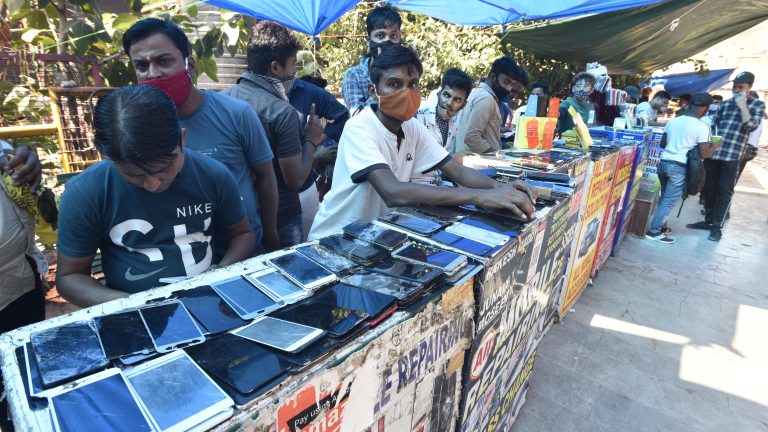
It’s been just about two months since Apple launched its first two flagship stores in India — one in Mumbai, one in Delhi — as part of a high-stakes gamble to sell more iPhones in the country. The stores are setting retail records, and as far as Apple shareholders are concerned, the system is working. But in the places where Delhi residents usually buy their phones, the situation looks different.
Gaffar Market is about an hour from Apple’s swanky New Delhi store. It’s one of the capital city’s major hubs for secondhand iPhone sales, with dozens of stores that display nothing but used iPhones. In a city where the phone can easily cost a month’s wages, Gaffar drives home a difficult truth for Apple: To most people in Delhi, the iPhone is still a luxury item.
So far, the glamor of Delhi’s new Apple store appears to have done little to affect business in Gaffar. As the shop owners tell it, Apple simply can’t compete on price.
“They come to this market only, as they know that the phones that have been newly launched will be available in this market within 10 to 15 days of the launch,” Vijay, a shop owner in Gaffar Market who asked to use only his first name, told Rest of World. “We give them the same phone, in the same brand-new condition for a price less than what they would pay for a new one.”
In many countries, Apple sells refurbished iPhones through its own retail channels, but Indian trade policy makes this uniquely difficult for the company. Since 2012, the Indian government has mostly blocked imports of used iPhones over concerns about e-waste and domestic production. Apple repeatedly pushed to overturn the policy in the years that followed, according to reports, but the government held firm. With no old iPhones coming into the country and few new models being sold, there’s a limited number of phones that can be refurbished — and what little supply there is tends to end up in markets like Gaffar.
“Whoever cracks the supply for this brand in the secondary market is bound to gain the most.”
But while secondhand supply is limited, research shows that used iPhones are increasingly popular in the Indian market. Apple only captured less than 5% of the smartphone market in India in 2022, making it one of the few countries where the tech giant still has room to grow. But the secondhand market is growing fast: Last year, 11% of the secondhand smartphones sold in India were iPhones, up from 3% in 2021, making it the “fastest-growing refurbished brand in India,” according to Counterpoint Research. Other data from Counterpoint shows that Apple has seen a year-over-year rise of 16% in the global refurbished market.
“India is an important market for used iPhones, but more than Apple, [third-party] retailers are cashing in from the sale of used iPhones,” Tarun Pathak, analyst at Counterpoint Research, told Rest of World. “Whoever cracks the supply for this brand in the secondary market is bound to gain the most.”
Pathak agreed that Apple is an aspirational brand in India — far more consumers would consider buying a refurbished model instead of a brand-new iPhone. “With the increase in quality processes and warranties, refurbished iPhone buyers are set to grow much more in the coming years,” he said.
Gaffar Market also allows people to sell their old handsets directly to shopkeepers, bypassing the hassle of finding buyers themselves. Customers looking to buy can shop around for the best deals across hundreds of stores.
“Go to any market across Delhi, the price listing for every product goes from our Gaffar Market,” shop owner Manmeet Singh told Rest of World. “We are the oldest in the business and the most reliable. Many times, even the phones that are still under a warranty period are available here. The customers trust us.”
As the sellers see it, their only disadvantage is a reliance on cash. “Even in our market, customers ask us if they can pay us in installments,” said shop owner Sukhbir Singh. “We would be at a loss if we did that. In that regard, iPhone stores are way ahead of us. This is the only battle we fight with them.”