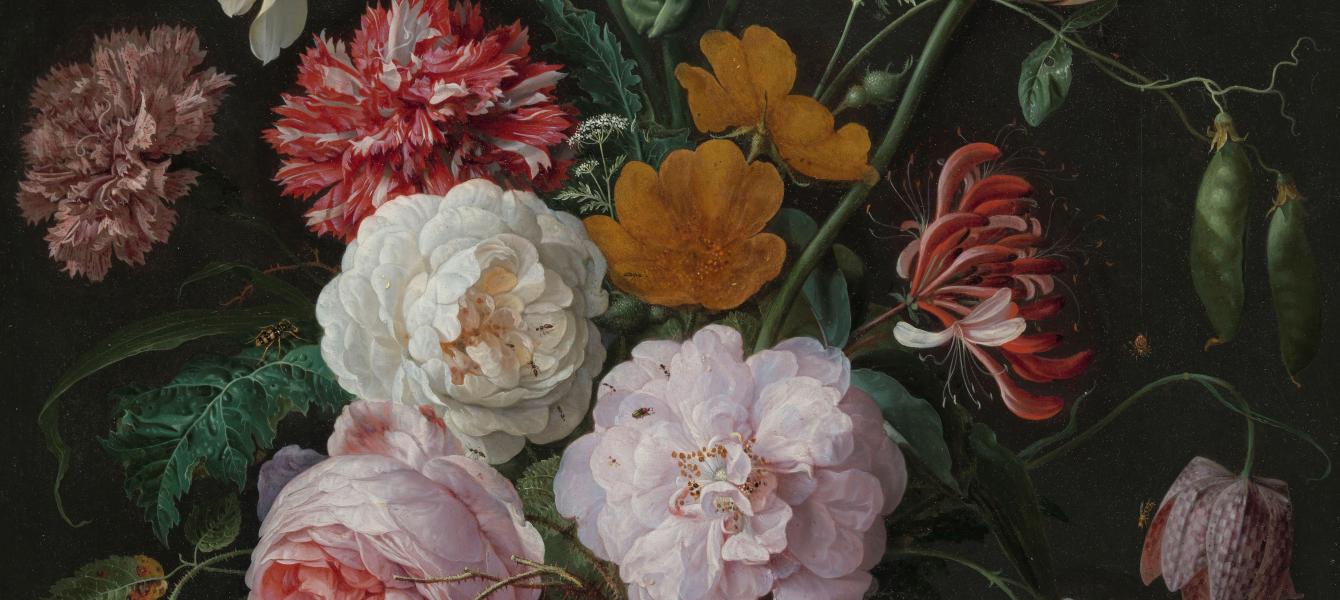
Additionally, they found that the arsenic species doesn't stay just where the artist used orpiment pigment. Conservators previously thought that degradation was concentrated at where the pigment was in a painting.
“This means that if you are a conservator, you have to not only look at where the arsenic pigment is, but in a large halo around the pigment,” Webb said.
Discovering that humidity could help degrade colors took a lot of trial and error, Webb said. First, the team recreated a sample of the arsenic pigment from scratch in the lab. Then they added egg yolk – a common pigment binder used by artists of the time – to the sample. They tested this egg-yolk sample under different humidity conditions in the lab and then compared their results with what they saw within the sample from de Heem’s yellow eglantine rose. That revealed that the arsenic species can spread after reacting with water in lab-grown samples and in paintings that are hundreds of years old.
In the future, the team wants to understand in greater detail the interactions between light, including from experimental X-rays, and the pigments. This will help them understand all of the reactions between the pigments and the binders in a more complex setting and further help conservation efforts, Webb said. Additionally, the researchers would like to determine the precise range of humidity levels that allow the arsenic species to grow in the pigment.
SSRL is a DOE Office of Science user facility.
Citation: T. H. Broers, Webb, Nelson Weker, et al., Journal of The American Chemical Society 14 April 2023 (doi/10.1021/jacs.2c12271)
For questions or comments, contact the SLAC Office of Communications at communications@slac.stanford.edu.