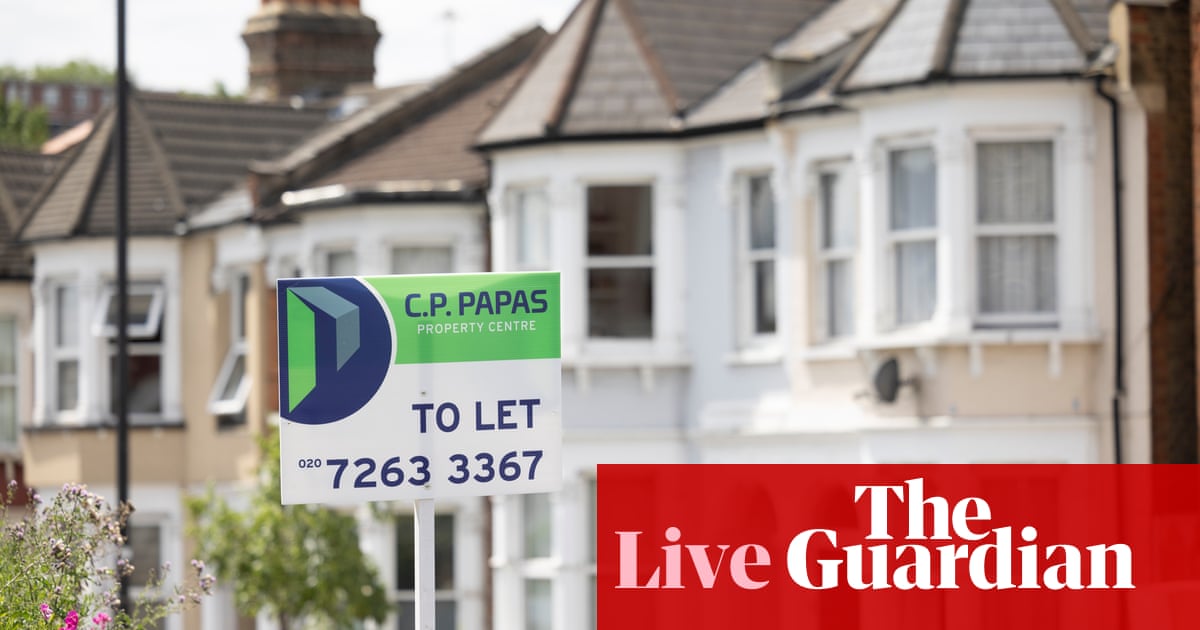
From 17h ago 05.23 EDT Treasury Committee questions mortgage providers Over in parliament, MPs on the Treasury Committee are starting to question mortgage providers on rising rates, house prices and forbearance. It’s a timely hearing, given average two-year fixed mortgage rates have just hit a 15-year high of 6.66%. UK two-year fixed mortgage rates hit highest level since 2008 Read more Here’s what to expect, from the committee: The cross-party Committee of MPs will examine the current state of the mortgage market, including levels of mortgage stress, arrears and forbearance, and the outlook for the market in light of higher interest rates. The Committee will question mortgage providers on consumer behaviour following recent rate rises, the impact on house prices and the wider housing market, and mortgage affordability and availability. Government support schemes and the recently agreed ‘mortgage charter’ are also likely to be discussed, as are buy-to-let mortgages and the rental market, and the take-up of long-term fixed rate deals. Here’s the panel: Andrew Asaam, Homes Director, Lloyds Banking Group
Bradley Fordham, Mortgage Director, Santander UK
Charlotte Harrison, Interim CEO (Home Financing), Skipton Building Society
Henry Jordan, Home Commercial Director, Nationwide
Nigel Terrington, Chief Executive, Paragon Banking Group
12h ago 10.43 EDT Deutsche Bank have predicted that the Bank of England will lift interest rates by half a percentage point next month. Previously, Deutsche had forecast a quarter-point rise, from 5% to 5.25%. But following this morning’s strong labour market data, showing wage growth running at 7.3%, it has upped its forecasts for the next meeting of the BoE’s Monetary Policy Committee. Deutsche’s chief UK economist, Sanjay Raja, explains: For now, evidence of still more persistent wage pressures will keep the MPC’s foot on the accelerator. A second consecutive 50bps hike now looks more likely than not.
12h ago 10.00 EDT Over in Moscow, the central bank has reported that Russia’s current account surplus shrank by 85% in the first half of this year, to $20.2bn. That’s a sharp fall on the record surplus of $147.6bn in January-June 2022, when Russia profited from the surge in energy prices and also cut its imports due to sanctions imposed by the West. The Central Bank of the Russian Federation said the drop in the surplus this year was due to a fall in volumes of exports, and lower prices for oil and gas, and other Russian commodities. On a quarterly basis, the current account balance decreased to $5.4bn in April-June, down from $14.8bn in January-March. Reuters adds that oil and gas revenues, the lifeblood of Russia’s economy, fell 47% year-on-year in January-June, which the finance ministry put down to lower prices for Urals crude and lower natural gas export volumes.
13h ago 09.34 EDT Meanwhile in Brazil, inflation has dropped to its lowest level in almost three years. Annual inflation in Latin America’s largest economy slowed to 3.16% in June from 3.94% in May. Brazil Inflation Ratehttps://t.co/FFaoEzL7Ky pic.twitter.com/EsaH4hzcWk — TRADING ECONOMICS (@tEconomics) July 11, 2023 On a monthly basis, prices fell – by 0.08% – the first deflation registered since September of last year. This may encourage Brazil’s central bank to consider cutting interest rates from their current six-year high of 13.75%…. Rate cut expectations are gaining momentum as Brazil's annual inflation reaches its lowest point in almost three years. — Roensch Capital News (@RoenschNews) July 11, 2023
13h ago 09.00 EDT UK’s ‘zombie’ firms will be wiped out by rising interest rates Julia Kollewe Britain’s debt-laden “zombie” companies are expected to be wiped out by the surge in interest rates, an insolvency specialist has predicted. Begbies Traynor, a business recovery and financial consultancy, has said all of the nation’s zombies – companies struggling to service debts that have avoided bankruptcy through cheap borrowing costs – will have failed by the end of next year. “Over the next 18 months, we’ll see virtually all of them finally come to an end,” Ric Traynor, the executive chairman of the company, which is seen as a bellwether for the health of UK businesses, told Bloomberg. UK’s ‘zombie’ firms will be wiped out by interest rates, says insolvency specialist Read more
13h ago 08.58 EDT Thames Water: smart meters could curb hosepipe usage Helena Horton Cathryn Ross has said that Thames Water is looking at using smart meters to charge households for excessive water consumption in order to curb the use of hosepipes. She has taken aim at those with big gardens who “think that they care less about their water bills”. The CEO explained: “One of the biggest single useages of water is people watering gardens, if you put a hosepipe on for 10 minutes, that could easily use a typical daily consumption. So what we are looking at now we are pushing ahead with the smart meter roll out, could we look at tariff innovation that charged a set amount up to 100 litres of water per person per day, maybe a bit more for 110 120 let’s say, and then if you’re using more than 130 we can start charging you really much more, that might send signals about more efficient water usage”. She added: “People [who] have bigger houses with bigger gardens, maybe they think that they care less about their water bill, maybe those are precisely the sort of people who could pay more so we could then take some more of that money and invest it in the network or invest it in social tariffs”
13h ago 08.56 EDT Thames Water CEO: Climate breakdown puts London's supplies at risk Helena Horton Back at the London Assembly Environment Committee, Thames Water’s CEO has warned that water supplies are at risk in London due to climate breakdown. When asked about whether supplies are resilient, Cathryn Ross said: “In a nutshell we are living with an asset base that is older than we would like it to be, and even if it was in tip top condition if you were designing it today you wouldn’t be designing it in the way that we have it. It simply is not capable of delivering the resilience that people want today in the 21st century.” She said “numerous parts of the network” face a cocktail of problems and it is “not as resilient as we would like it to be”. Ross added: “The management of it during periods of extreme weather is becoming more challenging. We haven’t planned into business as usual what it takes to manage the resilient provision of water and waste water services in the face of climate change.
14h ago 08.42 EDT Today’s news of mortgage costs hitting their highest level in 15 years with an average rate of 6.66% will worry people further, at a time when “mortgage pressures on ordinary households are huge”, says Douglas Chapman, SNP MP for Dunfermline and West Fife. Following today’s Treasury Committee hearing on the mortgage market, Chapman says: Research this month from Citizens Advice Scotland reveals that around 11% of people always run out of money before payday, with a further 14% saying that this happens to them “most of the time”. This percentage will surely rise given today’s Committee panellists’ discussing averages of £235 increases on monthly mortgage repayments due to large interest rises and deals coming to an end, which on top of a crippling cost of living crisis, consistently high energy prices and rampant inflation explains why many people feel their financial resilience is being pushed to the limit.” “In addition, there was little encouragement for first time buyers today, who it appears need to spend longer amassing a larger deposit or tap into the Bank of Mum and Dad (which isn’t an option for everyone), and then also choose from a narrower portfolio of smaller properties in order to meet monthly mortgage payments and pass banks affordability stress tests.”
Updated at 08.49 EDT
14h ago 08.08 EDT Lisa Nandy MP, Labour’s shadow housing secretary, has said the increase in fixed-rate mortgage costs today is a sign of “Tory economic failure” “Too often, families who are saving for their first home but getting no closer to buying it feel like they’re doing something wrong. “But the fact of the matter is that the Tories have inflicted households with a mortgage bombshell, let renters down and failed to build the homes we need. “Millions are feeling the pain from this Tory economic failure. “Labour has a plan to start fixing this crisis. We would stop households missing out on the mortgage support they need by making measures mandatory, we will give greater rights and protections to renters, and we will take the tough choices to get Britain building.”
14h ago 08.05 EDT Henry Jordan, Nationwide’s home commercial director, has said house prices were expected to fall 6.5% from the peak seen last August. He told MPs on the Treasury committee: “We’ve already seen some fall in house prices, roughly about 4% from their peak in August last year. “We’d expect some further slight falls to around about 6.5%, would be our expected peak movement.” But, he doesn’t believe this is having a material impact on the number of customers in negative equity, saying: We have a very, very low exposure to negative equity currently, it’s 0.1% of our book. So we’re not seeing those movements in house prices really have any specific bearing.” A chart showing Nationwide house prices
Updated at 08.06 EDT