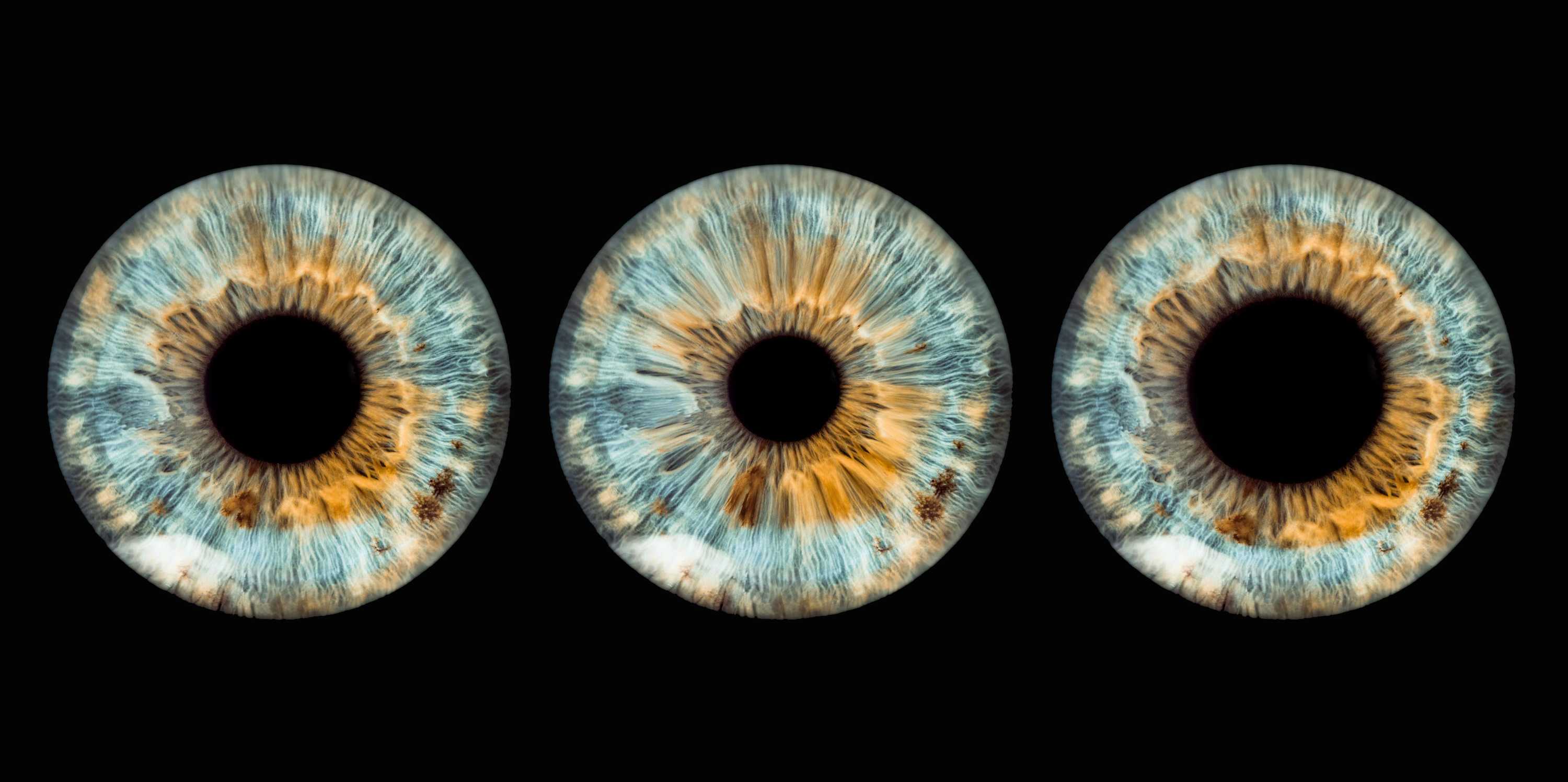
Up to now, the main determinant of pupil size alongside light was considered to be noradrenaline – known as a stress hormone – and its receptor system. But now, the ETH researchers have shown that instead, this role should be credited to the neurotransmitter orexin and its system of receptors. Noradrenaline neurons are in fact unable to maintain normal pupil state without orexin nerve cells. If the orexin system is switched off, the pupils remain far too constricted. “Essentially, noradrenaline neurons are slaves to orexin neurons,” says ETH Professor Denis Burdakov, colourfully describing this dependent relationship.
Link to narcolepsy
In their experiments, the researchers also established a dose-dependent link between nerve cell activity and pupil diameter. “The pupils show us precisely how active the orexin neurons in the hypothalamus are,” Burdakov says.
In addition to providing brain researchers with a new way of measuring orexin activity, this opens up new avenues for medical treatment. There is a long-established link between a disruption in orexin regulation and the sleep disorder narcolepsy. Recently, however, links have also been observed to other neurological conditions such as Alzheimer’s, stroke and the genetic disorder Prader-Willi syndrome. In this last condition, a malfunction in the diencephalon, or interbrain – where the hypothalamus is situated – leads to severe physical, cognitive and metabolic symptoms.
All four of these conditions have a sleep disorder component. In the future, examining pupil size could help more precisely research the influence of orexin on these conditions – and possibly even simplify and improve diagnosis, Burdakov says. At the present time, diagnosing narcolepsy still requires a lumbar puncture, which is an invasive procedure.
Unlocking consciousness regulation
As a neuroscientist, Grujic sees his discovery mainly as a key to better understanding how core functions of our consciousness are regulated. “Achieving the balance between focusing on the familiar and allowing our thoughts to wander and explore the world around us is an essential part of our ability to adapt to new situations,” he says. The prevalence and range of attention deficit disorders being diagnosed today shows just how difficult maintaining this balance can be, Grujic says.
Orexin is one of several neuromodulatory systems (others include noradrenaline and serotonin) that regulate this balance. These systems tip the balance one way or another depending on the organism’s needs. In the early days of human evolution, for instance, hungry hunter-gatherers had to cast around in search of a food source. If they were rewarded by the discovery of something to eat, they had then to shift their focus to their surroundings in order to be able to spy more of the food. And when the early humans were finally satiated, they could turn their attention to meeting their other needs.
Multiple neuron subsets for specific functions
In their study of orexin neurons, Burdakov’s research group managed to identify subsets that are involved in a variety of neural functions and thus in different components of this balance. Using a special kind of fluorescence microscopy, the scientists observed the response of individual orexin neurons in mice and compared this with fluctuations in pupil size. They used two-photon microscopy, which makes it possible to observe the activities of individual cells in the brain.
The researchers discovered neurons whose activity positively correlated with pupil size – and thus with the mouse’s level of arousal – and others whose activity negatively correlated. They also encountered some cells that both influenced pupil size and responded to rewards, as well as others that were connected to just one of the two factors.
Candidate for higher-level regulation
The identification of these specialised subsets within orexin neurons provides an initial insight into the ways in which these are wired to support central functions of our consciousness. What’s more, Grujic says that orexin’s influence on a host of different behavioural states – from attention, sleep-wake switching and reward-seeking to appetite and energy consumption – makes it a prime candidate for their higher-level regulation.
The ETH researchers’ findings throw open the door to many more avenues of scientific enquiry concerning the identification of additional neuron subsets and how they interact – both with each other and with the serotonin and noradrenaline systems. The researchers assume that answering such questions will lead not only to a far more detailed understanding of how our vital functions are regulated. They also foresee benefits in the diagnosis and treatment of attention and sleep disorders and of related conditions. And as the examples of Alzheimer’s and stroke suggest, these benefits could be greater than they at first seem.