Despite uncertainty over these substances’ toxicological profiles, the use of SCs is increasing worldwide [ 21 ]. Although there are several case reports and observational studies describing various effects (toxicities) of different SCs, to our knowledge, no articles compile those substances’ toxicological effects associated with each SCs. This systematic review’s goal is to summarize and discuss the toxicological effects of SCs.
SCs are classified into four distinct generations [ 17 ]. The first generation was the pioneer in terms of production; they are CB1 and CB2 full agonists, but with higher affinity than THC and more potent dopamine-stimulating action [ 18 19 ]. These include JWH-018, CP-47,497, and HU-210 derivatives [ 20 ]. The second generation includes AM-2201 and others from the JWH series, such as JWH-210. An even higher CB receptor affinity is characteristic of the second generation, which distinguishes itself from the first generation only in terms of chemical structure [ 18 ]. It corresponds to alkyl derivatives N-methyl piperidine and benzoyl indoles [ 20 ]. Compared to the first and second generations, the third generation has the highest affinity to the CB1 receptor, and examples include AB-CHMINACA and MDMB-CHMICA [ 19 ]. It presents an indole ring that has been replaced with an indazole or benzimidazole group. This generation also includes compounds with the carbonyl group replaced by a carboxylic or carboxamide group or quinolones with a secondary crystalline structure and nitrogen-containing groups [ 20 ]. Lastly, the fourth-generation SCs present an indole or indazole core; an ester, amide, or ketone linker; quinolinyl, naphthyl, adamantyl, tetramethylcyclopropyl, or other moiety ring; and a hydrophobic side chain attached to the nitrogen atom of the indole or indazole core. These main substances are 4F-MDMB-BINACA and 4F-ABINACA [ 17 ]. There are no clinical records about toxicological effects or information available as to the pharmacokinetics of the fourth generation.
Nonetheless, anecdotal accounts reported SCs as having deadly side effects, as well as causing neurological disorders (e.g., psychosis, agitation, irritability, paranoia, confusion, anxiety), psychotomimetic effects (e.g., hallucinations, delusions, self-harm), cardiac arrhythmias, several other physical conditions (e.g., tachypnea, hypertension, nausea, vomiting, acute kidney injury, fever, hyperglycemia, hypokalemia, sedation), and fatalities [ 7 15 ]. Later SCs generations, with psychoactive effects and anecdotal user reports, were released onto the drug market over time, producing severe adverse effects such as increased heart rate, panic attacks, and convulsions [ 16 ].
Since then, SCs use has grown considerably, which raises concerns about potential harm. Currently, there are hundreds of SCs known, and the SCs market is constantly evolving, so new compounds are continually being developed. Although often compared to THC, synthetic cannabinoids are not structurally related to the natural cannabinoids present in marijuana. Based on earlier SCs structures, four substructures with an indole, indazole, or carbazol core encircled by various N-substituents were used to create SCs. They form a heterogeneous group, but most SCs are lipid-soluble, nonpolar, composed of 22 to 26 carbon atoms, and very volatile when heated [ 6 ].
In the early 2000s, substances (e.g., JWH-018) which were primarily created for research purposes started appearing in smoking mixes, and these concoctions for smoking quickly gained popularity, particularly in nations where cannabis use for recreational purposes was prohibited or where users wanted to avoid being detected through standard drug testing. For this reason, several SCs began to be created in secret labs, combined with dried herbal mixes, and sold online as acceptable substitutes for cannabis (or ‘legal highs’). Known as ‘K2’ (in North America), ‘Spice’ (in Europe), ‘Youcatan’, ‘Chill’, or ‘Black Mamba’ and reportedly safe for eating, these concoctions have been widely marketed as smokable herbal combinations [ 11 ].
These chemical substances were developed by scientists in the 1970s to study the cannabinoid system and explore its potentially new therapeutic uses, such as the treatment of nausea and pain conditions [ 6 9 ]. Chemist John W. Huffman from Clemson University (USA) developed the JWH series, which has a more efficient bond with CB1 receptors [ 10 ]. Respectively, compounds JWH-018, JWH-122, and JWH-210 are 5, 60, and 82 times stronger than receiver Δ9-tetrahydrocannabinol (Δ9-THC) [ 10 11 ]. SCs have greater toxicity due to the binding power of SCs in cannabinoid receptors, increasing the chance of side effects.
Synthetic cannabinoids (SCs) are emerging drugs of abuse sold as ‘K2’, ‘K9’ or ‘Spice’ detected in herbal smoking mixtures. They are one of the drugs labeled as new psychoactive substances (NPS), which are not entirely controlled by the United Nations drugs conventions [ 1 2 ]. They have been associated with greater toxicity and higher addiction potential not related to the primary psychoactive component of marijuana, Δ9-tetrahydrocannabinol (Δ9-THC) [ 3 5 ]. In addition, the first cases of addiction and death related to SCs highlight the danger of their use [ 6 8 ].
This review searched for information on the following variables: title; author(s); year of publication; country; sample size; mean age; male/female ratio; study setting; study design; type of cannabinoid; dosage; toxic effects; and mortality outcome.
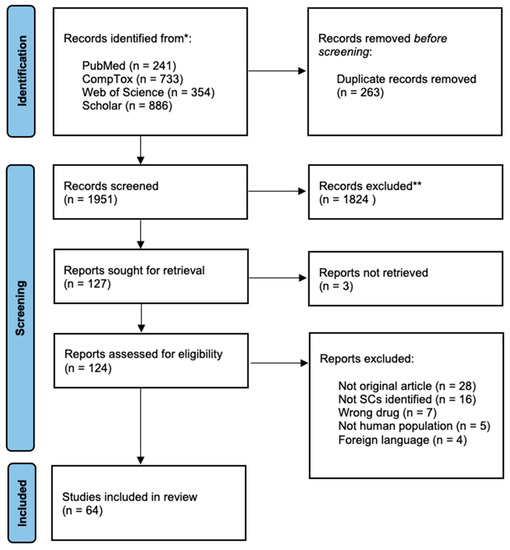
To select articles for this review, the first and the last authors read the abstracts of all studies found in the search. Duplicate articles were excluded. In the last step, the first author read the remaining studies. Inclusion and exclusion criteria were applied. The present review followed the PRISMA statement for transparent reporting of systematic reviews and meta-analyses [ 22 ], as presented in Figure 1
The keywords used in the search were ‘synthetic cannabinoid’ or ‘JWH*’, ‘AM*’, ‘RCS*’, ‘APINACA*’, ‘HU*’, ‘AM*’, ‘AB PINACA*’, ‘APICA*’, ‘MAM*’, ‘CHMICA*’, ‘CP*’, ‘UR*’, ‘XLR*’, ‘AKB*’, ‘AB-FUBINACA*’, ‘ADB*’, ‘EAM*’, ‘AKB*’, ‘WIN*’, ‘PB*’, or ‘MDMB*’. ‘Clinical trial’, ‘Case Reports’, ‘Clinical Study’, ‘Comparative Study’, ‘Evaluation Study’, ‘Multicenter Study’, ‘Observational Study’, ‘Randomized Controlled Trial’, and ‘Human’ (study) were the filters used in PubMed. The saturation strategy was used in the Google Scholar search (i.e., ending the search after three consecutive pages without studies within the topic of the review). The Preferred Reporting Items for Systematic Reviews and Meta-Analyses (PRISMA) were followed for data-gathering purposes. Research methods were registered on OSF https://osf.io/embk8/ (accessed on 15 March 2023).
We searched the PubMed database of the US National Library of Medicine, Google Scholar, CompTox Chemicals, and Web of Science up to May 2022 to identify relevant studies.
Original clinical trials analyzing synthetic cannabinoid toxicity and dependence were selected. The following were excluded: non-original studies (i.e., reviews, meta-analysis, discussion articles, study protocols), studies in languages other than English, animal studies not including synthetic cannabinoids abusers or dependents, and studies not analyzing outcomes regarding toxicity and addiction potential.
3. Results
Diagnostic and Statistical Manual of Mental Disorders (DSM-5) [ Sixty-four articles reporting the effects of synthetic cannabinoids in humans were included in our review. Two descriptive analyses of the studies were conducted separately: clinical studies (CS) and case reports (CR). Ten clinical studies and fifty-four case reports were included. Amongst the CS, 359 patients were assessed, with an average of 74% male and 26% female ( Table 1 ). Amongst the CR, data from 234 patients were analyzed, with 30 females (12.8%) and 233 (88.2%) males, with an average age of 26 years ( Table 2 ). Most subjects were recreational users, and 34% had criteria for cannabis use disorder according to the 5th edition of the(DSM-5) [ 23 ].
Twenty-six different cannabinoids were identified, including AB-CHMINACA, ADB-CHMINACA, AB-PINACA, ADB-FUBINACA, ADB-PINACA, AB-FUBINACA, MDMB-FUBINACA, MDMB-CHMICA, 5F-ADB, FUB-AMB, 5F-AMB, JWH-018, JWH-073, JWH-122, JWH-022, AM-2201, AM-694, MMB-2201, 5F-PB-22, 5F-AKB-48, PB-22, 6-APB, EAM-2201, BB-22, XLR-11, and UR-144. The most frequent were AB-CHMINACA, ADB-FUBINACA, and JWH-018, respectively. Analyses of SCs in blood, serum, or urine samples were performed using electrospray ionization liquid chromatography-tandem mass spectrometry.
The reported toxicologic effects were seizures, Glasgow Coma Scale (GCS) less than 10, disorientation, psychomotor agitation, red eyes, nausea, vomiting, anxiety, paranoia, palpitations, delirium, psychosis, reckless driving, mood swings, hypothermia, muscular stiffness, nystagmus, dilated pupils, drowsiness, mental confusion, supraventricular tachycardia, respiratory failure, hypoxemia, disseminated vascular coagulation, ischemic stroke, hemiparesis, dysarthria, aphasia, catatonia, persistent hallucination, and ischemic heart disease.
In our review, the most frequent toxic effects mentioned in CS were tachycardia, followed by seizures ( Figure 2 ). In total, 26.1% of CR detailed fatal intoxications from using SCs, particularly AB-CHMINACA, in which 50% of studies detailed the substance’s lethal effects. The reported studies presented severe degrees of intoxication and neuropsychiatric symptoms. In our study, the SCs AB-CHMINACA and ADB-FUBINACA had the highest frequency of symptoms and accounted for 41% of all reported fatalities.
Concerning the CS, four out of ten were conducted in the USA, three in the Netherlands, and one each in Germany, Japan, and the United Kingdom. Six out of ten studies reported using AB-CHIMINACA, which, jointly with MDMB-CHMICA, was associated with the worst outcomes. Nine out of ten studies took place in emergency departments. There was just one randomized controlled study, which was conducted in the Netherlands. Two CS reported death associated with SCs use, with AB-CHMINACA and MDMB-CHMICA being the reported SCs. The prevalence of neuropsychiatric symptoms was higher in third-generation SCs.
Most case reports studies were conducted in the USA, followed by Germany and the United Kingdom. In total, 26.8% (nineteen papers) of the articles related to fatal intoxication. Forty articles (56.3%) had emergency departments (ED) as their setting, 22.5% (sixteen papers) were outside hospital environments, 7% in psychiatric units (five papers), 4% in Institutes of Legal Medicine (three papers), and 10% did not specify (seven papers). Fifty-four studies specified the detected synthetic cannabinoid via either blood or urine clinical testing. Sixteen articles (22.5%) reported concomitant use of other drugs, primarily alcohol and cocaine.
AB-CHIMINACA and ADB-FUBINACA were the two cannabinoids most associated with death outcomes in the included studies, followed by MDMB-CHMICA and 5F-ADB, respectively. Thromboembolic events were reported with ADB-FUBINACA, JWH-018, and XLR-11 (e.g., ischemic heart disease, stroke). XLR-11 also had more association with psychosis, hallucinations, and paranoia.
The remarkable SCs toxicology findings included the medium concentration in blood for 5F-PB-22 (0.37 ng/mL), AB-CHMINACA (8.2 ng/mL), and 5F-ADB (0.38 ng/mL); in femoral blood for 5F-PB-22 (1.5 ng/mL), XLR-11 (11 ng/mL), ADB-FUBINACA (7.3 ng/mL), MDMB-CHMICA (3.5 ng/mL), EAM-2201 (12.6 ng/mL), PB-22 (1.1 ng/mL), JWH-210 (12 ng/mL), UR-144 (12.3 ng/mL), JWH-022 (3 ng/mL), MDMB-CHMICA (1.7 ng/mL), MDMB-PINACA (4 ng/mL), and FUB-AMB (3.7 ng/mL); in urine for JWH-018 (200 nM); and in postmortem blood levels for ADB-FUBINACA (56 ng/mL). Plasmatic concentrations linked to fatal defects range from 1.4 to 105 ng/mL. In autopsy cases, medium concentration in femoral blood was 0.00009 µg/g for AM-694, 0.0003 µg/g for AM-2201, and 0.00005 µg/g for JWH-018.