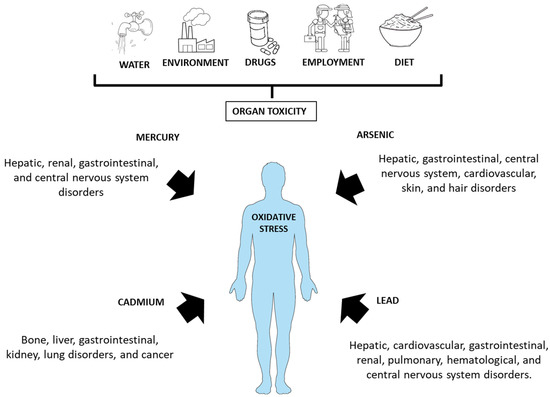
We conducted a preliminary assessment by searching for information on GFD, rice, and metals and found that the topic has been barely investigated; only six studies were identified. Therefore, we conducted an extensive literature review by searching for articles related to this topic in a wider sense, published during the last 20 years in Medline and Scielo, using the terms gluten-free diet + metals + free full text + observational study + humans + English, French, and Spanish, on the contents of four metals (As, Hg, Cd and Pb) and their relationships to diet. The objective of the review was to assess whether the evidence suggested that CD or consumption of a GFD, accepting the assumption that a GFD diet promotes high rice intake, was associated with increased levels of blood/urinary metal concentrations, and whether these, at physiological, supraphysiological, or toxic levels, represented a potential risk for human health. Most research on rice and human health has been conducted in Asia, with no reference to CD [ 22 ]. The results of our literature review present the total number of published data found and are presented as follows: GFD and treatment of CD and GRDs; As, Pb, and Cd bioaccumulation in persons on GFDs; metals in gluten-containing and gluten-free foods; rice cultivars and As in contaminated soils; future perspective and final comments.
Rice (L.) accumulates arsenic, with concentrations up to ten times higher than other cereals such as wheat. Rice grown under flooded conditions favors arsenic solubility in the soil and uptake into the plant, and therefore it is a major dietary source of arsenic for populations that consume relatively low drinking water concentrations of As [ 9 ]. Today, there is increased awareness of the health risk posed to humans by arsenic-contaminated rice consumption and it is a recognized threat to food safety [ 13 ]. The possibility of higher exposure to As through rice-rich processed foods, indeed, raises a problem because, although there are no studies that have exactly measuring it, daily practice clearly indicates that celiac patients and gluten/wheat intolerant persons consume much more rice than people on regular, non-restrictive diets [ 14 ]. Relevant metal contamination in farmland soil is a known threat to food security because of the potential bioaccumulation of heavy metals in crops such as rice, corn, and other vegetables grown in contaminated soil [ 15 ]. The development of the economy, improper disposal of wastewater and solid waste by humans, and the use of chemical fertilizers and pesticides have resulted in pollutants entering farmland soils through different routes, causing paddy field pollution [ 16 18 ] ( Figure 1 ). The relationship between these phenomena and a GFD is unclear but relevant. Recent meta-analyses [ 19 ] have suggested that higher consumption of white rice may increase the risk of developing type 2 diabetes, which is a condition closely related to celiac disease; the positive association between white rice intake and incidence of diabetes has been reported to be stronger among Japanese (= 59,288) [ 20 ] and Chinese cohorts (= 64,227) [ 21 ], two groups that are known to maintain high rice consumption.
Historically, the main health concern raised when dealing with gluten-free foods has been the potential aforementioned nutrition deficiencies. However, in recent years, concerns regarding heavy metals contamination in patients following GFDs has appeared to be a new scenario, because rice-based cereals and baby foods rich in rice have been found to contain high concentrations of arsenic (As) [ 8 10 ]. This has led to establishing specific limits for inorganic arsenic content in foods, including lowering the accepted As content in baby foods by half [ 11 12 ]. The European Commission (EC) modified the limit to 0.1-mg/kg for inorganic arsenic in rice food products for infants and young children. Limits also included non-parboiled milled rice (polished or white rice) (0.20 mg/kg limit); parboiled rice and husked rice (0.25 mg/kg); and rice waffles, wafers, crackers, and cakes (0.30 mg/kg limit for [ 11 ]. In 2016, the U.S. FDA proposed a limit, or “action level,” of 100 ppb for inorganic arsenic in infant rice cereal [ 10 ].
A gluten-free diet (GFD) is the treatment of choice for patients with celiac disease (CD) and gluten-related disorders (GRDs) [ 1 ]. A GFD eliminates natural foods/ingredients containing gluten and requires modifying processed food production to avoid gluten contamination. As a result, gluten-free products are often higher in fat, sugar, and energy content [ 2 5 ]; lower in magnesium, iron, zinc, and folate; and frequently, are poor sources of protein, fiber, iron, and B vitamins [ 6 7 ], as compared to their gluten-containing counterparts. Because of its low cost, rice is one of the most common alternatives used to replace wheat, rye, and barley in gluten-free foods.
2. Gluten-Free Diet and Treatment of CD and GRDs
Celiac disease is one of the most common autoimmune gastrointestinal diseases; over the last decades, its prevalence indicates a mean annual increase in frequency currently calculated at 7.5% per year [ 23 ]. CD is triggered by gluten present in the diet and the disease involves autoimmune and inflammatory damage to the small intestine in genetically susceptible individuals. To develop celiac disease a person must inherit the genetic predisposition; however, about one third of the population carries the risk genes and only ~1% of the population develops the disease, indicating that genetics is not sufficient to explain the condition. The environment participates by providing the triggering factor, i.e., gluten, and the disease is activated by environmental factors which, until now, have not been fully understood, among which changes in eating habits and the intestinal microbiota are considered to be significant factors [ 24 25 ]; yet, current knowledge is insufficient to explain the mechanisms involved. Currently, the only treatment for CD is a GFD for life.
Non-celiac wheat/gluten sensitivity. In recent years, an increasing number of persons in the general population have reported intestinal and extraintestinal symptoms after eating wheat. These patients have tested negative both for CD-specific serology and histopathology and for immunoglobulin E mediated assays; however, their symptoms improve on a GFD. This condition was formally described less than 10 years ago and, to date, it is not certain to what extent other wheat components, in addition to gluten [ 26 ], such as wheat amylase trypsin inhibitors [ 27 ] or wheat fructans (low-fermentable, poorly absorbed, short-chain carbohydrates or FODMAPs) [ 28 ] may contribute to the symptoms. Few reports refer to its prevalence, some estimates being at 4–6% of the population [ 29 ]. Patients suffering non-celiac wheat/gluten sensitivity are also treated with a GFD.
Wheat allergy. This immune adverse reaction is mostly mediated by IgE and is triggered by proteins contained in wheat and not necessarily in rye or barley, although IgE cross-reactivity has been described in some patients [ 30 ]. Treatment consists of avoiding eating any form of wheat, but gluten might be tolerated if it originated from non-wheat sources. The frequency of wheat allergy is largely unknown, although, recently, it was described at 3.9% in a series of 1203 adults [ 29 ]. In the USA, wheat is one of the eight most common foods to which people present allergic reactions. Regarding non-celiac wheat sensitivity, the only treatment is a wheat-free diet [ 31 ]; however, since the market only offers gluten-free products as alternatives, all these patients end up following a GFD.
Currently, a GFD is the only effective treatment for CD and GRDs. It is formed by uncontaminated naturally gluten-free foods (fruits, vegetables, sea foods, fish meat, poultry, legumes, nuts, and milk and dairy products) and processed foods that eliminate gluten as an ingredient or additive and avoid contamination during processing and distribution [ 32 ]. Gluten-free foods usually contain a limited number of ingredients, and they lack the fortification of their gluten-containing counterparts [ 33 ]. Rice has always been one of the mainin gredients in gluten-free foods due to its good palatability and low cost, and only recently have new ingredients emerged in the gluten-free food industry, such as quinoa, amaranth and other cereals, and pseudo cereals; they have better nutritional characteristics, but their higher cost limits their massification. Thus, rice remains to be the most consumed ingredient among those that maintain a GFD [ 34 ]. Among persons on complete diets in the USA, it is estimated that they consume 1 cup of rice daily [ 35 ].
The fashionable trend of eating “gluten free”. Consumption of gluten-free products has significantly increased and it has become an alimentary habit in the general population. There are scientifically unfounded perceptions that avoidance of gluten can improve health and help to lose weight and/or that gluten can be toxic for humans, thus, encouraging medically unjustified adherence to a GFD. Current medical recommendations indicate that only patients diagnosed with CD, non-celiac wheat sensitivity, and wheat allergy should eliminate gluten from their diets. Moreover, the available evidence does not support the idea that gluten might have adverse effects on human physiology and considering the well described nutrition deficiencies that may occur when a GFD is not properly supervised (see below), it seems largely justified not to maintain a GFD without a diagnosis to justify it.