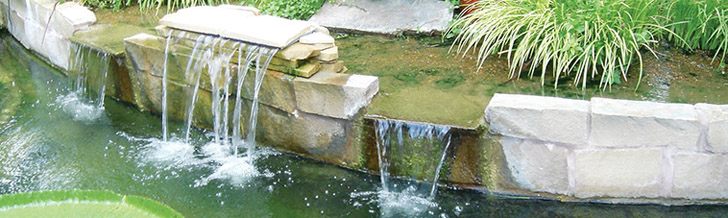
I have always been intrigued by the idea of turning waste into a resource, and that is exactly what a bog gravel filter does for you. It turns fish and plant waste into fertilizer (plant food). This plant food is then consumed by the plants growing in the filter. The happy byproducts of this process are clear water and low maintenance. If a bog gravel filter had a mission statement, this is what it would be:
To create an environment that maximizes organic decomposition and nutrient absorption, starving the (always-present) algae in the pond and keeping the water looking gorgeous!
Happy Customers
Here at Nelson Water Gardens we are so sold on bog gravel filtration that we will not build a pond without one, and for one solid reason: there are virtually NO callbacks from unhappy clients. They don’t call back because, with fewer pieces of equipment needed, there is less chance for breakdown; secondly, a properly constructed bog gravel filter only requires seasonal maintenance. That means more enjoyment of the water garden and less work for your client.
The only drawback to a bog gravel filter is that there is no fancy filtration system (or, as Cla Allgood of Allgood Outdoors calls them, “The Big Uglies”) to sell to a client. The bog gravel filter is designed and constructed onsite. If a client insists on a “big ugly” filtration system, we install one in addition to the gravel bog filter. In my opinion the loss of monies from not selling a fancy filtration system are more than made up by the peace of mind provided by no callbacks and customers who will be thrilled not just after the pond is constructed, but in the years to come.
Green Water
Let’s be clear (pun intended) about why ponds turn green. The green water is comprised of billions of tiny, one-celled, plant-like organisms called algae. Like plants, algae needs sunlight, carbon dioxide, water and nutrients to grow. Eliminate any one of these elements and it will not grow. Bog filters are extremely efficient at removing nutrients from the pond water.
This mission is accomplished by pumping pond water evenly through a gravel bed via a grid of perforated PVC pipework. The gravel provides the surface area for nitrifying bacteria to colonize. The bacteria reduce fish and plant waste into plant food. Growing in the gravel are bog plants that take up the plant food. The water is returned to the pond stripped of all nutrients, thereby “starving” the algae, which cannot grow.
Bog gravel filtration is not new. Mother Nature has been using this technique for eons, and in that context we call it an aquifer, swamp or marsh. NASA has experimented with the technique for waste treatment on space stations. Some Sanitation Facilities use it in wastewater treatment. In the pond industry, Dick Schuck presented this idea back in the early 1990s. Years ago I met a fish farmer who used this technique and ended up making more money from the plants he grew in the filter than the fish! Nelson Water Gardens has been building bog gravel filters for the past 18 years.
Learning From Our Mistakes
Eleanor Roosevelt once coined a saying that informs what we do:
“Learn from the mistakes of others. You can’t live long enough to make them all yourself.”
Over the last 18 years of constructing bog gravel filters, we’ve made plenty of mistakes and have also refined the process. We’ve given countless lectures and workshops and have learned from the feedback from the audience. In a backward kind of way, I’m going to start with the mistakes we made in order to remove immediately any preconceived notions about the technique.
In some instances the right way to do it seems wrong. For example, removing the soil from plants before planting in the gravel substrate seems logical, but don’t do it! And if a little bit of gravel does the job, then a lot of gravel should be even better, right? Well…not when it comes to depth of the filter bed. Build deeper than 12 inches and the system can fail. Surface area is key; the greater the surface area, the more filtration! So here are the top 10 mistakes made constructing bog gravel filters:
Too deep a bed of gravel. This is the most common mistake made. You need no more than 12 inches of inch gravel substrate. If you are adding a gravel bog to an existing deep pond area, construct a false bottom.
The bog is too small. For water gardens, 10 to 15 percent of the surface area should be bog, and for koi ponds there should be 25 to 30 percent.
Wrong size gravel. Use 3/8-inch pea gravel. Period. End of story.
Not capping the pipes. Water follows the path of least resistance and will simply shoot out the ends instead of through the slots.
Not enough plants. Initially you should plant one plant per square foot.
Wrong plants. There are many aggressive species which can clog the pipes and grow out of the filter.
Washing the soil off the roots of the plants before planting in the gravel. Don’t do this! There is not enough nutrition in a new bog to sustain new transplants. Just knock the pot off the plant and plant it—soil, roots and all—directly into the gravel. We promise the soil will not “contaminate” the bog or pond.
Not taking the plants out of their pots. This severely limits the plants’ ability to absorb nutrients and defeats the purpose of the bog gravel filter.
Starving the bog. This happens when a pre-filter* is placed on the intake of the pump. This not only stresses the pump but defeats the entire purpose of the bog by starving the plants of the nutrients that are being caught in the pre-filter.
*We are speaking of a true mechanical pre-filter (usually made from foam pads which need frequent cleanings) and not a pump protector or intake screen.
Not installing a clean-out pipe (or pipes).
Even Wrong Can Be Right
Even a bog gravel filter constructed all wrong works to a certain degree. Near our shop, our local county park installed a koi pond. Unfortunately, it was built without any filtration, and you couldn’t even see an inch into the water. Eventually the pond was retrofitted with their notion of a bog gravel filter using 3- to 5-inch rock instead of -inch gravel. (Why? I don’t know!) Additionally, the plants were left in their pots in the rock substrate. Despite these drawbacks, the pond did clear to a 12-inch depth! It has since been redone properly.
>> Related Content: Plant Options with Bog Filters
Building a Bog Gravel Filter
A bog gravel filter can be constructed in any number of ways. Examples of the most common configurations we have used in constructing water gardens include:
Partition: The filter is within the pond, separated by a porous retaining wall.
Raised: The filter is built next to and higher than the pond; water flows back via a stream or waterfall.
Border: A ledge, 12 inches deep and as wide as it needs to be, is constructed around the perimeter of the pond. At the edge of the ledge a porous wall is built to retain the gravel.
Island: Created by building a porous retaining wall on all sides in the middle of the pond.
Pottery Bog: You can create a filter from decorative pottery! Pottery bog filters are great for small ponds or additional filtration for larger ponds!
Directions for Creating a Partition Bog Gravel Filter
Follow the usual directions for building a liner pond. Size is determined by pond surface: 10 to 30 percent of the pond surface should make up the bog. If you plan to stock a lot of fish or koi, go with a larger size. Remember that you don’t have to dig deeper than 12 inches in the bog area. Ideally the entire area, pond and bog, should be constructed with one sheet of liner.
Using cinder block, stone, bricks or any other stable building material, construct a dry wall (no mortar used) to section off the bog filter from the rest of the pond. One technique we recommend is using cinder blocks (painted black with exterior latex paint) and then “capping off” the blocks with a decorative stone of your choice.
Figures 1 & 2 illustrate burying the pipe from the pump to the filter. However, where possible, we recommend laying a flexible tubing* in the bottom of the pond. Just run the tubing through the lower portion of the wall connecting the pump to the distribution pipes in the bog filter. Put a PVC female adapter fitted with the appropriately sized hose barb fitting to receive the flex hose from your pump.
Install the pump on the opposite side of the pond from where the bog filter is located. This is to facilitate good circulation of water throughout the pond. Select a pump that will turn the volume of the pond over every one to four hours. (You can go with a higher flow rate if you wish.)
Piping Directions
In all but the smallest of bogs use 1.5” to 2” PVC pipe. The larger diameter pipe allows for better water distribution and easy maintenance of the piping over time. The outlet of the pump also factors in when determining the size of the pipes. Always bump up the pipes for efficient use of the pump. For example, use 2” pipe on pumps with 1.5” outlet.
The PVC pipe is cut with slots approximately 1 inch apart; the slots should be cut approximately 1/3 of the way through the pipe. (A Circular Saw or Grinder works great.)
Next, lay the distribution pipe on top of the pond liner in the area partitioned off for the bog filter. Be sure the slotted portion faces up. Gravel bogs 2 to 3 feet in width can be fed by a single line of pipe. Wider areas require additional lines, spaced 2 to 3 feet apart. This layout is similar to setting up a septic drain field.
The end of each line of pipe should have a “cleanout.”** Cut this pipe (now referred to as the “cleanout pipe”) to discreetly rise just above the gravel bed.
To accomplish this, use a sweep elbow or double 45-degree elbow to join the distribution pipe to the vertical cleanout pipe. The cleanout pipe is capped with a female adapter and a threaded cap. Spray paint the cap black or brown and it will “disappear” from view.
Once you are satisfied with your piping layout and location of the cleanout pipe(s), glue all parts together. Hook up to the pump and turn it on the see if the water is evenly distributed.
*Using tubing within the pond means less possible leakage, easier repairs, and less likelihood of damage.
**The under-gravel pipes can be cleaned out by simply removing the cap from the cleanout pipe; water pressure from the pump will help dislodge any debris that has collected in the pipes. You can thread a hose barb adapter to the female adapter and attach a piece of flexible tubing to recycle this nutrient-rich water into a flower bed! A reverse flow can be achieved by turning off the pump and putting a pressure washer down the stand pipe.
Planting
Now you are ready to shovel 3/8-inch pea gravel into the bog gravel filter area, but only fill halfway (the rest of the gravel will be added during the planting). Remember, stick with 3/8-inch pea gravel!
Most gravel is not very clean. Wash it as best you can before adding to the filter, but be aware it will muddy or cloud up the pond. Do not to worry; it will clear up. After all, that’s what the filter is designed to do! Now that the construction process is finished, it’s time to plant your bog.
Select your bog plants and arrange them in the bog area that has been filled halfway with gravel. Be sure you stay away from the plants in the middle list. It’s best to plant the tall plants towards the back of the filter, and lower growing plants in front. Create interest by contrasting plants with different foliage colors or textures.
Slip the plants out of their pots and place them with soil intact on top of the gravel. Do not wash the soil from the roots! There is not enough nutrition in a brand-new bog to sustain the plants. (Trust us, the soil will not wash into your pond.)
After the plants have been placed, gently shovel in the remaining gravel. Your goal is to place the plants at the appropriate level so that when the rest of the gravel is added, the gravel will be at or above the water level. In other words, no standing water in the gravel filter area.
Turn on your pump and your bog filter is now off and running with years of clear water enjoyment to come.