« previous post | next post »
A week ago, I was in Gothenberg, Nebraska and went to the local historical museum. I asked the volunteers there what was the most unusual, interesting, and important exhibit they had. One of them, Barbara Fisher, thought for a moment, then said, "We have a unique collection of barbed wire fence downstairs, each strand of which is specific to the ranch or tract where it was used." She must have read my mind and heart, for that is just the sort of thing that would captivate me.
So I dashed down the stairs and beheld:
That incredible collection of barbed wire fences — each one different (I'll describe that in more detail below) — was put together by Roy Farnstrom, a retired electrician.
Here's one panel of the collection:
And here are some closeups:
From the way the barbs were wrapped around and woven through the horizontal strands, the ranchers could tell at a glance if the land and animals enclosed within belonged to them — I call them "signature barbs" — sort of like a premodern QR code.
When people started settling the Great Plains, there was nothing out here but millions of buffalo and some scattered Indians. There were no land divisions, no fences, no houses, no roads, no towns…. Moreover, since the land was so inhospitable, most people were intent on going further westward — even to the coast.
The first barbed wire was invented in 1867 by Lucien B. Smith of Kent, Ohio, which is 32 miles from my home in Osnaburg, Ohio. That changed everything. Wooden fences were vastly more expensive (there were very few trees out here then), difficult to install, and hard to maintain — plus they weren't as effective as barbed wire. So the barbed wire fences started to impose some order on the Great Plains.
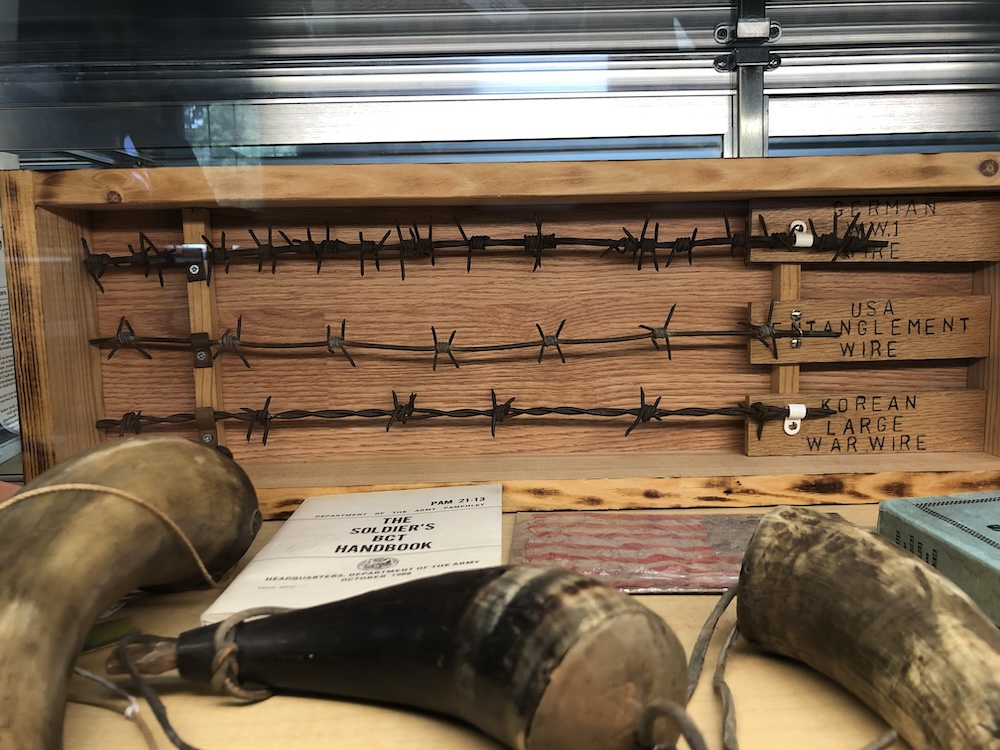
After studying the Farnstrom collection for several hours, I went back upstairs and was surprised to find this:
The first row is German barbed wire from WW I, the second is US "entanglement wire", and the third is Korean "large war wire".
A hundred miles to the west, at Crusty's Feed Store in Arthur, I was delighted to find this collection of barbed wire fence with signature barbs:
It was assembled by Barbara Jean Hartman. According to the naming practices of the area, she had several nicknames: Bobbie, Bobbie Jean, and Cookie. The last one derives from her serving as cook on the chuckwagon when the ranchers and cowboys went out to brand their cattle or engage in other group efforts.
There are other ways that ranchers signal their ownership of animals, the most colorful of which is branding, a practice that goes all the way back to ancient Egypt. Here in the sandhills of western Nebraska, the members of the community will come together and brand one rancher's recently born cattle on a Saturday morning, then have a meal together, somewhat like an Amish barn raising.
Branding reminds me of the tamgas of Central Asian peoples:
A tamga or tamgha (from Old Turkic: , romanized: tamga, lit. 'stamp, seal'; Turkish: damga; Mongolian: tamga; Adyghe: тамыгъэ, romanized: tamığə; Kabardian: дамыгъэ, romanized: damığə) was an abstract seal or stamp used by Eurasian nomads and by cultures influenced by them. The tamga was normally the emblem of a particular tribe, clan or family. They were common among the Eurasian nomads throughout Classical Antiquity and the Middle Ages. As clan and family identifiers, the collection and systematic comparison of tamgas is regarded to provide insights into relations between families, individuals and ethnic groups in the steppe territory.
(Wikipedia)
Still to come in this series on communication in the Great Plains, I will write on the Pony Express, the transcontinental railroad, and the telegraph, plus how and when they shaped our nation, not to mention how Gothenberg — in the heart of Nebraska — came to be called by that Scandinavian name.
Selected readings
[Thanks to Nancy Fisher and Bryan Walker]
Permalink