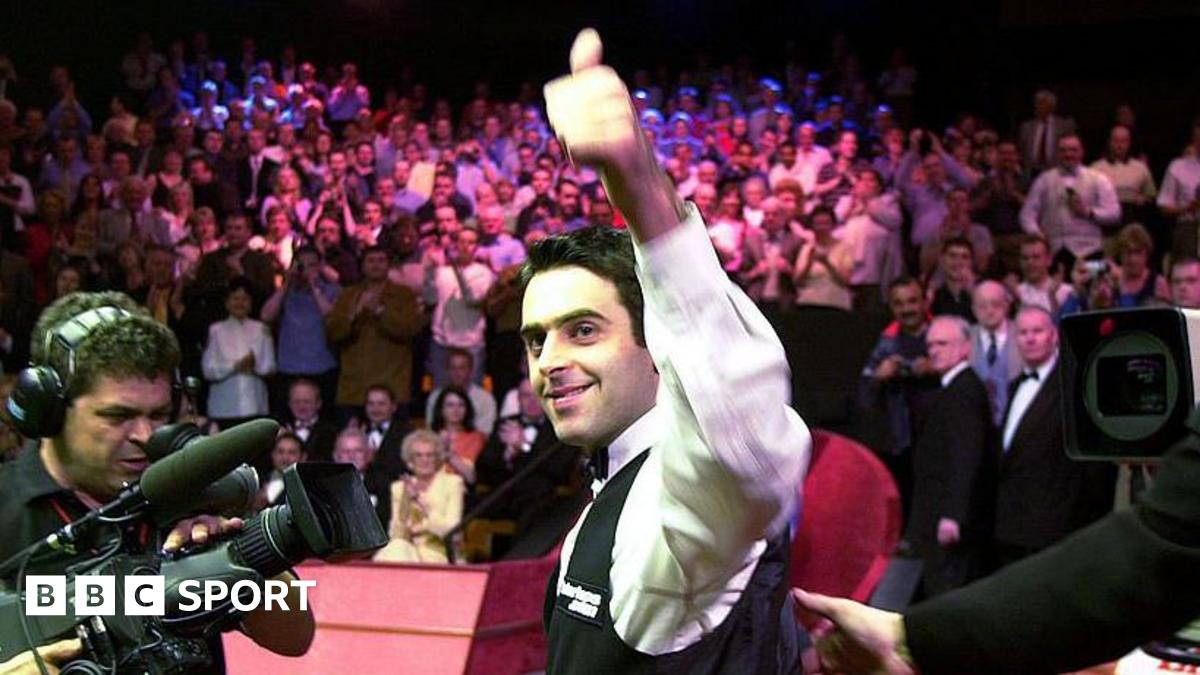
Down go the lights inside Sheffield's Crucible Theatre, an overhead galaxy replaced by darkness.
Heavyweight auditorium doors thud closed. A handshake between the protagonists disguises hell-bent hunger to degrade each other as far as non-contact sport allows.
The world beyond this claustrophobic den of tension and turmoil becomes irrelevant. Phones are switched off, senses flick to high alert.
New energy fills the air: anxious, anticipative. Crowd commotion hits a heavy metal high and drops steeply to silence.
All that matters in this moment is one of life's most edifying trivialities: snooker.
The gunshot clack that follows is resin on resin, the cue ball rippling off the pack of reds, signalling the start of a stage show without a script.
Rinse and repeat for 17 days. The marathon of the mind has begun.
Never take a result for granted at the Crucible; high stakes can discombobulate the very best.
"It has its own fingerprint as a snooker venue," says six-time world champion Steve Davis.
"I've had moments in there when it's been the most wonderful place. There were other times when I wanted the whole place to swallow me up because it was the worst place ever."
Davis was humbled 10-1 in round one by Tony Knowles in 1982, his first year as defending champion. He was turned white as a sheet by Dennis Taylor in the 1985 black-ball final, then turned over by a Yorkshireman when Bradford's Joe Johnson triumphed a year later.
Fortunately for him, Davis also has rip-roaring memories of triumph at the theatre that this year is staging the World Snooker Championship for a 50th time.
Most don't.
Twenty-four men have lifted the trophy in Sheffield; hundreds have left empty-handed.
The Crucible and all that it entails chews up players, scars them. All the greats have been through the wringer. But what is it that makes the 980-seat venue so special?
How did a venue once considered a "dropouts' hangout" become snooker's ultimate stage?