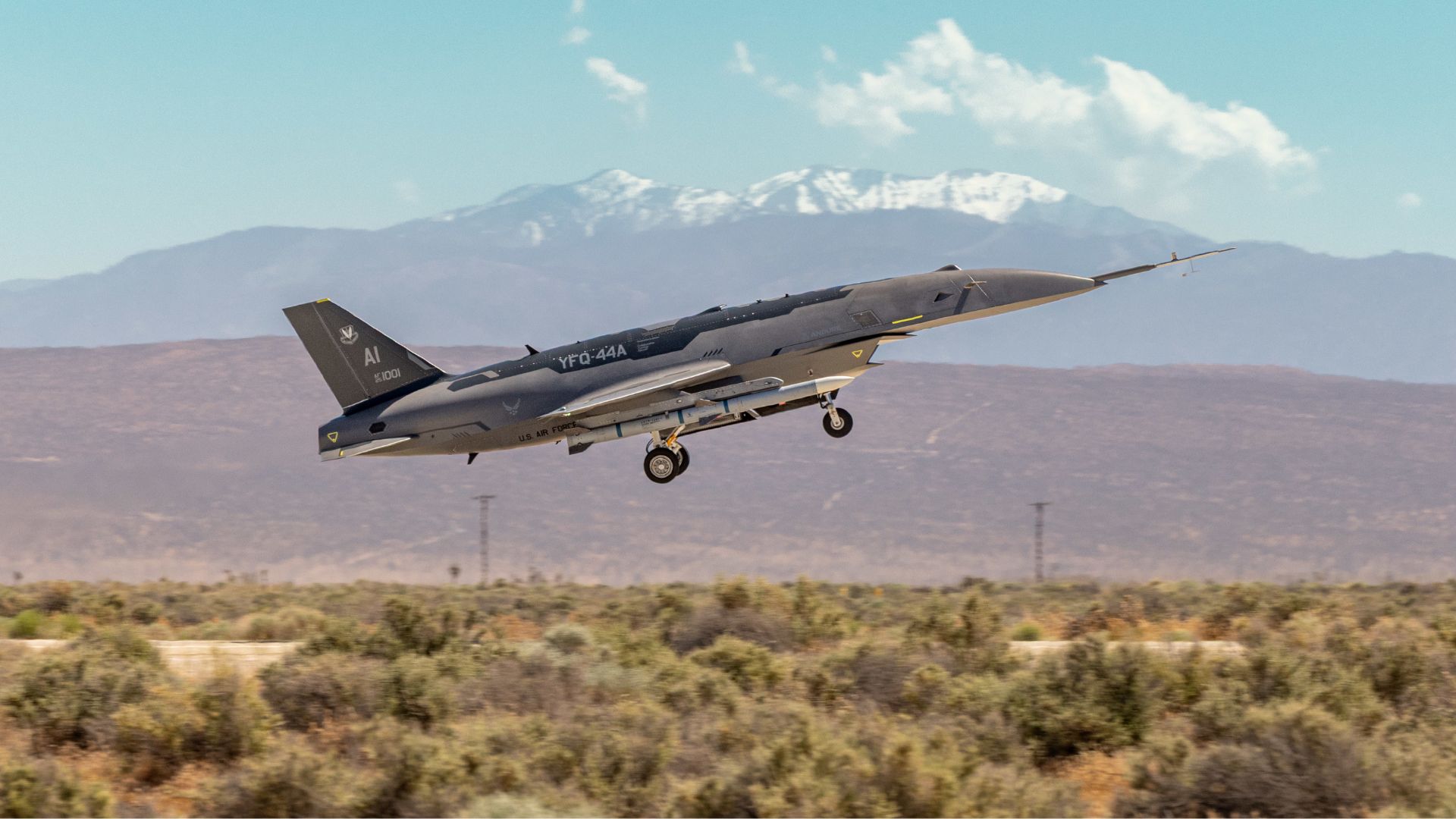
Just days after a U.S. Army CH-47F Chinook completed its first fully automated approach and landing with no pilot input, the U.S. Air Force has pushed autonomy further into combat aviation. In a recent exercise, Air Force airmen operated a semiautonomous jet-powered combat drone through a series of sorties, marking a key step in the Collaborative Combat Aircraft (CCA) program. The test campaign took place at Edwards Air Force Base and focused on turning experimental systems into operational capability.
Airmen from the Experimental Operations Unit (EOU) led the effort using Anduril Industries’ YFQ-44A aircraft. The exercise reflects a broader push to accelerate development under the Air Force’s Warfighting Acquisition System. Operator-led testing shift EOU personnel handled the full mission cycle. They launched, recovered, and turned the aircraft between sorties. Crews also managed weapons loading, pre-flight checks, and in-flight tasking. EOU and Anduril crews maintain YFQ-44A at Edwards Air Force Base, Calif. Credit – U.S. Air Force photo by Ariana Ortega Operators used a ruggedized laptop to upload mission plans. They initiated autonomous taxi and takeoff sequences. The same system allowed them to task the aircraft mid-flight and review post-flight data. The setup removed the need for large, fixed base infrastructure. It also highlighted the aircraft’s simplified logistics footprint. Previously, many drone systems relied on continuous human piloting. That approach is changing.
“There is no operator with a stick and throttle flying the aircraft behind the scenes,” Jason Levin, Anduril’s senior vice president of engineering for air dominance and strike, said in an October 2025 company release. The exercise also showed how quickly crews can adapt. With only a few days of training, a small team maintained and turned the aircraft between missions. Faster acquisition push The Air Force designed the exercise to test a new acquisition model. It brings operators, engineers, and acquisition teams into a tight feedback loop. “This experimental operations event was executed by EOU members from start to finish. Every sortie generated and flown was done with a warfighter, not an engineer or test pilot, kicking the tires and controlling the prototypes,” said Lt. Col. Matthew Jensen, EOU commander. “We are learning by doing, at a speed and risk tolerance accepted by the USAF’s most senior leaders, to ensure CCA is ready to operate and win in the most demanding combat environments.”
The approach prioritizes speed over perfection. “By embedding the operators from the EOU with our acquisition professionals, we create a tight feedback loop that lets us trade operational risk with acquisition risk in real-time,” said Col. Timothy Helfrich. “This isn’t just a test; it’s a demonstration of how we are adopting a more agile process. An 85% solution in the hands of a warfighter today is infinitely better than a 100% solution that never arrives.” The CCA program aims to deliver uncrewed aircraft that operate alongside fighters like the F-22 and F-35. These drones could handle strike missions, reconnaissance, and high-risk tasks. The Air Force has indicated it wants at least 1,000 such aircraft. That scale would significantly expand combat capacity without adding more pilots. Anduril and General Atomics are both developing candidate platforms.
The service selected both firms in April 2024 for early development. Anduril began flight testing in October 2025. It announced production plans for the YFQ-44A in March 2026. General Atomics started ground testing in May 2025. The Air Force has not confirmed how many units it will order. It may select only one vendor for full-scale production later this year. For now, the recent exercise signals momentum. It also shows how the Air Force plans to accelerate deployment of autonomous combat systems in contested environments.