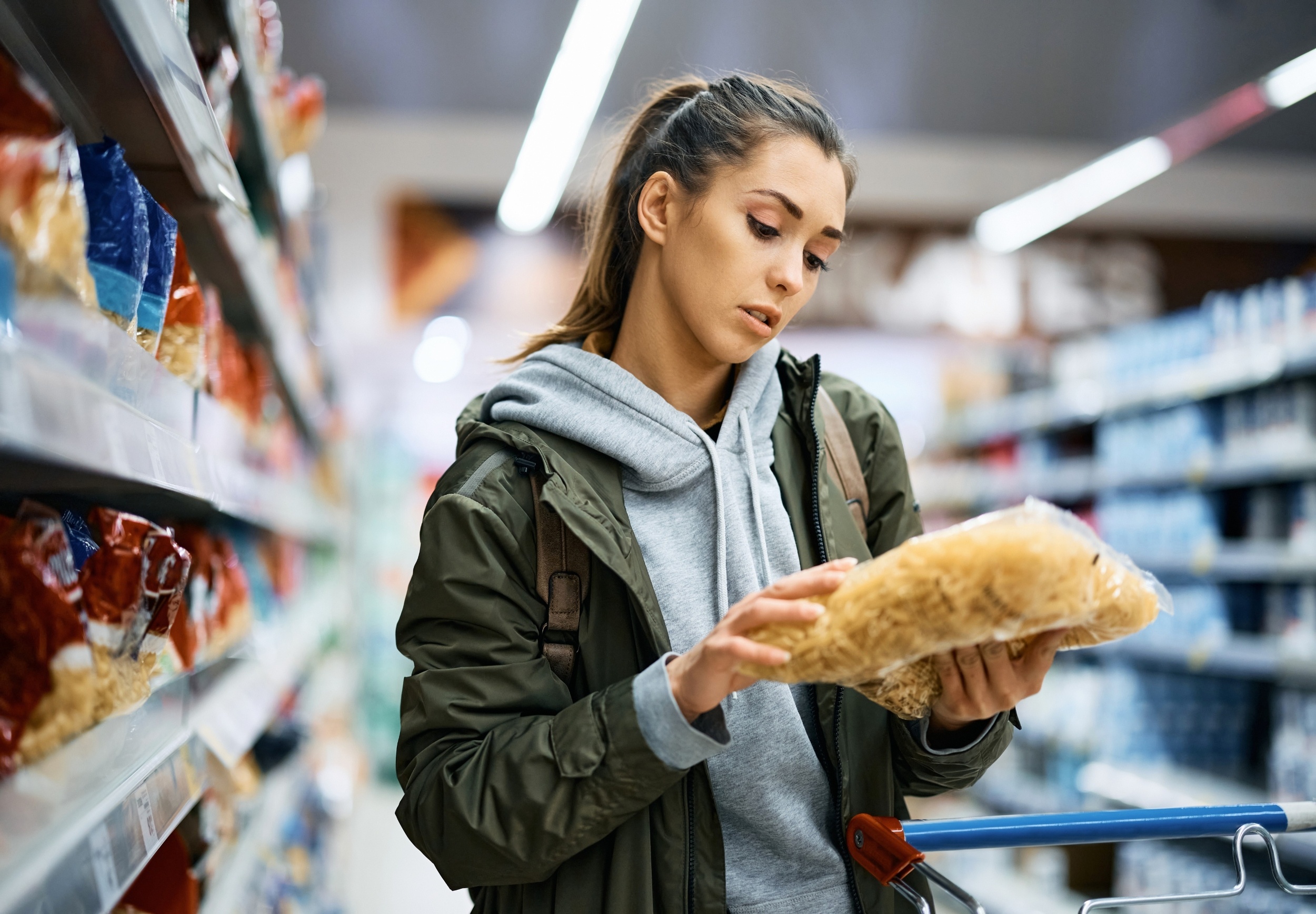
A clear “healthy” label on snack packaging may do more than catch the eye. New research suggests it can nudge shoppers toward better choices and even make them willing to pay more, especially when the label carries the backing of a government agency.
Researchers at Oregon State University and Tufts University looked at how shoppers responded to snack products with and without healthy labels.
The team paid special attention to the FDA’s updated definition of “healthy” and a proposed FDA healthy icon for food packages.
Food labels influence choices
Food labels are supposed to help people make sense of what they are buying. But in reality, shopping decisions are often made quickly.
Many people are then left trying to sort through confusing health claims, mixed messages, and packaging designed to grab attention more than inform.
In 2024, the FDA updated its definition of “healthy” for food packaging. The old definition had been in place since 1992, so the change was meant to bring the label more in line with current nutrition science and federal dietary guidance.
The agency also proposed a new “FDA healthy” icon, although that symbol is still going through the approval process. The researchers wanted to know whether those kinds of labels actually make a difference when people are choosing what to buy.
“Our main finding is that trust in government was an important part for people and that they were willing to pay more for that label,” said lead author Katherine Fuller, an assistant professor at Oregon State University.
That finding suggests shoppers are not just reacting to the word “healthy” in a vacuum. They are also reacting to who seems to be standing behind it.
A real-world shopping experiment
To explore that question, the researchers ran an experiment in 2023 with 267 shoppers at six grocery stores in the Boston area.
Participants were shown pictures of 15 real snack products on tablets while they were in the store. Nine of those products met the new FDA standard for healthy foods, while six did not.
First, shoppers looked at the products without any special healthy label. They then saw the same products again, now labeled as healthy, either with a generic tag or an FDA label.
Each participant was given $5 in cash and a $10 store gift card. They were told the $5 could go toward buying a product they selected in one of the scenarios shown.
That meant their choices had actual financial consequences, which is a much better way of testing behavior than simply asking people what they think they might do.
“Giving study participants purchasing power in a setting that mirrored a real shopping experience let us better observe how the labels might influence behavior,” said senior author Sean Cash, an economist at Tufts.
Labels changed shopper behavior
The study found that people were already somewhat more likely to choose healthier snacks over unhealthy ones. But the labels pushed that preference further.
Adding healthy icons made shoppers more likely to choose healthier products. Both the generic label and the FDA label increased healthy snack selections, but only the FDA label had a statistically significant effect.
This suggests that not all labels work the same way. A simple health cue may help, but an official-looking label backed by a trusted regulator seems to carry more weight.
The study also found that shoppers were willing to pay more for healthier foods. On average, consumers would pay 59 cents more for a healthy product with an FDA-endorsed label than for one without.
That may not sound huge at first glance, but across many purchases it becomes meaningful. And for food companies, it sends a clear message that labeling can affect both choice and value.
Trust changed everything
One of the strongest patterns in the study was the role of trust. Participants also completed a survey covering demographics, knowledge of healthy foods, levels of general trust, and trust in government.
That allowed the researchers to see whether the power of the label changed depending on how people viewed institutions.
The survey revealed that FDA label worked better when consumers said they trusted the government more.
“Our findings demonstrate that labels act as signals for consumers, and policy can shape how well those signals work,” Cash said. “When labels are viewed as credible, such as when they have the endorsement of a government agency, they are more likely to influence eating patterns and purchasing habits.”
Better guidance for shoppers
The results land at a time when many people feel overwhelmed by conflicting nutrition advice. Packaging claims can be vague, trendy, or misleading.
What counts as healthy often shifts depending on who is speaking. That may be why a clearer signal matters so much.
“Right now, there is a lot of misinformation about what is healthy and what isn’t healthy,” Fuller noted.
“Having a clear label, supported by scientific research, saying this is healthy because we checked, is important.”
Thus, clear, credible guidance can influence what people choose when they are standing in front of a shelf trying to decide. In a shopping environment full of noise, that kind of clarity may matter more than it seems.
The study is published in the journal Food Quality and Preference.
—–
Like what you read? Subscribe to our newsletter for engaging articles, exclusive content, and the latest updates.
Check us out on EarthSnap, a free app brought to you by Eric Ralls and Earth.com.
—–