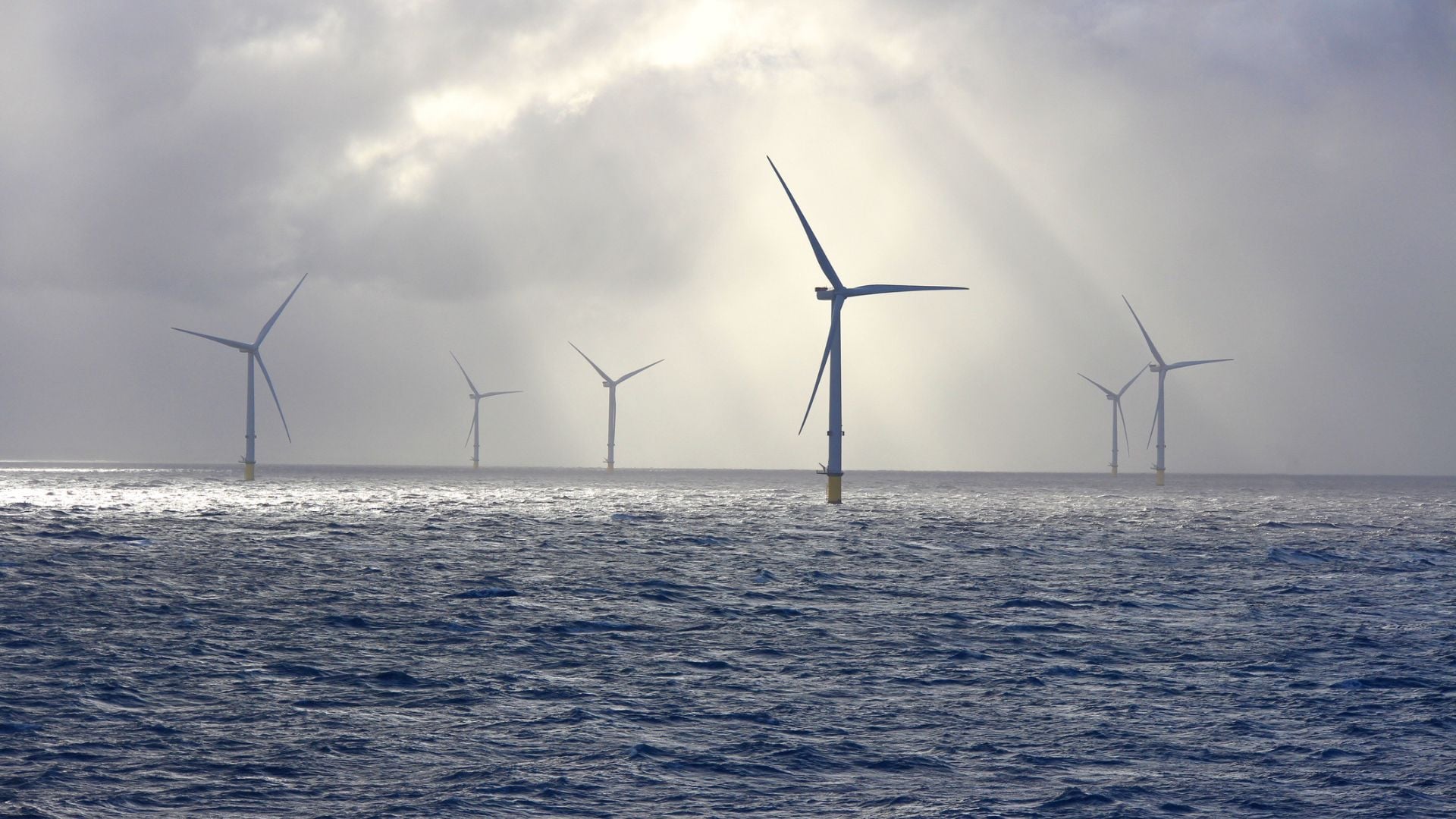
The Tokyo Metropolitan Government has announced an ambitious plan to build the world’s largest floating offshore wind farm off the Izu island chain. Aiming for completion by 2035, the project is designed to produce at least 1 gigawatt (GW) of power to supply both the islands and mainland Tokyo. Currently, the world’s largest operational floating farm is in Norway, but it produces less than 100 megawatts. Tokyo’s vision is ten times that size. If achieved, this power output is roughly equivalent to that of one nuclear reactor.
To keep the momentum going on the Izu Islands project, the Tokyo Metropolitan Government is reportedly launching field surveys to analyze the region’s seabed topography and local weather patterns. The bold plan Compared to offshore wind farms drilled into the seabed, floating wind farms use buoyant platforms that float on the water’s surface, secured by a complex system of mooring lines and anchors. This design is gentler on the marine environment during installation because it avoids the heavy seafloor excavation and pile-driving required for “bottom-fixed” structures. To bridge the gap between the ocean and the consumer, the energy captured by these floating giants is converted into electricity and transmitted via high-voltage subsea cables. These cables are laid directly along the ocean floor, forming a hidden power artery that connects remote maritime sites to both local island communities and the mainland power grid.
Governor Yuriko Koike first introduced this vision at COP29 in 2024. Since fiscal 2025, the government has been actively consulting with local residents and the fishing and shipping industries across the affected island municipalities to navigate the project’s logistical and social impacts. Reportedly, the project focuses on a quintet of island communities, spanning Oshima, Niijima, Kozushima, Miyake, and Hachijo. May stretch beyond 2035 But the path to 2035 is steep. To bolster the project’s momentum, the Tokyo government tripled its fiscal 2026 budget to 2.7 billion yen ($17 million), specifically targeting comprehensive wind studies and seabed soil analysis for cable routing. However, the path to commercialization remains rocky; while the central government prepares to open bidding for construction and operations, officials warn of mounting skepticism from the private sector.
Potential contractors are increasingly wary of the market, citing concerns over the project’s long-term profitability and the high risks associated with offshore entry. In 2025, Mitsubishi Corp. pulled out of major wind projects in northern Japan. The reasons were familiar: soaring material costs and a weaker yen. While the national government views offshore wind as a pillar of its 2050 net-zero goal, the Izu region is currently only classified as a preparation zone — the earliest stage of development. Critics suggest the 2035 target is unrealistic, noting that offshore projects typically take over a decade to complete and that this project is still in its infancy. The South China Morning Post reported that analysts note that while the capacity may match that of a nuclear reactor (1 GW), the actual output will likely be much lower (roughly 40 percent capacity for wind vs. 80-90 percent for nuclear).
Coupled with the Izu region’s naturally high wind speeds, the initiative directly supports Japan’s national mandate to achieve 45 gigawatts of offshore wind capacity by 2040, making it a strategic fit for the country’s broader energy transition. According to the expert, floating turbines represent a tiny fraction of wind power installations worldwide, with Japan still trailing behind Europe’s more advanced technological lead in the sector.