Your support helps us to tell the story Read more Support Now From reproductive rights to climate change to Big Tech, The Independent is on the ground when the story is developing. Whether it's investigating the financials of Elon Musk's pro-Trump PAC or producing our latest documentary, 'The A Word', which shines a light on the American women fighting for reproductive rights, we know how important it is to parse out the facts from the messaging. At such a critical moment in US history, we need reporters on the ground. Your donation allows us to keep sending journalists to speak to both sides of the story. The Independent is trusted by Americans across the entire political spectrum. And unlike many other quality news outlets, we choose not to lock Americans out of our reporting and analysis with paywalls. We believe quality journalism should be available to everyone, paid for by those who can afford it. Your support makes all the difference. Read more
Palestinians are using rubble from the war to repave streets destroyed during Israel's two-year assault on Gaza, crushing concrete and metal into pavement under a U.N.-run project they hope will mark a first step toward rehabilitating their damaged cities.
The project, run by the United Nations Development Programme, comes as progress stalls in U.S. President Donald Trump's Gaza plan, meant to build on an October Israel-Hamas ceasefire by surging aid and rebuilding the enclave from scratch.
It marks a bid by the U.N. and Palestinians to use locally available machinery to clear mountains of rubble that officials say is blocking access to water wells and hospitals and making it difficult to get the economy going again.
CRUSHING AND REUSING RUBBLE
Alessandro Mrakic, head of UNDP's Gaza office, said the territory faces one of the largest post-war clearance challenges in memory with an estimated 61 million tons of rubble.
"Beyond the collection (of rubble), we have started sorting, we have started crushing, and, as such, reusing it," Mrakic said. "We have used almost the same amount that we have collected."
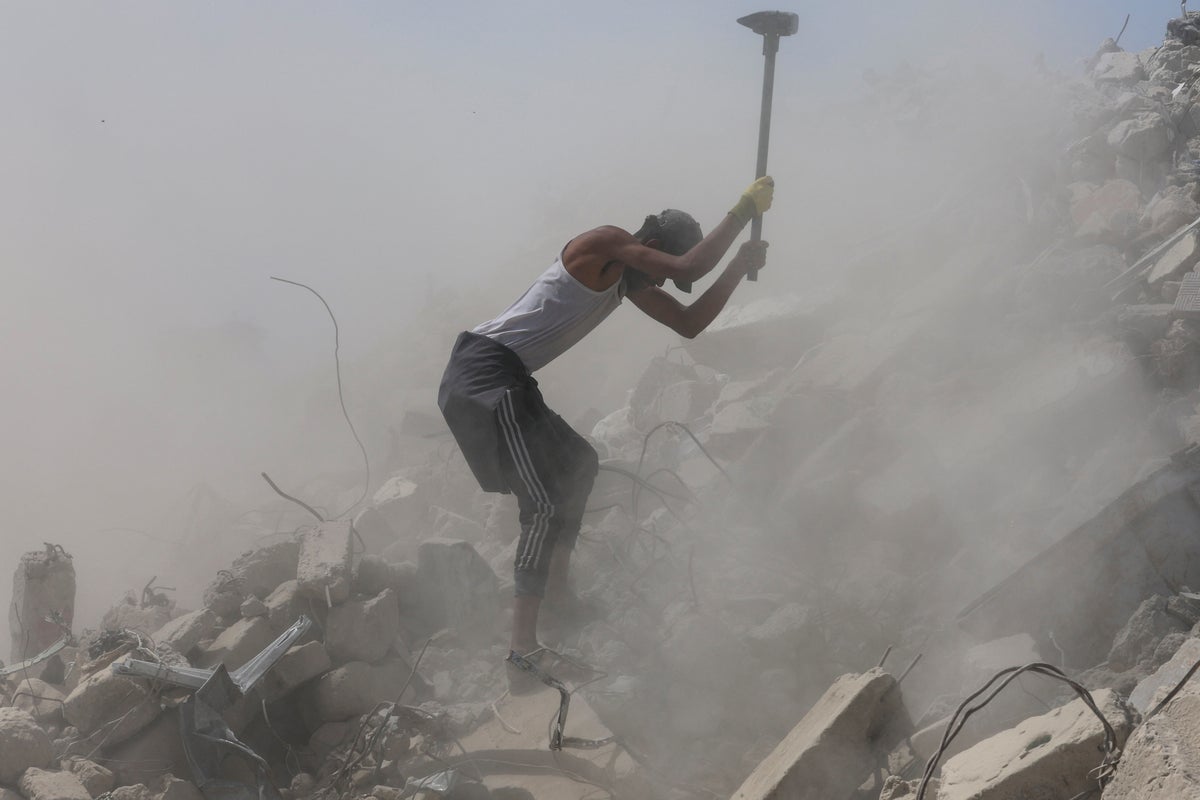
open image in gallery Mountains of rubble are blocking access to water wells and hospitals and making it difficult to get the economy going again ( REUTERS )
Mrakic said UNDP teams, staffed by Palestinian workers, were using the rubble "to rehabilitate roads and pave areas for shelter and community kitchens".
In Khan Younis in southern Gaza, Palestinians were operating heavy machinery to tear through mountains of destroyed concrete, sending plumes of dust into the air as workers picked through the twisted steel and rubble of damaged buildings.
Progress is being slowed by dangers hidden beneath the debris, officials say. Before rubble can be removed, sites must be checked for unexploded ordnance, in coordination with the U.N.'s mine service.
For Palestinian workers, the risks are tangible.
"I can't find any other source of income, that is why I do this work. (You) could get hurt," said Ibrahim al‑Sarsawi, 32.
open image in gallery Gaza rubble clearance could take seven years to complete ( REUTERS )
He said the work site's location near the Israel-Hamas armistice line meant he could be exposed to stray Israeli fire.
JUST THE 'TIP OF THE ICEBERG'
Gaza rubble clearance could take seven years to complete, UNDP says, assuming accelerated, unimpeded access for heavy machinery and consistent fuel supplies, which are generally scarce in Gaza under Israeli restrictions.
Israel cites security concerns for its restrictions in Gaza, where it launched its assault following Hamas-led attacks on Israel on October 7, 2023.
UNDP has so far removed about 287,000 tons of rubble - but that is just the "tip of the iceberg", according to Mrakic.
Recovery and reconstruction in the tiny territory will require $71.4 billion over the next decade, according to a final Gaza Rapid Damage and Needs Assessment released this month by the European Union, United Nations, and World Bank.
open image in gallery The project comes as progress stalls in Trump's Gaza plan, meant to build on an October Israel-Hamas ceasefire by surging aid and rebuilding the enclave from scratch ( REUTERS )
"The war is over, but (this) is the beginning of a new war," said Sobhi Dawoud, 60, a displaced Palestinian living in a tent encampment in Khan Younis.
This "new war", he added, is one "of reconstruction, the beginning of removing the rubble, and (fixing) infrastructure, electricity, water, sewage, schools, and streets."