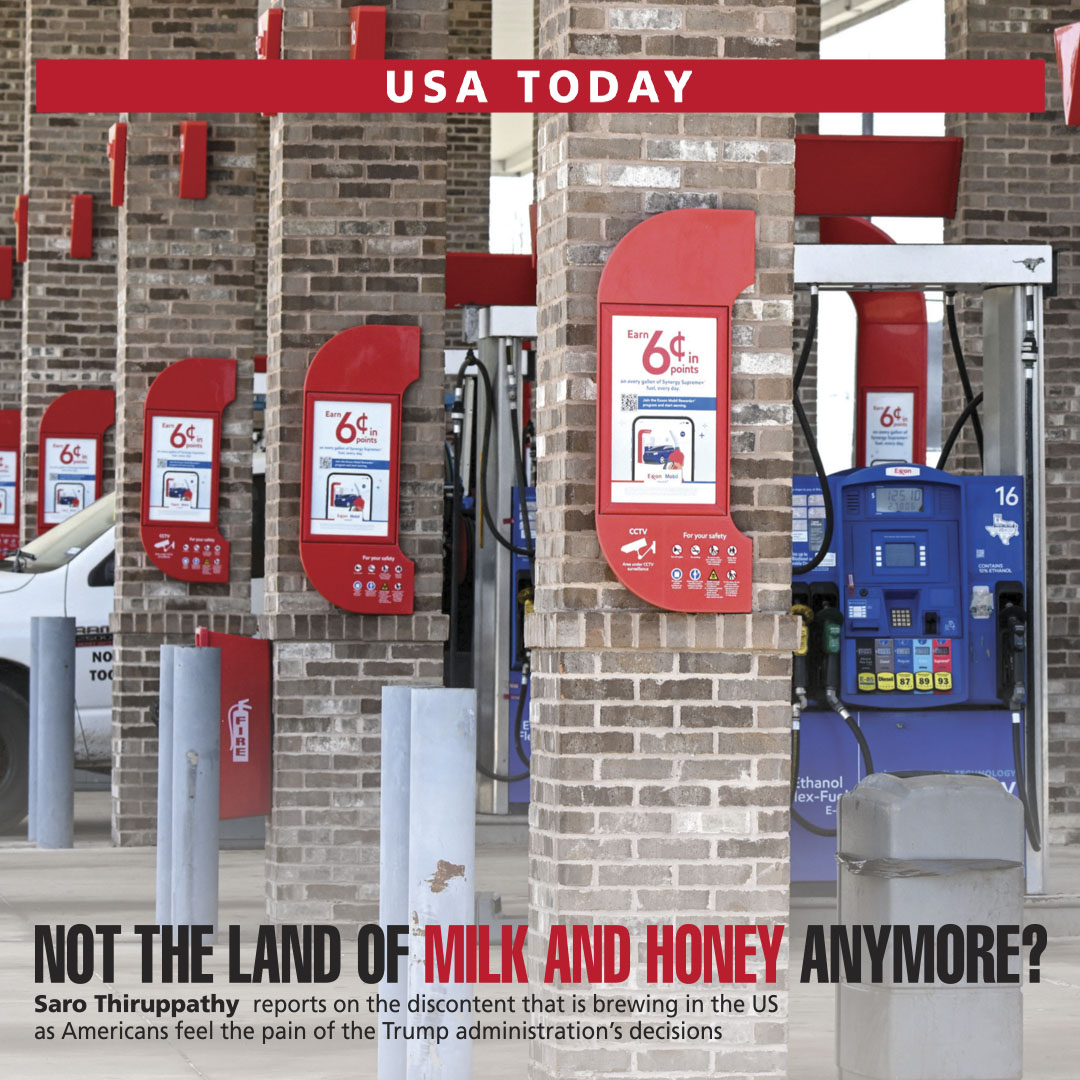
NOT THE LAND OF MILK AND HONEY ANYMORE?
Saro Thiruppathy reports on the discontent that is brewing in the US as Americans feel the pain of the Trump administration’s decisions
A nation that was founded in 1776 on the back of land grabs, the near destruction of its indigenous people, and a fake perception that’s been and continues to be perpetuated among the population – that of greatness and virtue – is facing a demonstrably hard time.
And it’s not because of a foreign invader, another Great Depression or repeats of the financial crises of 1987 and 2008.
This time around, the slow but sure destruction of America is being triggered from within by the current administration – by the impact of the tariffs that President Donald Trump imposed on friends and foes alike; and the more recent war against Iran.
Even though America boasts the largest economy in the world, valued at around US$ 31 trillion, it was also in debt to the tune of 39 trillion dollars at the end of April. Americans are also facing renewed inflationary pressures due to poor fiscal policies at home and the inexplicable wars abroad that are being instigated by Trump and his team.
The trade war launched in February last year arbitrarily raised tariffs on US imports. And the belief was that the countries that were in the firing line would come crawling to the White House and beg for relief.
Some nations did beg for a reduction while others used their ingenuity and sought more lucrative markets for their exports.
POORLY EDUCATED In 2016, Trump famously claimed that he prefers Republicans because they are poorly educated.
This perception has stood him in good stead since most of his Make America Great Again (MAGA) voters aren’t knowledgeable about macro and microeconomics, foreign affairs, geography, world history, arithmetic and so on.
So it’s been a cakewalk for him to coerce them into believing that it’s the exporters of goods to the US who are paying the tariffs.
Trump has claimed that the US Treasury is becoming richer due to the tariffs pouring in from outside when in fact, American importers and local consumers are bearing the financial burden of the additional costs.
And since much of MAGA still seemingly religiously believes anything that Trump utters, they’re convinced that they aren’t being inconvenienced in any shape or form.
In spite of the various wars that the US has waged against an array of nations since the end of World War II, the American people have been generally insulated from the negative effects of economic collapse, loss of employment, food insecurity, destroyed homes, fields and factories, and lower incomes.
This may be why many of them support the war hawks who help keep the US military machinery well-oiled and profitable.
As one would expect however, the tariffs are hurting American consumers by acting as regressive taxes – and 96 percent of the cost burden is negatively impacting importers, retailers and consumers. This Trumpian experiment has also added 0.7 percent to inflation and raised the costs that households incur by about US$ 1,000 annually.
In spite of aiming for domestic protectionism on the factory floor, the local cost of manufacturing has increased dramatically due to imported raw materials becoming more expensive. And this has resulted in approximately 100,000 jobs being lost over the past 12 months.
FOOD GROWS DEAR The price of food has also spiked and many Americans are bearing the brunt of this.
It’s reported that around 60 percent of the population are stressed about their grocery bills, and this is leading to changes in habits such as buying in bulk, exploring cheaper alternatives and using community food distribution sites.
It has also been said that last year, about 14 percent of American households claimed they lacked access to a nutritious diet.
Trump’s decision to eradicate illegal migration has impacted the farming community due to a lack of labour and this in turn has contributed to rising food prices. And Americans, who generally enjoy eating out, are now opting to prepare food at home rather than dine at fast food outlets or restaurants.
Meanwhile, many of them are also struggling with medical and welfare costs, and it has been reported that only 55 percent of the population can afford reasonable healthcare today – and nearly two-thirds of households, who earn less US$ 2,000 a month, are finding it difficult to obtain decent healthcare.
PRICE AT THE PUMP But the rapidly spiralling cost of fuel is what’s impacting Americans most adversely. Since public transport isn’t exceptional and long commutes are the norm, almost 93 percent of them own cars – and those beasts are mostly gas guzzlers.
So the financial stress at the pump is reaching incredible levels in response to the US-Israel war on Iran. The closure of the Strait of Hormuz to the United States and its allies has left Americans unhappy over the rising cost of fuel – even if the other costs of war don’t particularly bother them…