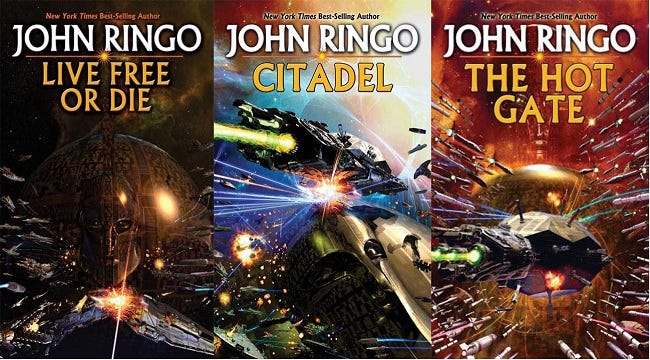
There’s this book by John Ringo called Live Free or Die, part of the Troy Rising trilogy, that has become so engraved in my mind that it’s been occupying my thoughts for years. So, I’m putting it on paper to get it out.
The plot is rather simple, a twist to the first-contact scenario, not unlike The Expanse. An alien race known as the Grtul extends their Portal Network into Earth's solar system via something like a Von Neumann Probe. From the stargate, two alien starships visit Earth. The Glatun are peaceful, but the Horvath are not so much. They, the Horvath, destroy several cities on Earth in a single attack. This attack was considered by them a warning shot, and Earth was given an ultimatum: surrender all stockpiles of precious metals, or they would continue shooting. They will return each year to take their tribute. In the meantime, the Glatun continue to trade with Earth, and through a series of fortunate events, our hero gets his hands on a beat-down, centuries-old starship, which he uses to lift large mirrors into space and collect asteroids from the belt. The books are great, with the first one being the best, as it describes the ideas of how to grow a space industry really fast and in an innovative way. A way I have never seen anywhere else.
Asteroid mining
Usually, when we talk about asteroid mining, what comes to mind is sending miners up into space Armageddon style and chopping at the rock bit by bit, but John Ringo had other ideas.
Space is cold, but heat is also an issue, as there is no easy way to cool down an object once it gets hot. There's nothing to transfer heat to. Given enough time, an object will cool down. However, if you continuously apply heat, it will become increasingly hotter until it eventually melts. Needless to say, this explanation is simplistic, but for this article, it will suffice. For more information on heat management in space, you can look up this NASA article, Thermal Management in Space.
The gist of it is that mirrors are used to heat an asteroid and melt it, then slowly spin it up. Now, let’s say we have a molten rock in space. What can we do with it? It turns out we can do a lot. If we slowly spin the rock on one axis, it will create a disk and act as a centrifugal separator, with heavier elements like uranium, gold, platinum, etc., migrating towards the edge of the disk. This process, if done long enough, can provide pure material rings, not unlike the rings of a tree, with each ring having material based on its atomic weight. By using the same mirror, but with a focusing ring, we can then peel the disk to get the material into strips. Mining, separation, and refinement are all done in one single step with minimal human involvement.
Depending on the asteroid's composition, the last step can be replaced by just cooling the disk and using it as a substrate for an even larger mirror and building up an array of mirrors. The final array in the books looks something like a Dyson swarm of mirrors around the sun, making it possible to generate massive petawatt, and more, laser arrays that are used for construction and defense.
The most insane idea is to use that array of mirrors to bore a hole in an iron asteroid, place an ice comet in it, and cap it off. Then start heating it until it melts and the water starts to boil. This will balloon the asteroid and create a hollow interior. Then just cut a cap in it and pull it out. You have just created a space station. In the book, this process was used to create an immense battle station, Troy, that had walls kilometers thick and an interior diameter that is around 7 kilometers. A quick Death Star.
How long will it take for a single 100m2 mirror to heat 100m3 Iron asteroid to the melting point if it’s placed at Earth L1, assuming a perfect dielectric mirror?
asteroid = 100m3 Iron Density = 7874.3 kg/m3 m = V * D m = 100m3 * 7874.3 kg/m3 m = 7874300 kg
ΔE = m × c × °Δθ c is the specific heat capacity in J / kg °C specific heat capacity of iron is 450 J/kg/°C θ (‘theta’) is the temperature change in degrees Celsius, °C The temperature in outer space is generally 2.73 Kelvin (-270.42 Celsius) θ = 1538 + 270 θ = 1808°C
E = 7874300kg * 450J/kg/°C * 1808°C E = 6,406,530,480,000J E = 6406.53048GJ
E(J) = P(W)× t(s) Sun power @ L1 = 1373.33 W/m2 Sun power with 100m2 mirror = 137333W t = E / P t = 6,406,530,480,000J / 137333W t = 46,649,607s t = 539.92 days
So with one 100m2 mirror, it would take 540 days, with 2 half that, and so on.
EDIT: as r/IsaacArthur/ informs me my numbers are rather optimistic. An object will lose energy via radiant heat and can not be ignored. It is not a small amount. So, it will take a little bit longer with one mirror.
EDIT: I redid the calculations with radiant heat and latent heat. The latent heat of fusion is the additional energy required to change a substance from a solid to a liquid at its melting point, without increasing its temperature further.
ΔE_melt = m × L_fL_f is the latent heat of fusion for iron, 247,000 J/kg ΔE_melt = 7,874,300 kg * 247,000 J/kg ΔE_melt = 1,944,952,100,000 J ΔE_melt = 1,944.9521 GJ E_total = ΔE_heat + ΔE_melt E_total = 6,406,530,480,000 J + 1,944,952,100,000 J E_total = 8,351,482,580,000 J E_total = 8,351.48258 GJ E(J) = P(W) × t(s) Sun power @ L1 = 1373.33 W/m² Sun power with 100 m² mirror = 137,333 W
t (without radiant loss) = E_total / P t = 8,351,482,580,000 J / 137,333 W t = 60,816,805s t = 703.9 days An object loses energy via radiation, scaling with T^4 (Stefan-Boltzmann law). Assuming an average loss reduces effective power by ~50%: P_net ≈ 137,333 W / 2 ≈ 68,666.5 W t (with radiant loss) = 8,351,482,580,000 J / 68,666.5 W t = 121,633,610 st = 1407.8 days
So with one 100 m² mirror, it would take ~704 days without radiant loss, or ~1408 days with radiant loss. With 2 mirrors, half that, and so on.
Now, it’s all science fiction, but what reading and watching science fiction has taught me is that it’s only science fiction until someone does it. Almost anything in the modern world was at one point science fiction.
It wouldn’t surprise me if it turns out that our moon was hollow just like a battle station Troy. There’s nothing like a good hypothesis to tickle a curious mind.
What If?????