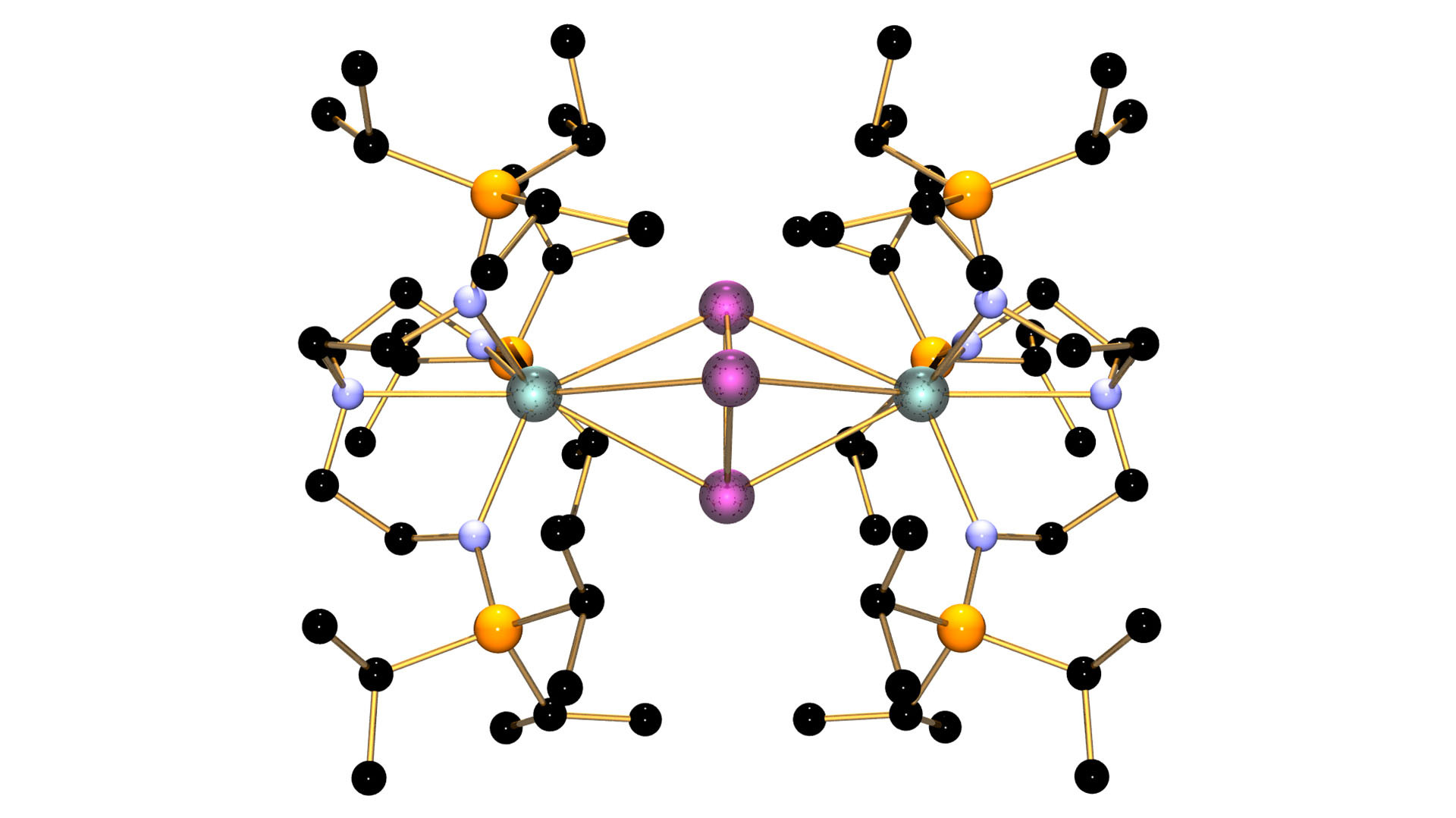
In a world first, the team, led by Professor Stephen Liddle, discovered a new type of aromatic molecule made entirely of metal atoms, the heaviest of its kind ever confirmed. The team stabilised an extremely rare three‑atom ring of bismuth, held between two large metal atoms (uranium or thorium) in a structure known as an “inverse‑sandwich” complex.
This breakthrough provides fresh insight into one of chemistry’s most familiar concepts – aromaticity – and shows it can occur not only in carbon‑based rings like benzene, but also in unusual clusters of heavy metals.
A new twist on a classic chemical idea
In everyday chemistry, aromatic molecules such as benzene are valued for their stability, which comes from electrons circulating smoothly around a ring. This “ring current” is a signature of aromaticity and is usually found in organic (carbon-based) molecules.
The new study shows that a tiny ring of three bismuth atoms (Bi₃) also supports these circulating currents, behaving as an aromatic system, despite being made entirely of heavy metals.
Even more remarkably, this behaviour is dominated by sigma (σ) electrons, rather than the more familiar π electrons that define aromaticity in organic chemistry.
What this means for chemistry
The finding bridges the gap between traditional organic chemistry and the emerging field of all-metal aromaticity, offering:
The heaviest aromatic ring ever identified, made from three bismuth atoms.
The first actinide “inverse sandwich” complexes supporting such a metal ring, using uranium and thorium to hold the Bi₃ unit in place.
Clear experimental and computational evidence that the bismuth ring has strong ring currents – a hallmark of aromaticity – even in the presence of large, magnetic metal ions.
This adds a new entry to the catalogue of aromatic molecules and helps scientists understand how aromaticity behaves in heavy elements, which is valuable for areas such as materials science, metal cluster chemistry, and actinide research.