Your support helps us to tell the story Read more Support Now From reproductive rights to climate change to Big Tech, The Independent is on the ground when the story is developing. Whether it's investigating the financials of Elon Musk's pro-Trump PAC or producing our latest documentary, 'The A Word', which shines a light on the American women fighting for reproductive rights, we know how important it is to parse out the facts from the messaging. At such a critical moment in US history, we need reporters on the ground. Your donation allows us to keep sending journalists to speak to both sides of the story. The Independent is trusted by Americans across the entire political spectrum. And unlike many other quality news outlets, we choose not to lock Americans out of our reporting and analysis with paywalls. We believe quality journalism should be available to everyone, paid for by those who can afford it. Your support makes all the difference. Read more
Ancient DNA analysis has revealed a rare instance of two siblings being buried together in an Anglo-Saxon grave.
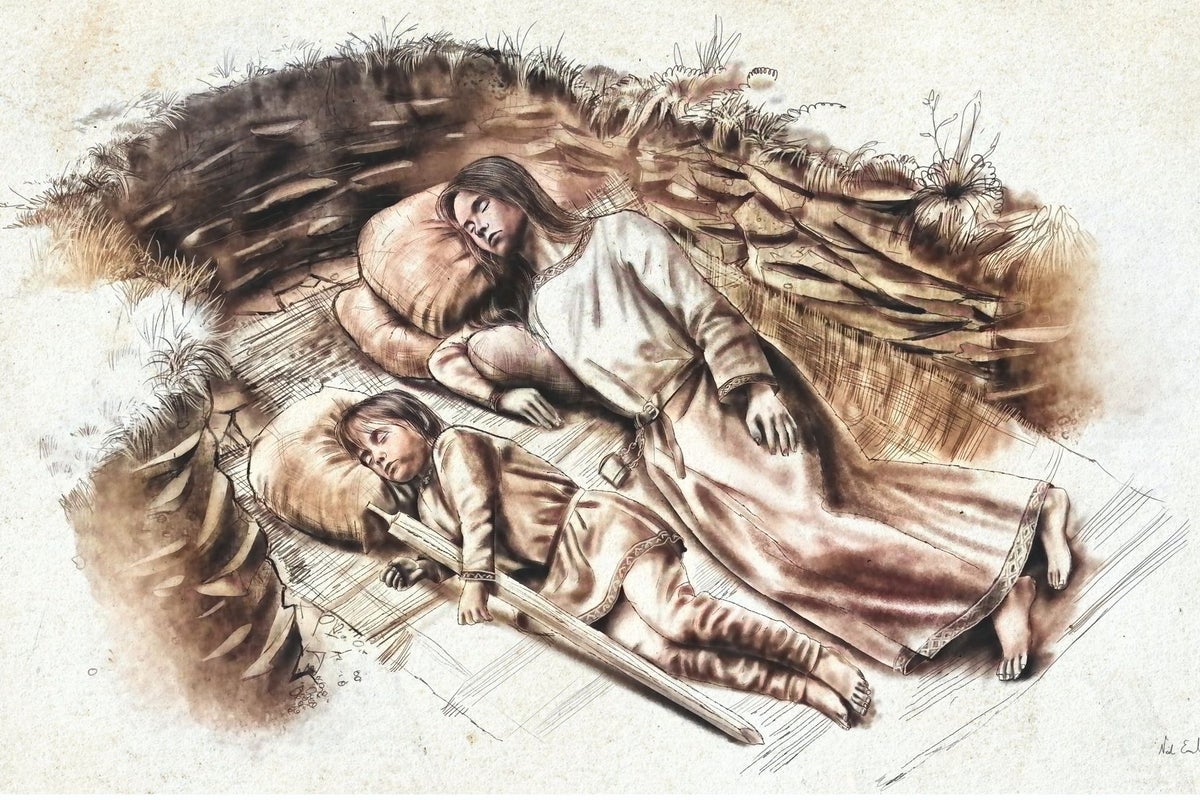
The grave in Cherington, Gloucestershire, contained a young boy buried with a sword and an older girl buried with a workbox.
Both children had been placed on their side, with the older girl facing the younger boy in a deliberate composition which implied a familial bond.
The double burial is a rare discovery in an Anglo-Saxon cemetery context, as it was a relatively uncommon practice, according to Cotswold Archaeology, which uncovered the grave. Researchers believe the joint burial suggests they died from a fast-acting infectious disease.
Matt Nichol, lead archaeologist on the site, said: “Recently realising the two children buried were actually brother and sister really brings the human side of our Anglo-Saxon past much closer – it becomes more poignant, in a way we very rarely experience.”
open image in gallery Ancient DNA analysis has revealed that two children buried together in an Anglo-Saxon grave were brother and sister ( Neil Emmanuel )
He added: “The excavation work was also undertaken during some very wet weather conditions, which makes the work even more worthwhile. It is findings like these that remind us of the importance of archaeology when unravelling our past, and what makes the profession so fascinating.”
The discovery was made during excavations in 2024 by Cotswold Archaeology and in collaboration with Operation Nightingale, a programme that supports the recovery of wounded and injured military personnel through archaeological work.
DNA testing was then carried out by the Francis Crick Institute, which proved the two children were siblings.
open image in gallery A volunteer painstakingly uncovers one of the Anglo-Saxon burials ( Cotswold Archaeology )
“I was fascinated to hear this incredible news – the results show how important scientific advances have been for archaeology,” said Richard Osgood MBE, senior archaeologist for the Ministry of Defence and founder of Operation Nightingale.
“The work has revealed an astonishing, if tragic family story.”
open image in gallery Many of the graves were furnished with lavish metal grave goods, making their safe recovery of high importance ( Cotswold Archaeology )
The children’s grave lies within an Anglo-Saxon cemetery that first came to national attention following the discovery of the nationally significant ‘princely burial’, in which a child was interred with high-status grave goods, including a sword, shield, knife, and both silver and glass vessels.
The site had already been brought to archaeological attention through earlier metal-detector finds and follow-up evaluation, which showed that important Anglo-Saxon remains survived in a vulnerable arable setting.
With some burials lying on rocky platforms and beneath extremely shallow topsoil – in one case just 14cm deep – excavation was necessary both to recover known remains and artefacts, and to reduce the risk of further deterioration or illicit removal.