Your support helps us to tell the story Read more Support Now From reproductive rights to climate change to Big Tech, The Independent is on the ground when the story is developing. Whether it's investigating the financials of Elon Musk's pro-Trump PAC or producing our latest documentary, 'The A Word', which shines a light on the American women fighting for reproductive rights, we know how important it is to parse out the facts from the messaging. At such a critical moment in US history, we need reporters on the ground. Your donation allows us to keep sending journalists to speak to both sides of the story. The Independent is trusted by Americans across the entire political spectrum. And unlike many other quality news outlets, we choose not to lock Americans out of our reporting and analysis with paywalls. We believe quality journalism should be available to everyone, paid for by those who can afford it. Your support makes all the difference. Read more
Officials battling two large wildfires that have destroyed dozens of homes in southern Georgia warned Tuesday that firefighters are bracing for a prolonged battle even after weekend rains gave a big boost to containment efforts.
“A little bit of rain is going to help us, but it’s not going to get us out of this situation,” Georgia Gov. Brian Kemp told a news conference after touring the fire areas Tuesday. “We’re going to be in this for a while.”
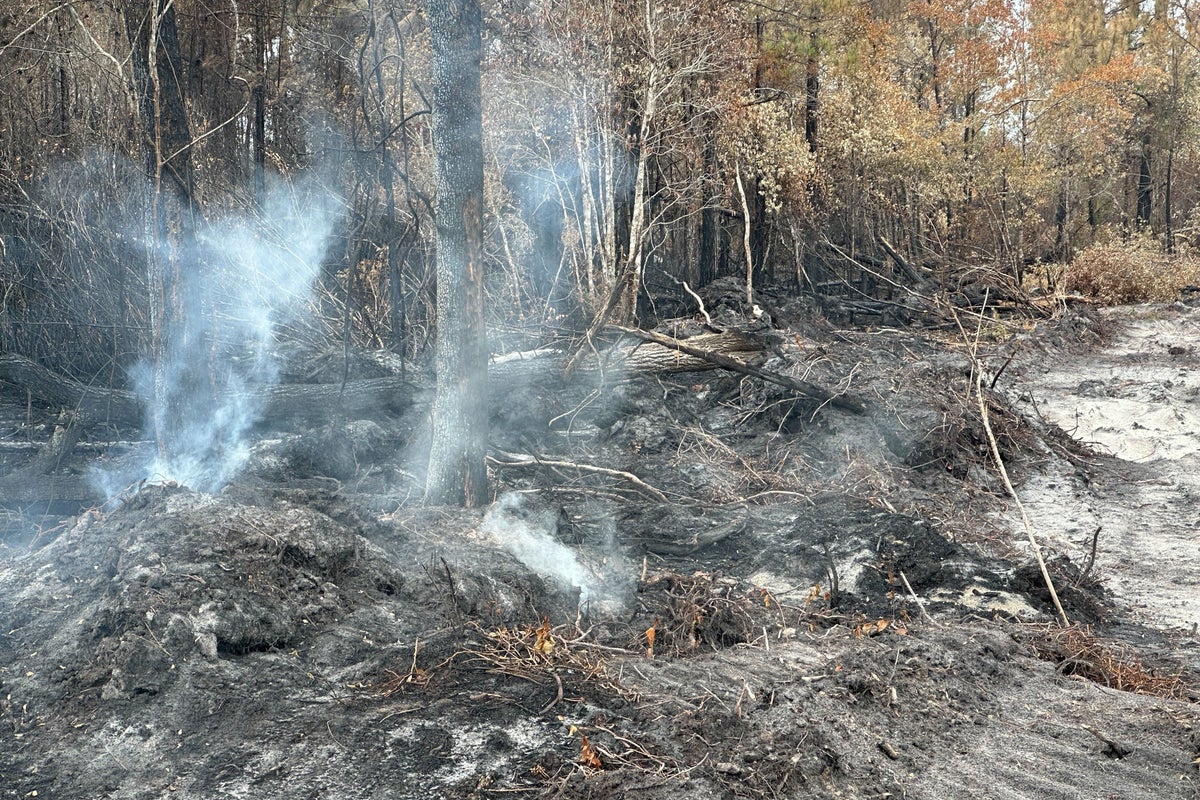
A fire that has burned roughly 35 square miles (90 square kilometers) and destroyed more than 80 homes in rural Brantley County was 32% contained, the command team overseeing the fire response said Tuesday. That's up from just 6% containment reported Monday.
Rains on Sunday slowed the fire enough to give crews an opening to widen containment lines along the perimeter and to snuff out some smoldering pockets, said Johnny Sabo, director of the Georgia Forestry Commission.
“As that number increases, our confidence at holding it in that footprint increases,” Sabo told reporters. He added: “We have a long way to go. I just want to stress that.”
A larger wildfire in sparsely populated Clinch and Echols counties has charred more than 50 square miles (130 square kilometers) at the Georgia-Florida line. Sabo said crews have held that fire to roughly the same footprint for four days. It was considered 23% contained Tuesday.
One home and several dozen sheds and other smaller structures were destroyed, said Don Thomas, a Georgia Forestry Commission spokesperson.
An unusually large number of wildfires are burning this spring across the Southeast. Scientists say the threat of fire has been amplified by a combination of extreme drought, gusty winds, climate change and dead trees and other vegetation.
No fire injuries or deaths have been reported in Georgia. A volunteer firefighter in Nassau County, Florida, died last week after suffering an unspecified medical emergency while suppressing a brush fire.
Progress made against the Brantley County blaze prompted local officials to lift evacuation orders Monday for roughly 1,500 people who had fled their homes. About 2,500 remained displaced, said Susan Heisey, a spokesperson for the fire command team.
Local officials have warned people returning home to be prepared to evacuate again if necessary.
Both Georgia fires ignited as the state's worst drought in two decades has rendered vast pine forests and swampy lowlands tinder dry and highly combustible.
Investigators concluded the Brantley County fire began April 20 when a foil balloon touched a power line, creating an electrical arc that set the ground ablaze. The fire in Clinch and Echols counties started April 18 by a falling spark as a man was welding a gate, according to state officials.
Forecasts showed a high chance of more rain over the fires this weekend. There's also a possibility of thunderstorms, which can produce lightning that causes new fires.
Officials haven't said how long the Georgia fires might burn, only that it will take significant rainfall to extinguish them.
Sabo noted that a vast fire sparked by lightning in the nearby Okefenokee Swamp in 2011 burned for just shy of a year.