Your support helps us to tell the story Read more Support Now From reproductive rights to climate change to Big Tech, The Independent is on the ground when the story is developing. Whether it's investigating the financials of Elon Musk's pro-Trump PAC or producing our latest documentary, 'The A Word', which shines a light on the American women fighting for reproductive rights, we know how important it is to parse out the facts from the messaging. At such a critical moment in US history, we need reporters on the ground. Your donation allows us to keep sending journalists to speak to both sides of the story. The Independent is trusted by Americans across the entire political spectrum. And unlike many other quality news outlets, we choose not to lock Americans out of our reporting and analysis with paywalls. We believe quality journalism should be available to everyone, paid for by those who can afford it. Your support makes all the difference. Read more
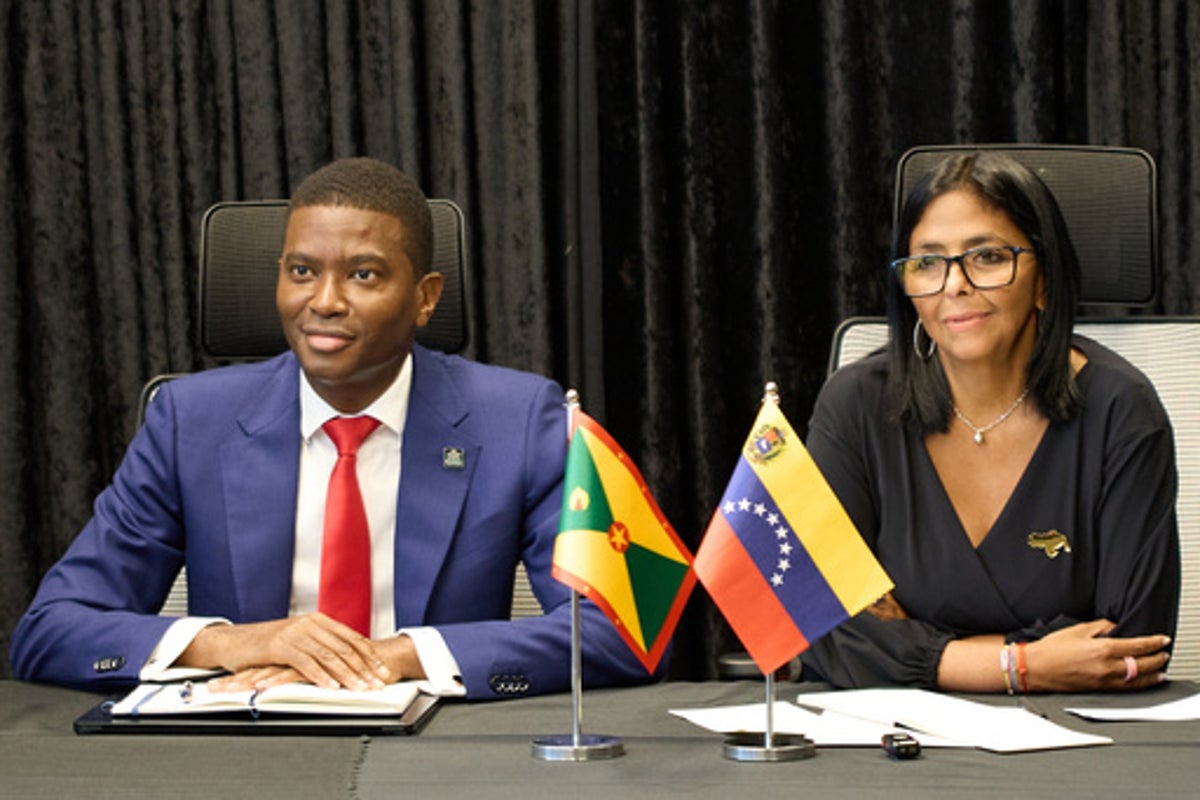
Guyana has formally complained to Caribbean leaders after Venezuela’s acting President Delcy Rodríguez was seen wearing a controversial pin during official visits. The emblem depicts a map of Guyana’s western region, which Venezuela has long claimed as its own.
The contentious pin is shaped like the Essequibo region, a resource-rich area that constitutes two-thirds of Guyana’s territory. This territory lies at the heart of a centuries-old dispute with neighbouring Venezuela, which borders Guyana to its west.
Venezuelan government officials, state television anchors, lawmakers, and members of the ruling party have increasingly adopted the pin. This trend reportedly followed the U.S. capture of Nicolás Maduro in a stunning nighttime raid on his residence in Caracas, Venezuela's capital, in early January.
In a note addressed to Terrance Drew, the prime minister of St. Kitts and Nevis and chairman of the Caribbean trade bloc Caricom, Guyanese President Irfaan Ali stated that the pin unequivocally asserts "Venezuela’s claim to Guyana’s territory."
Rodríguez wore the pin when she visited Barbados on Monday, and previously, during a visit to Grenada earlier in April, her first overseas trip since she took over after Maduro's seizure.
open image in gallery Interim President of Venezuela Delcy Rodríguez speaks during an official visit to Venezuela at Miraflores Palace on April 24, 2026 ( Getty )
In his note, Ali said he fears Rodríguez’s use of the pin on official trips could be misinterpreted as her hosts' “acquiescence or tolerance" of Venezuela's territorial claims.
“Caricom’s principled support for Guyana must be reflected not only in declarations but in the context and conduct of official engagements,” he added, referring to the bloc.
Venezuela has long argued that an 1899 international boundaries commission cheated it out of the area during British colonial rule. The land dispute is currently before the International Court of Justice in the Netherlands.
In his note, Ali also reminded the trade bloc that it has unequivocally supported Guyana’s claim to the region at key meetings and insisted Venezuela should not be allowed to display “symbols and maps” of Essequibo as it would only undermine the case before the international court.
He has also railed against the inclusion of Essequibo on official maps of Venezuela, calling it a ”calculated and provocative assertion of a claim” that Guyana has persistently rejected.
In recent years, Venezuela has sent gunboats to U.S.-run offshore oilfields licensed by Guyana, demanding that oil production there be halted, threats that the rigs have ignored.
In Caracas, government officials could not be immediately reached for comment.