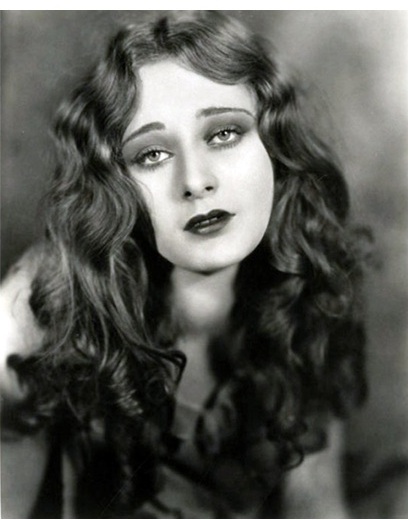
Dolores Costello in (1922–24[1]), full-length portrait, standing, right profile; wearing a short dancing costume. (Photo courtesy of Wikipedia/public domain)
Hollywood knew her as the “Goddess of the Silent Screen,” but Dolores Costello Barrymore’s truest sanctuary was far from the studio lights—in the peaceful avocado groves of Fallbrook.
Born Sept. 17, 1903, in Pittsburgh to actors Maurice and Mae Costello, Dolores became a child actress in the 1910s, appearing alongside her father. By the 1920s, she was celebrated for her beauty and screen presence, earning the WAMPAS Baby Star award in 1926.
The beautiful Dolores Costello in 1926 (Photo courtesy of The Fallbrook Historical Society)
Film fan magazines praised her ethereal quality, with Photoplay describing her as “one of the loveliest women ever to face a camera” (Photoplay, 1926) and The New York Times noting her “grace and serenity” in Old San Francisco (1927).
Dolores Costello and George O’Brien in the American film Noah’s Ark (1928) – publicity still (cropped ) (Photo courtesy of Wikipedia/public domain)
Dynamic Duo
In 1928, she married actor John Barrymore, forming one of Hollywood’s most high-profile couples.
(Photo courtesy of the Fallbrook Historical Society)
Barrymore himself was quoted in publicity reports as saying: “I just laid eyes upon the most preposterously lovely creature in all the world. She walked into the studio like a charming child, slender and shy and golden-haired. Never saw such radiance. My God! I knew that she was the one I had been waiting for. Waiting all my life, just for her.”
Dolores Costello was considered “Goddess of the Silent Screen” (Photo courtesy of the Fallbrook Historical Society)
Together, they had two children, Dolores Ethel Mae (“DeeDee”) Barrymore, born April 8, 1930, and John Drew Barrymore, born June 4, 1932.
Their marriage ended in divorce in 1935 due to Barrymore’s increasing alcoholism and desertion. She was awarded custody of their children and $163,000 in securities in the divorce settlement ([The New York Times, Oct. 10, 1935]).
On a side note, Dolores was the grandmother of actress Drew Barrymore.
Photo of John Barrymore and family in 1934. Standing: John Barrymore holding John Drew Barrymore. Seated: Dolores Costello Barrymore with Dolores Barrymore on her lap. (Photo courtesy of Wikipedia/public domain)
A New Life in Fallbrook
According to the Fallbrook Historical Society, her connection to Fallbrook began in September 1938, when she visited with her future second husband, Dr. John Vruwink. They purchased a 40-acre ranch at 1030 De Luz Road in April 1940, where they planted avocados and initially used it as a weekend retreat from Hollywood.
During World War II, the U.S. Navy requisitioned the ranch for military use, forcing the couple to relocate to Los Angeles. After the war, they reclaimed the property, and by the late 1940s, she had retired there permanently.
Although the ranch was never a significant producer of avocados, she embraced a quieter life away from the spotlight. The Fallbrook Historical Society said that she became deeply involved in community life, volunteering at St. Peter’s Church, the Fallbrook Woman’s Club, the Fallbrook Children’s Home Society, and the Friends of Fallbrook Library. She also served as an area lieutenant for the March of Dimes, judged events such as Pioneer Days, and was a longtime member of the Fallbrook Republican Women’s Club.
Newspaper clipping with Dolores Costello at her Fallbrook Ranch with her dogs. (Courtesy of The Fallbrook Historical Society)
Even as her movies continued to screen at the Fallbrook Mission Theater on Main Avenue, the former star maintained cordial relations with neighbors.
Dolores Costello sporting the hairstyle of the day in 1926. (Photo courtesy of Wikipedia/public domain)
“Dolores was a private person, but she had cordial relations with her Fallbrook neighbors,” the Historical Society said. “She was often publicly seen volunteering around town.”
The De Luz Road home remained her residence from 1940 until her death, though tragically, it was destroyed in a March 1978 flash flood, and much of her memorabilia was lost. Her grandson, John Barrymore III, confirmed the house no longer exists, though the land has since been subdivided, the Fallbrook Historical Society said.
Dolores Costello, around 1950 (News clipping courtesy of the Fallbrook Historical Society)
Death and Buried
Dolores Costello Barrymore passed away from emphysema on March 1, 1979, at Fallbrook Hospital at age 75. She was buried at Calvary Cemetery in East Los Angeles alongside her parents.
From her early days as a child actress in the 1910s, through her rise as the silent screen’s “Goddess” in the 1920s, her transition to talking films in the 1930s and 40s, and her decades in Fallbrook beginning in the 1940s, her life bridged Hollywood’s Golden Age with a quieter, community-centered existence.
The next time I visit Fallbrook, I think I will see avocados in a different light.
Dolores Costello – Filmography Appendix Theater poster for Tenderloin (1928) starring Dolores Costello. (Photo courtesy of Wikipedia/public domain)
Child & Early Roles
1914 – The Daddy of Them All (short, uncredited) – surviving: unknown
1915 – Cinderella’s Satin Slipper (short) – surviving: unknown
Silent Era / Adult Roles
1925 – Sally, Irene, and Mary (uncredited) – surviving: incomplete
1925 – Greater Than a Crown – surviving: incomplete
1926 – Mannequin – surviving: partial prints
1926 – The Sea Beast – surviving: complete
1926 – Bride of the Storm – surviving: lost
1926 – The Little Irish Girl – surviving: incomplete
1926 – The Third Degree – surviving: partial
1927 – When a Man Loves (with John Barrymore) – surviving: incomplete
1927 – Old San Francisco – surviving: complete
1927 – The Heart of Maryland – surviving: complete
1927 – The College Widow – surviving: lost
1928 – Tenderloin – surviving: lost
1928 – Glorious Betsy – surviving: complete
1928 – Noah’s Ark – surviving: complete
1929 – The Redeeming Sin – surviving: lost
1929 – Glad Rag Doll – surviving: lost
1929 – Madonna of Avenue A – surviving: lost
1929 – Hearts in Exile – surviving: partial
1929 – The Show of Shows – surviving: complete
1930 – Second Choice – surviving: lost
1931 – Expensive Women – surviving: complete
Sound Era / Later Roles
1936 – Little Lord Fauntleroy – surviving: complete
1936 – Yours for the Asking – surviving: complete
1938 – The Beloved Brat – surviving: complete
1938 – Breaking the Ice – surviving: complete
1939 – King of the Turf – surviving: complete
1939 – Whispering Enemies – surviving: unknown
1939 – Outside These Walls – surviving: complete
1942 – The Magnificent Ambersons (Orson Welles) – surviving: incomplete theatrical version
1943 – This Is the Army (cameo) – surviving: complete
Sources
Photoplay magazine profiles, 1926–1928 (Media History Digital Library / Internet Archive)
The New York Times, Oct. 10, 1935, “WIFE DIVORCES JOHN BARRYMORE; Former Dolores Costello, Charging Desertion, Gets Children and $163,000 in Securities”
Fallbrook Historical Society, Tom Frew, Historian
Fallbrook Enterprise, various issues 1949–1975
IMDb – Dolores Costello Filmography
Catholic Cemeteries & Mortuaries, Calvary Cemetery, East Los Angeles
Library of Congress / Silent Film Survival Catalog (for surviving vs. lost status)
Debbie L. Sklar is a long-time contributing editor to the Times of San Diego. For more historical stories about Hollywood’s Golden Age visit here and here.