Your support helps us to tell the story Read more Support Now From reproductive rights to climate change to Big Tech, The Independent is on the ground when the story is developing. Whether it's investigating the financials of Elon Musk's pro-Trump PAC or producing our latest documentary, 'The A Word', which shines a light on the American women fighting for reproductive rights, we know how important it is to parse out the facts from the messaging. At such a critical moment in US history, we need reporters on the ground. Your donation allows us to keep sending journalists to speak to both sides of the story. The Independent is trusted by Americans across the entire political spectrum. And unlike many other quality news outlets, we choose not to lock Americans out of our reporting and analysis with paywalls. We believe quality journalism should be available to everyone, paid for by those who can afford it. Your support makes all the difference. Read more
Ukraine is rolling out a new line of defence against the relentless barrage of Russian drones: private air defence companies tasked with protecting businesses and critical infrastructure.
Last year, Kyiv launched a pilot programme allowing industrial firms to establish their own air defence groups. So far, 20 companies have registered, with two already offering operational services, according to the Defence Ministry.
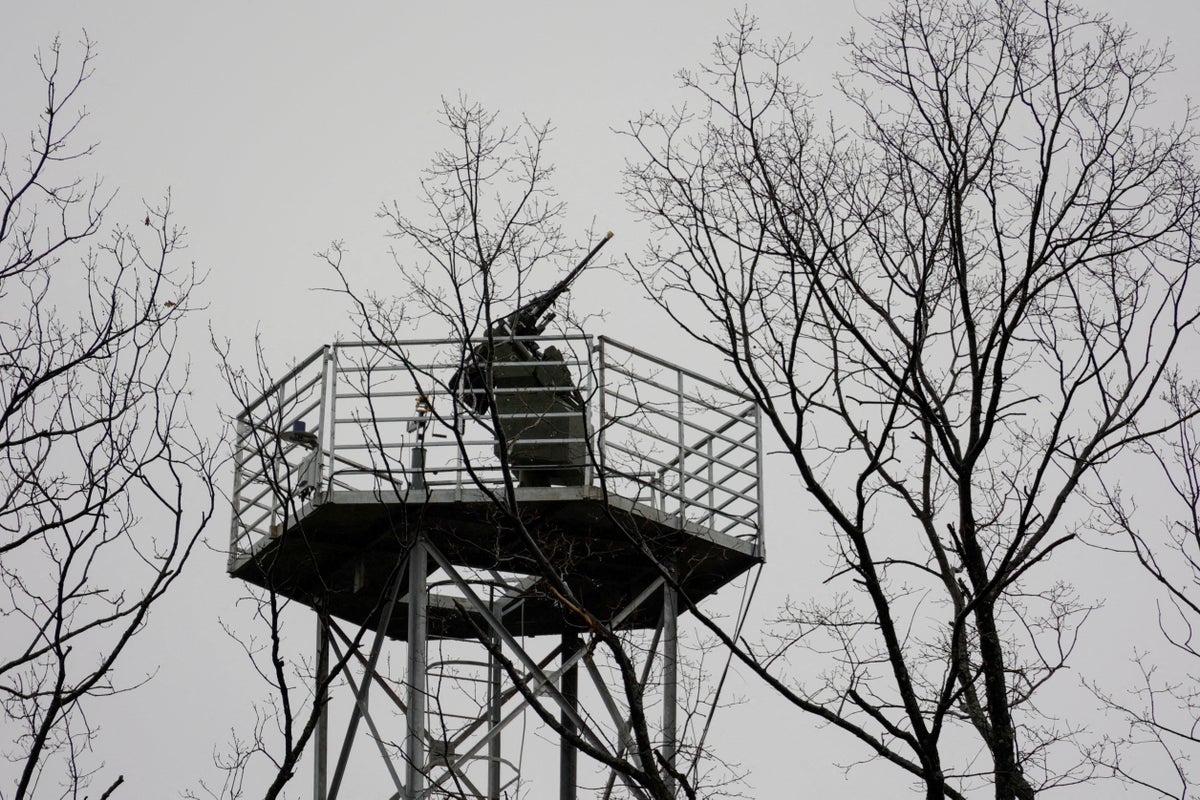
Carmine Sky, one such company, deploys several layers of protection tailored to client needs. These range from interceptor drones to automated turrets armed with M2 Browning heavy machine guns.
"It's like an onion, made of layers," said Ruslan, a company representative who provided only his first name for security reasons.
Russia launches thousands of low-cost, long-range attack drones at Ukraine every month. While most are intercepted, those that get through have wrought havoc on military infrastructure, factories, and energy facilities, depriving millions of people of heating and lighting last winter.
Ruslan spoke to Reuters in a dim control room, its walls draped with masking nets, where Carmine Sky's employees monitor for Russian drones.
open image in gallery Employees of a private security company use simulators to train to fly with an interceptor drone, amid Russia's attack on Ukraine, in an undisclosed location ( Reuters )
Operators reclined in padded chairs, their fingers resting lightly on gamepads as they search for targets.
The company operates in Ukraine's northeastern Kharkiv region as well as other regions, Ruslan said, without specifying which. He declined to identify any of the firm's clients.
"We are only complementing the traditional state air defence model," Ruslan said. "State air defence has a more strategic role, while we are local."
The firms must receive authorisation by the Ministry of Defence before starting operations and are incorporated into the Ukrainian air force's command-and-control system.
"Targets and the decision to open fire is made solely by them," said Ruslan. "We cannot do so on our own."
Defence Minister Mykhailo Fedorov touted early successes last month, saying Russian drones had been shot down in the Kharkiv region by an unnamed private firm. And on April 17, he said a private air defence unit had downed a jet-powered Shahed drone.
open image in gallery Carmine Sky deploys several layers of protection from interceptor drones to automated turrets armed with M2 Browning heavy machine guns ( Reuters )
To be hired, civilian recruits must pass a rigorous vetting process, including a polygraph test, which is then repeated every quarter, Ruslan said.
Roman Korzh from Gvardiia, another firm offering air defence services, said training a drone interceptor pilot from scratch takes around three weeks for someone with no prior experience. Those who do not qualify as pilots are absorbed into crews as spotters or technicians.
Gvardiia's main recruitment pool is existing volunteer air defence formations, which already have combat experience.
"The volunteer units are, as they say, our backbone," said Korzh, who is responsible for training.
Duty schedules are flexible, allowing recruits to organize their shifts around civilian jobs, if needed.