Your support helps us to tell the story Read more Support Now From reproductive rights to climate change to Big Tech, The Independent is on the ground when the story is developing. Whether it's investigating the financials of Elon Musk's pro-Trump PAC or producing our latest documentary, 'The A Word', which shines a light on the American women fighting for reproductive rights, we know how important it is to parse out the facts from the messaging. At such a critical moment in US history, we need reporters on the ground. Your donation allows us to keep sending journalists to speak to both sides of the story. The Independent is trusted by Americans across the entire political spectrum. And unlike many other quality news outlets, we choose not to lock Americans out of our reporting and analysis with paywalls. We believe quality journalism should be available to everyone, paid for by those who can afford it. Your support makes all the difference. Read more
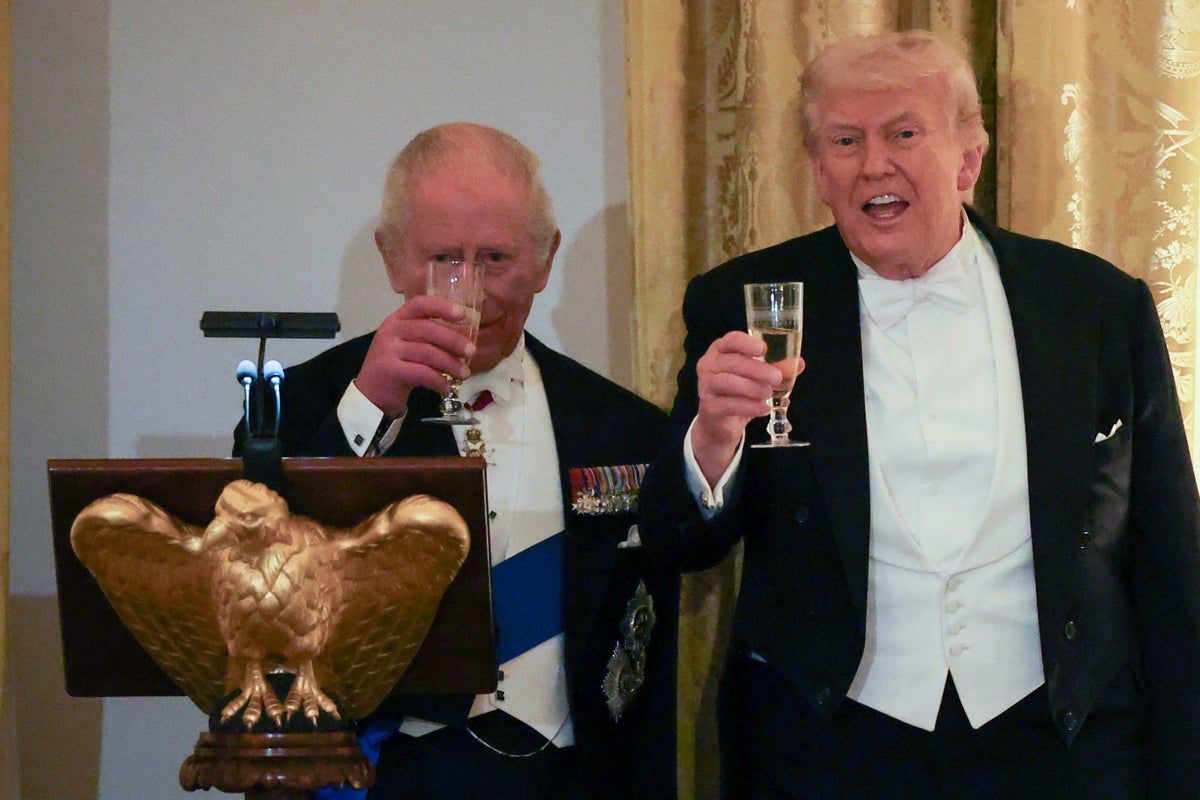
King Charles drew laughs during a jovial state dinner in the East Room of the White House alongside the Queen, President Donald Trump and first lady Melania Trump.
The king called Trump’s second term “historic” and said he enjoyed being “back in this wonderful building, the heart of your democracy.”
The royal then turned to Trump’s controversial ballroom project, quipping that he noticed the president’s “readjustments to the East Wing.” He then reminded the audience that the British attempted a “real estate redevelopment of the White House in 1814,” referencing the burning of much of the capital by the British military.
In August of 1814, however, British troops captured Washington with little to no resistance before setting the Capitol ablaze.
open image in gallery King Charles drew laughs during a jovial state dinner in the East Room of the White House alongside the Queen, President Donald Trump and first lady Melania Trump ( Reuters )
Furniture and Library of Congress books were used as fuel, and the building was severely damaged, according to the Architect of the Capitol.
The Executive Mansion – the previous name given to the White House – was also gutted by flames and so was the city’s naval yard.
Britain said the arson came in retaliation for the burning of York (now Toronto) by the Americans the previous year.
Both events occurred during the so-called War of 1812, which began when American soldiers invaded Canada, which was then controlled by the British.
Declaring war while Napoleon was marching on Moscow, the U.S. had incorrectly assumed that France would defeat Britain in the Napoleonic Wars.
Following the French leader’s defeat and abdication in 1814, the British shifted more of their resources to the US, sending a party of 4,000 soldiers across the Atlantic to make life difficult for the Americans.
Andrew Lambert, a professor of naval history at King’s College London, told The Independent in 2021 that the incident showed divisions in American society.
While the war effort received support from the newly elected Congress in 1812, the northern and eastern parts of the country opposed it. “The war exposes – and this I think is very relevant – fundamental divergences between different sections of American society,” Mr Lambert says, explaining that it paved the way for the Civil War.
He adds that after the US lost the War of 1812 “quite badly”, American leaders embarked on a propaganda campaign, filled with “nationalist nonsense” such as the description of the hostilities as a second War of Independence.
“Does that sound familiar?” Lambert said at the time in reference to Trump’s refusal to accept his defeat in the 2020 presidential election.
open image in gallery A protester waves a Trump flag inside the US Capitol building in front of a 19th century painting on 6 January, 2021. ( Getty Images )
The 1814 incident became widely talked about in 2021 in the wake of the January 6 Capitol riot.
In fact, these two efforts to repaint history were pictured side by side that fateful day, when a rioter was photographed waving a Trump flag in front of an enormous 19th-century artwork inside the Capitol building.
The William Henry Powell painting depicts the U.S. victory at the Battle of Lake Erie in September 1813, one of a few naval successes that featured prominently in American accounts of the conflict.
Returning to the violence in Washington on Wednesday, Lambert adds one more historical message: that the rioters’ actions constituted a “visceral reaction from a group who feel that the tide of history is against them.”