Your support helps us to tell the story Read more Support Now From reproductive rights to climate change to Big Tech, The Independent is on the ground when the story is developing. Whether it's investigating the financials of Elon Musk's pro-Trump PAC or producing our latest documentary, 'The A Word', which shines a light on the American women fighting for reproductive rights, we know how important it is to parse out the facts from the messaging. At such a critical moment in US history, we need reporters on the ground. Your donation allows us to keep sending journalists to speak to both sides of the story. The Independent is trusted by Americans across the entire political spectrum. And unlike many other quality news outlets, we choose not to lock Americans out of our reporting and analysis with paywalls. We believe quality journalism should be available to everyone, paid for by those who can afford it. Your support makes all the difference. Read more
Cases of a deadly fungal infection known as Valley Fever have been rising across the West over the past decade, leading to thousands of cases and hundreds of deaths. Now, researchers have revealed the scope of the impact in a major Texas city and identified the cause of infections.
Valley Fever cases in El Paso – the site of frequent migrant crossings – have more than tripled between 2013-2022, rising from under 10 to dozens, the new research shows, due to the region’s frequent and blinding dust storms.
The strong winds that supercharge the storms whip up spores of the soil-dwelling fungus known as Coccidioides, and exposure leaves residents vulnerable to serious cases of meningitis and long-term lung infections.
Human-caused climate change is largely to blame, making the conditions that fuel extreme weather events including storms and drought more likely with each year of increased warming from greenhouse gas emissions. But that trend shows no signs of slowing without major action to limit emissions, so the new findings could – at the very least – help better inform the city’s response.
“Understanding the connection between climate and disease is no longer optional,” Thomas Gill, a professor at the University of Texas at El Paso, said in a statement. “It’s essential for building resilient communities in regions like ours.”
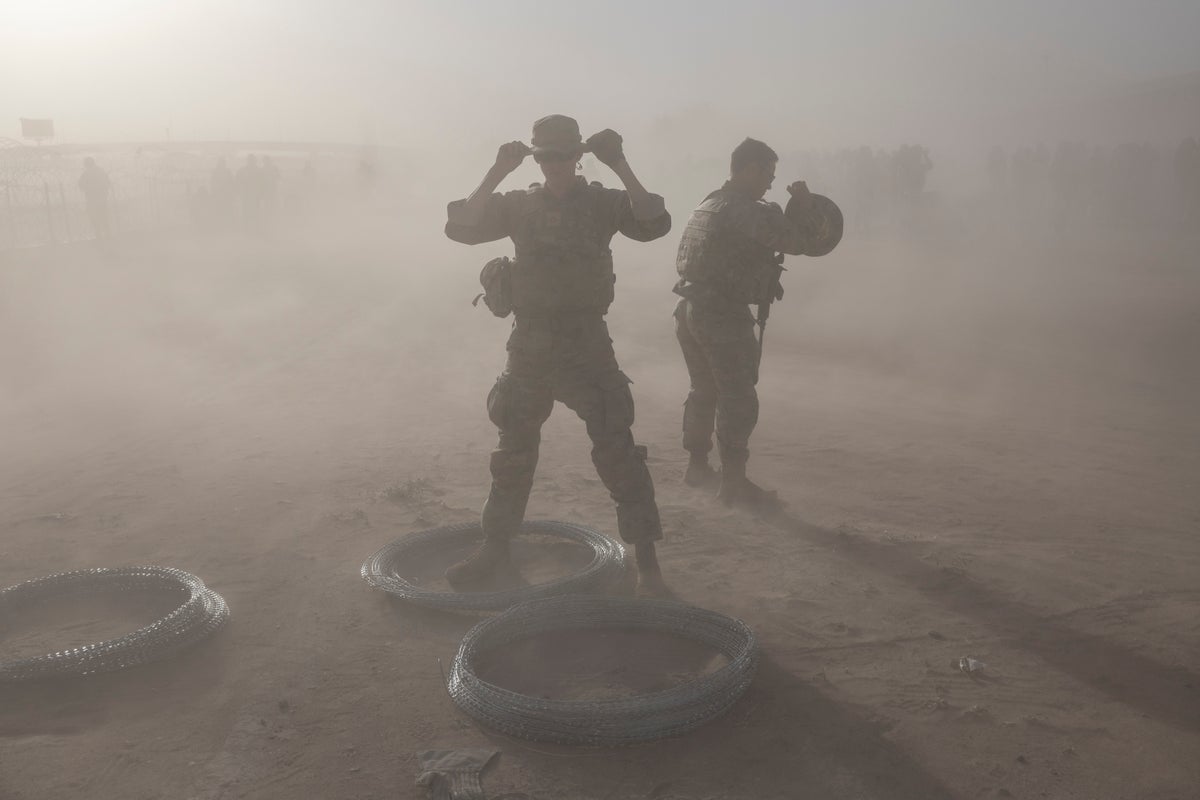
open image in gallery Texas National Guard soldiers uncoil razor wire during a dust storm in El Paso at the U.S. Mexico border fence in May 2023. The border city is frequently hit by dust storms that researchers say are fueling higher rates of Valley Fever ( Getty )
Predictive factors
The highest number of cases were found to occur in the summer months, between July and August, when there were more triple-digit temperature days.
Temperatures that exceeded 102 degrees Fahrenheit in the previous month before the dust storm and peak winds gusting above 64 miles per hour several months earlier were both factors that fueled higher amounts of disease, the researchers found.
So was unusually high concentrations of dust particles in the air – particularly those that are 10 micrometers in diameter or smaller.
These are factors the researchers say health officials across the West can take into account for future planning and communications to residents in affected areas.
In El Paso, Sunday is expected to be one of the windiest days the area has seen this spring, and local meteorologists have warned that blowing dust could reduce visibility. That could be a day with a heightened exposure risk.
open image in gallery An immigrant mother and child from Venezuela walk through a dust storm while waiting to be processed for asylum claims in El Paso, Texas, in May 2023. Dust storms can cause reduced visibility ( Getty )
“Our work shows that Valley Fever risk can be anticipated based on environmental signals,” Gabriel Ibarra-Mejia, an associate professor of public health sciences at the university, said. “By recognizing the conditions that precede increases in cases, health officials and clinicians can be better prepared to detect, diagnose and respond to this disease.”
The science behind the storms
Storms form more often in warmer atmospheres, scientists say.
Warmer air near the Earth’s surface helps to create the upward motion that helps storms form and grow, known as convection.
And warmer temperatures also have an impact on the level of dust in an area.
Warm air and drought can dry out soil and kill vegetation.
open image in gallery El Paso is located in the Chihuahuan Desert, which includes White Sands National Park ( Getty/iStock )
That dust is picked up due to strong winds from thunderstorms, sometimes creating a wall of dust that can be miles long and several thousand feet high, according to the National Oceanic and Atmospheric Administration.
The geography of an area is also a factor, and dust storms are common in flatter areas, allowing wind to build up momentum. El Paso, for example, is located in the Chihuahuan Desert, which features flat and dry valleys and White Sands National Park.
The stronger the storm, the more dust may be picked up.
“Extreme wind and dust events may disturb soils in ways that release larger amounts of the fungus into the air,” said Gills.