Compiled by Prashanthi Cooray
THE POWER OF NARRATIVE
Mariam Omar examines how leadership and culture drive transformation
This is because stories activate parts of the brain linked to empathy and memory, helping people understand not only what’s happening but why it matters.
In Sri Lanka, the apparel industry has had an interesting journey. Despite contributing meaningfully to the country’s economy for decades, women working in it were once reduced to stereotypes – the so-called ‘Juki girl.’
Over time, we have worked hard to challenge that narrative by improving how we operate, investing in employee wellbeing and ensuring their work uplifts the communities they come from.
But changing reality doesn’t change perceptions overnight. And that’s where storytelling matters.
For instance, our sewing machine operators are now known as our Formula 1 drivers. Everyone else in the organisation – from the CEO to teams in sales, product development, supply chain and engineering – has one job: to support her to win the race. If she wins, we win.
When the story is told this way, the person who creates value is placed firmly at the centre. And over time, this changes how people see the industry and its employees.
Q: What role does empathy play in leadership within high pressure industries such as apparel manufacturing?
A: In my view, empathy is simply having a sense of what’s real for someone else. In any industry, it is not merely a soft skill that’s nice to have but a practical necessity.
Some of the best leaders I know assume people are doing the best they can with what they have. To do that, you need empathy: it allows you to see things from their perspective and understand what someone is good at, where they may need support and how best to help them succeed.
When leaders understand what’s real for an employee on the floor – whether it’s how a shift is structured, how a process flows or how a workstation is designed – it often leads to better working conditions, safer environments and more sustainable performance over time.
The same applies externally.
When a business is designed with empathy in mind – i.e. considering how customers and consumers will respond at every touchpoint and how employees will engage with the processes required to deliver on that promise – outcomes tend to be better.
In my experience, decisions made with empathy tend to age better for both our people and customers.
Q: What are the most effective ways for organisations to create work environments where people truly feel valued and respected?
A: In my experience, people feel valued when leadership is consistent about a few simple things – for example, being vulnerable when needed, building trust deliberately by living stated values and learning from mistakes rather than hiding them.
Equally important is how people are brought together – when leaders create environments where trust is built intentionally and time together has meaning, respect tends to follow. Culture is not defined by grand statements alone but how everyday interactions are handled in line with stated values.
Q: In industries with high employee turnover, what strategies can help companies build long-term engagement and empowerment?
A: A clearly defined employee value proposition (EVP), anchored in growth and development, connection and care, and meaning and purpose, helps create that connection.
When these pillars are reinforced through visible behaviours and supported by practical initiatives – such as career pathways, job rotation and wellbeing programmes – they become embedded in the organisation rather than remaining aspirational.
We’ve found that when an EVP is grounded in genuinely meaningful pillars, employees are more likely to stay because they have something purposeful to rally around – whether that’s contributing to their community or being part of a broader mission.
Engagement deepens most when purpose is woven into everyday work, not positioned as an add-on through standalone activities.
Q: How can corporate communications help shape industry wide transformation, beyond promoting a single brand?
A: People are more likely to act when they understand why something matters – not only to the business but to themselves and the broader system they operate within.
Communications can support this by telling stories that connect everyday actions on the ground to long-term strategy and impact – whether that’s integrating digital tools, changing the way we work or evolving operating models to cater to new business realities.
When stakeholders are aligned around a shared narrative of why a transformation is needed, it becomes easier to move in the same direction. Transformation is rarely the result of a single voice; it typically emerges from many voices across the ecosystem telling the same story consistently over time.
In that sense, good communication plays a critical role in coordinating change and driving meaningful transformation.
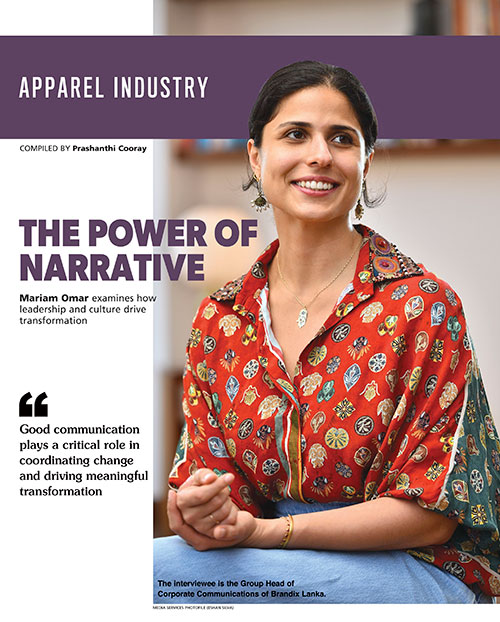
The interviewee is the Group Head of Corporate Communications of Brandix Lanka.