Your support helps us to tell the story Read more Support Now From reproductive rights to climate change to Big Tech, The Independent is on the ground when the story is developing. Whether it's investigating the financials of Elon Musk's pro-Trump PAC or producing our latest documentary, 'The A Word', which shines a light on the American women fighting for reproductive rights, we know how important it is to parse out the facts from the messaging. At such a critical moment in US history, we need reporters on the ground. Your donation allows us to keep sending journalists to speak to both sides of the story. The Independent is trusted by Americans across the entire political spectrum. And unlike many other quality news outlets, we choose not to lock Americans out of our reporting and analysis with paywalls. We believe quality journalism should be available to everyone, paid for by those who can afford it. Your support makes all the difference. Read more
New York City mayor Zohran Mamdani said on Wednesday that would encourage King Charles to return the 105.6-carat Koh-i-Noor diamond to India.
Mr Mamdani made the remark during King Charles and Queen Camilla’s state visit to the US, with the third day spent in New York.
The mayor told reporters ahead of a meeting with Charles that: “If I were to speak to the King separately from that, I would probably encourage him to return the Koh-i-Noor Diamond.”
Mamdani, who is Indian American, was speaking before a ceremony that commemorated victims of the deadly September 11 2001 attacks. While Mamdani later met King Charles at the commemorative event, it remains unclear whether the issue was raised directly in their conversation.
Buckingham Palace declined to comment, and Mamdani’s office did not confirm any discussion on the matter.
Mr Mamdani’s remarks have once again revived the long-running debate over the Koh-i-Noor diamond, which India has repeatedly called for Britain to give back.
The Koh-i-Noor diamond has held a prominent place in Britain’s crown jewels since 1911, when it was set in a cross at the front of Queen Mary’s crown. It was later replaced by a replica in 1937 when the huge diamond was moved to the Queen Mother’s crown for her and King George VI’s coronation.
Queen Camilla then avoided controversy over the Koh-i-Noor by choosing to use Queen Mary’s crown, modified so that the replica was removed. In doing so she became the first consort since the 18th century to reuse a crown at a coronation.
The Queen Mother’s crown, which also features a purple velvet cap and ermine trim, was made in 1937 for Queen Elizabeth, consort of King George VI, to be worn on her husband’s coronation on 12 May 1937.
open image in gallery Queen Elizabeth (2nd-L, future Queen Mother), her daughter Princess Elizabeth (4th-L, future Queen Elizabeth II), Queen Mary (C) , Princess Margaret (5th-L) and the King George VI (R), pose at the balcony of the Buckingham Palace on May 12, 1937 ( CENTRAL PRESS/AFP via Getty Imag )
It is laden with 2,800 diamonds set into its platinum frame. The band comprises of alternating clusters of diamonds forming crosses and rectangles, bordered by single rows of brilliant-cut diamonds.
The crown also features large diamonds, including one given to Queen Victoria in 1856 by the Sultan of Turkey.
But the most controversial diamond is the Koh-i-Noor diamond, which is set into the front cross of the crown in a detachable platinum mount.
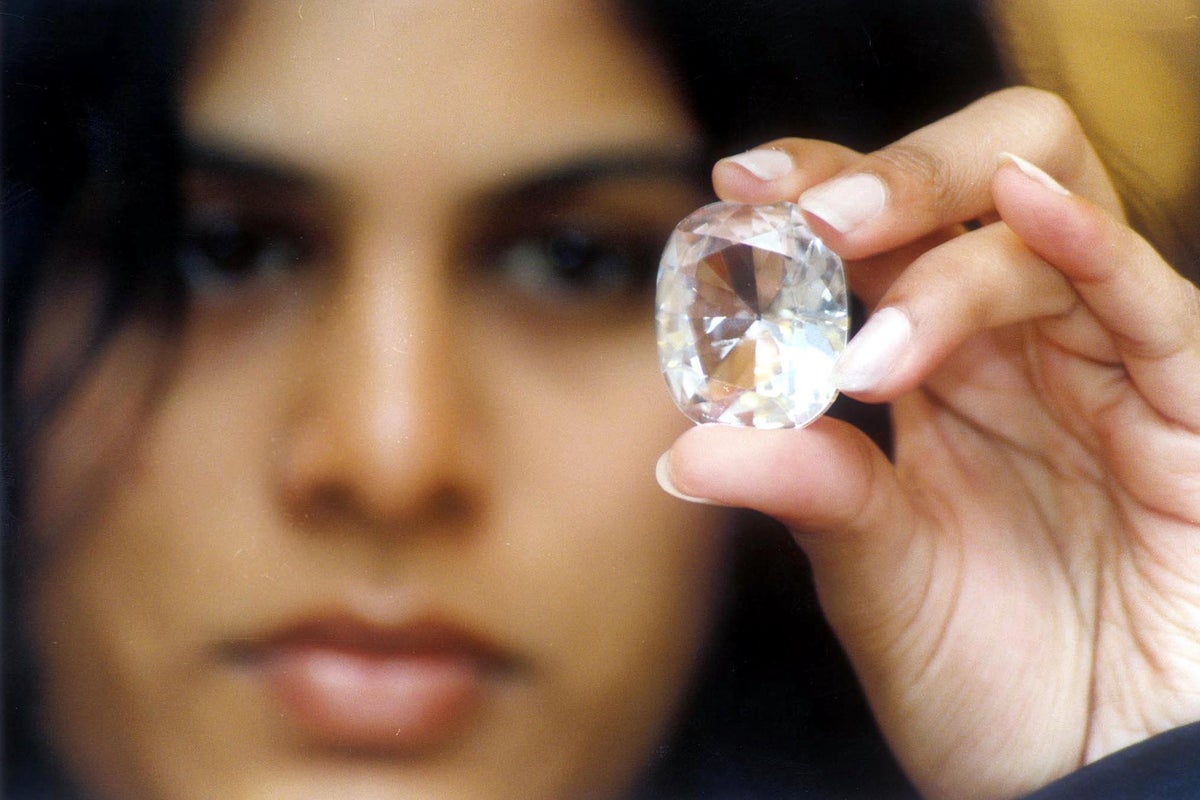
The Koh-i-Noor diamond was mined in India and is one of the largest-cut diamonds in the world, weighing 105.6 carats (21.12g). It is part of the British Crown Jewels.
The first written record of the Koh-i-Noor diamond appears in 1628, during the Mughal Empire. The diamond was set into Mughal ruler Shah Jahan’s Peacock Throne, alongside the Timur Ruby.
open image in gallery Circa 1625, Shah Jahan (1592 - 1666), Mogul emperor ( Getty Images )
It was later acquired by Persian ruler Nader Shah when he invaded Delhi in 1739 and looted the city of tonnes of treasure, including the Peacock Throne.
The Koh-i-Noor diamond continued to be passed between various rulers in Central Asia, eventually ending up in the hands of Sikh ruler Ranjit Singh in 1813, according to historians Anita Anand and William Dalrymple’s book, Koh-i-Noor: The History of the World’s Most Infamous Diamond.
Singh returned the diamond to India and died in 1839. By this time, the British East India Company had expanded its control throughout the Indian subcontinent and had its eyes set on the Koh-i-Noor diamond, as possession of it would be a symbol of “power and colonial superiority”.
However, it was not until 1849 that the British were able to get their hands on the coveted stone. During this time, they had imprisoned Rani Jindan, the youngest wife of Singh and mother of the last Maharaja, her 10-year-old son Duleep Singh.
Following years of violence, she and her son found themselves to be the only people left in line for the Punjabi throne.
open image in gallery File: Executive Director of Jewels de Paragon (JDP) Pavana Kishore shows a replica of the "Koh-I-Noor" diamond on display at an exhibition intitled "100 World Famous Diamonds" in Bangalore 19 May 2002 ( AFP via Getty Images )
According to Anand and Dalrymple, the British forced Duleep to sign a legal document that amended the Treaty of Lahore. Signing it meant Duleep would give up ownership of the Koh-i-Noor to the British and all claim to sovereignty.
This is how the diamond came into possession of Queen Victoria. It went on display at the 1851 Great Exposition in London, although people were unimpressed at it simplicity.
In response, Victoria’s husband, Prince Albert, had the Koh-i-Noor recut and polished. In the process, it became much smaller – reduced by half – but shone more brilliantly.
The stone was worn as a brooch by Victoria, but was later set in the crown of Queen Alexandra, the wife of Edward VII, and then in the crown of Queen Mary, the wife of George V. It was then reset into the crown of the Queen Mother.
The Queen Mother’s crown was placed on top of her coffin for her lying-in-state and funeral in 2002. Since then, it has resided on public display in the Crown Jewels exhibit in the Tower of London.
The Koh-i-noor diamond is believed to be worth between US$140 million to US$400 million, but its true value is unknown and it has been said it is priceless.
The Indian government has demanded that the British return the Koh-i-Noor diamond to them several times over the years after the country gained independence in 1947.
Its most recent request was made in 2016, when it said it would make every effort to bring back the diamond.
open image in gallery Pall Bearers carry the coffin of Queen Elizabeth, the Queen Mother from the gun carriage on which it travelled from Westminster Hall to Westminster Abbey in London for the funeral service ( AFP via Getty Images )
The royal palaces website makes no mention of disputes around ownership of the diamond, saying only that the diamond is “steeped in myth and anecdote”.
A description of the Koh-i-Noor reads: “Discovered in 15th-century India, it was passed from ill-fated male hand to hand, until it earned a reputation of bringing bad luck to men. It was presented to Queen Victoria in 1849.”
Anand told the Smithsonian Magazine in 2017 that the Crown Jewels exhibit should make its history clearer.
“What I would dearly love is for there to be a really clear sign by the exhibit. People are taught this was a gift from India to Britain. I would like the correct history to be put by the diamond,” she said.