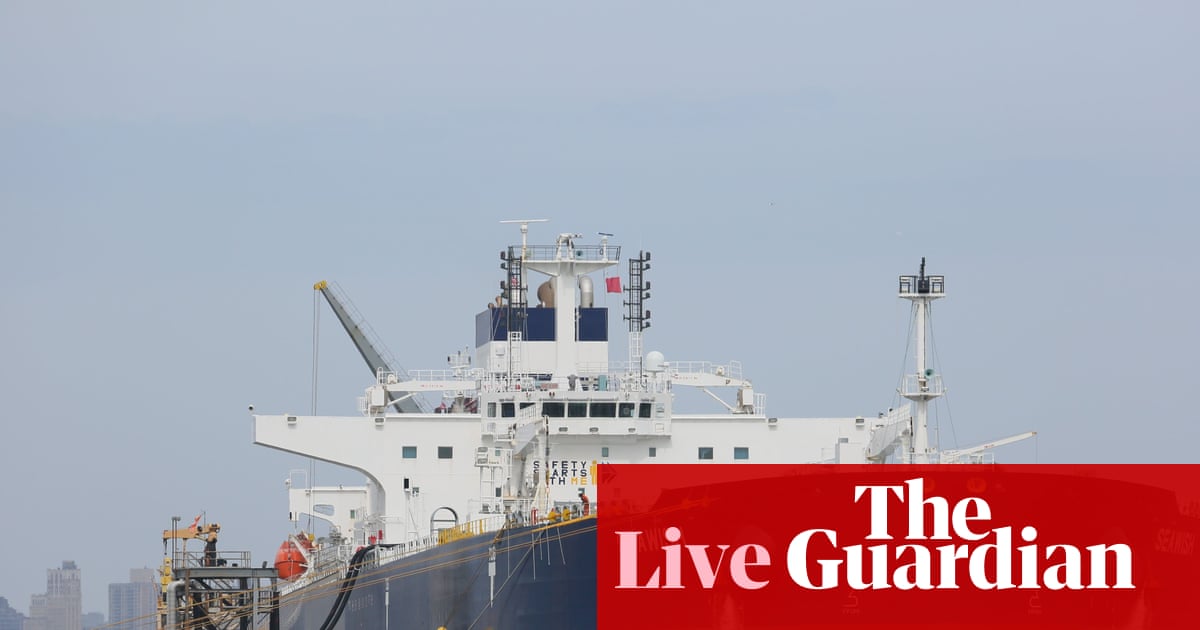
From 6m ago 07.00 EDT Bank of England holds rates unchanged at 3.75% The Bank of England has left interest rates unchanged at 3.75%. The central bank’s rate-setting monetary policy committee (MPC) voted to leave borrowing costs on hold at noon, after its latest meeting. The vote by the nine-member committee to keep rates on hold was split eight to one. The Bank’s chief economist Huw Pill voted for a rate hike to 4%. The Bank is charged with keeping UK inflation at a target of 2% in the medium term. It has lowered interest rates six times since mid-2024, and had been expected to cut again this year before the US-Israeli war on Iran began on 28 February. However, soaring energy costs as a result of the effective closure of the strait of Hormuz have began to push up inflation around the world. Inflation in the UK rose to 3.3% in March, from 3% in February. Petrol and diesel prices have soared since the start of the Middle East conflict, reflecting a jump in the global oil price to above $100 a barrel. Share Updated at 07.02 EDT
19m ago 06.48 EDT We are moving closer to the Bank of England’s interest rate decision at noon. We are expecting no change to its main rate of 3.75%. Share
28m ago 06.39 EDT Water companies are leading the gains on the FTSE 100 index in London, after United Utilities laid out new investment plans. The company forecast higher annual revenues and said it has submitted plans to regulator Ofwat for a further £1.4bn investment programme that could create 4,000 supply chain jobs. This would support housing, data centres and clean energy development, at a time when Britain’s water sector is under mounting pressure to address pollution after numerous spills, and strengthen long-term infrastructure resilience. Russ Mould at stockbroker AJ Bell said: double quotation mark Plans for a massive flood of investment at water utility company United Utilities has created an unusual level of excitement for a part of the stock market historically seen as pretty boring. In more recent times the water sector’s name has been mud with investors, regulators, the public and politicians thanks to issues around pollution and financial mismanagement across the broader sector. The plan to support areas like data centres, clean energy and new homes is being taken as a game changer by investors for now, although delivering on this big programme of spending and remaining on time and on budget is the big challenge for the company.
United Utilities posted an adjusted profit after tax for the year to 31 March of £730m, up from £513.3m the year before, and said it expects evenue to rise to between £2.7bn and £2.8bn in the current year. Chief executive Louise Beardmore said: double quotation mark Operationally, we are making real progress on the issues that matter most, including significant reductions in storm overflow spills and sewer flooding, alongside strong customer service performance. Share
38m ago 06.29 EDT Oil prices retreat after hitting four-year highs Brent crude has retreated, reversing earlier declines of as much as 7%, and is now trading 1.65% lower at $116.18 a barrel. The global oil benchmark rose above $126 a barrel earlier, the highest since March 2022, after a report that Donald Trump will be briefed about military options against Iran today. The United States is pressing ahead with plans for an international coalition to open the strait of Hormuz, according to a State Department cable seen by Reuters, as oil prices surge on fears of lengthy disruptions to global fuel supplies. On the stock markets, the FTSE 100 index has climbed 110 points, or 1.1%, to 10,323. Germany’s Dax added 0.3%, while the French CAC index fell 0.6% and Italy’s FTSE MiB dipped slightly. AJ Bell investment director Russ Mould has looked at this morning’s moves: double quotation mark The FTSE 100 was helped by its oil and gas heavyweights but elsewhere there was heavy selling in Europe as the energy price shock threatens to intensify and with it dials up inflationary pressures across the board in the global economy. A strong performance in emerging markets helped Unilever to beat expectations, but the robust performance merely helped the shares stand still as investors weigh what is likely to be a pretty difficult consumer backdrop. Mining services business Weir slumped as long-serving CEO Jon Stanton announced plans to stand down. Stanton has helped to significantly reshape the business and the investor reaction implies some trepidation about Weir’s prospects under new leadership despite resilient trading. The final meeting for Jerome Powell as Federal Reserve chair was an eventful one despite the lack of change on headline interest rates. While President Trump appointee Stephen Miran voted, as he has consistently done, for a rate cut – three other members objected to language suggesting future cuts. Powell insisted he would stay on as a governor until 2028 after surrendering his current role and again decried interference from the Trump administration to put the spotlight on this area of market concern once again. Share Updated at 06.44 EDT
1h ago 06.10 EDT Jasper Jolly Volkswagen lost more than a billion euros from US tariffs and the cost of ending production of a battery vehicle in Tennessee in response to Donald Trump’s anti-electric car policies. Germany’s biggest carmaker on Thursday reported a €500m cost of winding down production of the ID.4, an electric crossover SUV, in favour of producing a bulkier petrol SUV, the Atlas. It also said there was a €600m cost from US tariffs. Trump’s turn against electric cars has pushed manufacturers selling to the US to U-turn on battery cars in favour of more polluting vehicles. At the same time, Volkswagen and others have been struggling with competition from Chinese manufacturers who have been able to undercut them on electric cars. Oliver Blume, Volkswagen’s chief executive, said: double quotation mark The world is undergoing fundamental change – and we are aligning our strategy consistently. Wars, geopolitical tensions, trade barriers, stricter regulations, and intense competition are creating headwinds. The company’s response has been to plan cuts to its manufacturing footprint, and to consider giving spare factory space to Chinese manufacturers. Arno Antlitz, Volkswagen’s chief financial officer, said: double quotation mark In this environment, the planned cost reductions are not enough. We must fundamentally transform our business model and achieve structural, sustainable improvements. This includes improving the cost structure of our vehicles without compromising product substance, significantly reducing overhead costs, increasing the efficiency of our plants, and accelerating technology development and decision-making. Share
2h ago 05.14 EDT Eurozone grows 0.1% in first quarter; inflation rises to 3% in April The eurozone grew by 0.1% in the first quarter, while inflation jumped to 3% in April driven by a near-11% surge in energy prices. The EU also expanded by 0.1% between January and March, according to a flash estimate published by Eurostat, the statistical office of the European Union. In the fourth quarter of 2025, GDP increased by 0.2% in both areas. Germany, Europe’s largest economy, grew by 0.3% as we reported earlier, while France, the second-biggest economy, showed zero growth, and Italy, the No. 3, expanded by 0.2%, and Spain, the fourth-largest economy, managed 0.6% growth. Among the member states for which first-quarter data is available, Finland (+0.9%) recorded the highest increase, followed by Hungary (+0.8%), Estonia and Spain (both +0.6%). Declines were recorded in Ireland (-2.0%), Lithuania (-0.4%) and Sweden (-0.2%). Separate data showed inflation rose to 3% this month, from 2.6% in March. Energy is estimated to have the highest annual rate in April (10.9%, compared with 5.1% in March), followed by services (3.0%, compared with 3.2% in March), food, alcohol & tobacco (2.5%, compared with 2.4% in March) and non-energy industrial goods (0.8%, compared with 0.5% in March). Share Updated at 05.16 EDT
2h ago 04.56 EDT China’s factories increased production for a second month in April to ship goods early to buyers worried the Iran war will drive up costs, with new export orders at their highest level in two years. The official purchasing managers’ index for manufacturing dipped to 50.3 from 50.4 in March, but held above the 50 mark that separates growth from contraction. It was better than economists had expected. Teh sub-index for new export orders rose to 50.3, the highest since April 2024, from 49.1 in March. Zhiwei Zhang, chief economist at Hong Kong-based Pinpoint Asset Management, told Reuters: double quotation mark It will be interesting to see if the official trade data confirm the resilience of exporters in coming months. The outlook for the export sector is very important for China’s economy, as domestic demand has been weak. Share Updated at 05.05 EDT
2h ago 04.42 EDT German economy surprises with 0.3% growth in first quarter Germany’s economy, Europe’s largest, surprised with 0.3% growth in the first three months of the year, defying the adverse impact of the Iran war – for now at least. This was faster than the 0.2% growth seen in the fourth quarter of last year, according to official figures. This was revised down from 0.3%. The Federal Statistical Office (Destatis) reported that both household and government spending in the first quarter were higher than in the previous quarter, while exports also rose. More details will be released next month. Carsten Brzeski, global head of macro at ING, said: double quotation mark Almost exactly one year after the new German government – under chancellor Friedrich Merz – came into office, today’s data suggests that the German economy is better than its reputation implies. However, it would be risky to assume that today’s performance can simply be continued. The war in the Middle East and soaring energy prices, combined with a lack of structural reform and clear strategy for how to restore competitiveness, do not bode well for Germany’s growth outlook. Judging from the latest sentiment indicators, the signs of a recovery on the back of fiscal stimulus, particularly in defence and infrastructure, have started to fade away. Soaring energy prices have again exposed the fact that Germany is one of Europe’s largest net importers of energy. Some 6% of its oil imports come from countries in the Middle East. The so-called energy-intensive industries in Germany account for some 17% of industrial gross value added and employ just under one million people. With the war in the Middle East now gradually shifting from a pure energy price shock towards an energy supply and broader supply chain shock, the German economy is once again at the centre of an exogenous, global, disruption. View image in fullscreen An underwater drone at the German Navy base presents capabilities and applications of mine countermeasures in Kiel, on 23 April. Photograph: Fabian Bimmer/Reuters But, he added: double quotation mark Even if fears of another year of stagnation have returned, it should be clear that the planned investments in defence and infrastructure are still on track and should support the economy this year and beyond. The fiscal impulse is real, it just needs time to reach the real economy. Share
3h ago 04.26 EDT DCC shares tumble after Irish energy distributor rejects private equity takeover approach The Irish energy distributor DCC has rejected a £4.95bn takeover proposal from US private equity groups, saying it undervalued the company. Shares in the London-listed company, which is based in Dublin, fell 5.1% to £55.80. The cash proposal of £58 a share from KKR and Energy Capital Partners represented a premium of 8% to DCC’s closing price before the offer was made public on Wednesday. Under UK takeover rules, the consortium has until 10 June to make a firm offer or walk away. It is the latest private equity pursuit of a UK-listed company, with bidders attracted by British and Irish firms’ comparatively lower valuations. Other FTSE-100 companies that have been taken over or pursued in the past few months include the insurer Beazley, the investment company Schroders and the product testing company Intertek. Beazley, which specialises in insuring against cyber-attacks that also covers fine art and luxury yachts, in early February agreed to be taken over by bigger Swiss rival Zurich. Not long after, Schroders succumbed to a takeover by the US investor Nuveen, which ends two centuries of family ownership of the historic British asset management group – but will create one of the world’s biggest fund managers. Intertek is being pursued by the Swedish investment company EQT, which is working on an improved proposal, according to Bloomberg News. DCC, which distributes liquid gas, biofuels, and renewable energy to businesses and households, has been simplifying its operations to focus on its core energy business, having offloaded its healthcare and technology assets. Analysts at RBC Capital Markets said: double quotation mark We think there is a good chance that a deal happens, but are not convinced it will be much more than 10% ahead of the current price. Share Updated at 04.31 EDT
3h ago 03.58 EDT In Germany, unemployment rose more than expected in April, above the 3 million mark. The jobless figure, which is adjusted for seasonal effects, increased by 20,000, according to offical figures. Economists had expected a rise of 4,000. Andrea Nahles, head of the labour office, said: double quotation mark There is still no sign of a turnaround in the labour market. The spring upturn remains weak in April as well. Share
3h ago 03.40 EDT Air France-KLM cuts capacity forecasts, though summer travel demand remains strong Air France-KLM has reported a smaller first-quarter loss than expected, but is scaling back capacity because of the US-Israeli war with Iran and soaring jet fuel costs. The Franco-Dutch carrier expects its fuel bill to rise by $2.4bn this year. Capacity (i.e. more seats) will now increase by 2% to 4% this year, rather than 3% to 5% as previously planned. Other European airlines, including easyJet and Tui, have also revised their outlooks, and expect to feel the impact of the closure of the strait of Hormuz, which has sent energy prices soaring, more acutely in the coming months. Air France-KLM chief executive Ben Smith said: double quotation mark While fuel price increases are not yet reflected in the results we present today, they are expected to weigh on the coming quarters. The company said it is limiting discretionary spending, including travel expenses, and has frozen hiring for non-operational staff, while continuing to recruit for operational jobs such as mechanics. View image in fullscreen A low-cost Air France subsidiary Transavia plane flies over Nantes, western France. Photograph: Loïc Venance/AFP/Getty Images The group said its fuel hedging strategy remains in place and it is already 33% hedged for 2027. However, it also said summer travel demand remains strong, with European destinations such as Italy and Spain popular, as travel to parts of the Middle East remains constrained. It said it had seen an initial boost after the Iran war broke out as more people booked flights to Asia, but plans to expand its long-haul capacity gradually as people are postponing travel plans or booking closer to the date of travel. Air France-KLM reported a first-quarter operating loss of €27m, a €301m improvement over last year. Share
4h ago 03.16 EDT French economy shows zero growth in Q1; Spanish GDP slows France’s economy did not grow at all during the first quarter, with households spending less and a slump in exports. GDP was unchanged between January and March, after 0.2% growth in the fourth quarter, according to figures from the French statistics office Insee. Household consumption declined slightly (-0.1% after +0.4%), and investment fell back (-0.4% after +0.3%). Overall, the contribution of domestic demand (excluding inventories) to GDP growth was zero this quarter, after it added 0.4 points to fourth-quarter GDP. The contribution of foreign trade to growth was strongly negative this quarter (-0.7 points after +0.6 points): exports fell sharply (-3.8% after +0.8%), while imports declined again (-1.7% after -0.8%). Total production, of goods and services, was once again sluggish, rising by 0.1%, after a 0.2% gain in the previous quarter. Meanwhile, Spain’s economic growth slowed to 0.6% in the first quarter from 0.8% expansion in the previous quarter, preliminary data from the National Statistics Institute showed. However, this was slightly better than expected. Spain’s economy has been one of the top performers in Europe, in part thanks to record tourist numbers, and grew 2.8% last year. The Spanish government still expects the economy to grow 2.2% this year, although it said earlier this week that uncertainty triggered by the US-Israeli war on Iran could affect the forecast. Share
4h ago 03.07 EDT Whitbread to cut 3,800 jobs Joanna Partridge Premier Inn owner Whitbread is to cut about 3,800 jobs in the UK and Ireland as it resets its five-year business strategy, after tax rises and pressure from a US activist investor. The cuts will affected about 12% of Whitbread’s 30,000-strong workforce in the UK and Ireland working in its Beefeater and Brewers Fayre restaurants, which are usually located next to or inside Premier Inn hotels. The company said consultations with affected employees would begin immediately. Whitbread said it expected to retain a “significant proportion” of those affected and would try to find alternative roles for them, given it hires about 15,000 people each year. Whitbread was one of the biggest fallers on the FTSE 100, down 4.4%. The cuts come after Whitbread began a fresh review of its business in November, a year after it first announced its five-year plan, after it was hit by higher costs in the chancellor’s budget. View image in fullscreen Beefeater restaurant in England. Photograph: Peter Jordan/Alamy Britain’s largest hotel operator had already been in the process of converting some of its underperforming Beefeater and Brewers Fayre restaurants, usually located next to or inside its Premier Inn hotels, into hotel rooms. Whitbread warned after Rachel Reeves’s 2025 budget that tax changes would cost it an additional £50m this year, amid changes to the way business rates are calculated. This came hot on the heels of an earlier cost squeeze due to higher wage bills and rising food prices. Whitbread’s new strategy means it will become a pure hotel business, about seven years after it sold the Costa Coffee chain to soft drinks giant Coca-Cola in a near-£4bn deal. This means that as it stands the Beefeater restaurant brand - established in 1974 in known for serving steaks and classic pub dishes – will disappear from UK high streets. Share Updated at 03.48 EDT