Your support helps us to tell the story Read more Support Now From reproductive rights to climate change to Big Tech, The Independent is on the ground when the story is developing. Whether it's investigating the financials of Elon Musk's pro-Trump PAC or producing our latest documentary, 'The A Word', which shines a light on the American women fighting for reproductive rights, we know how important it is to parse out the facts from the messaging. At such a critical moment in US history, we need reporters on the ground. Your donation allows us to keep sending journalists to speak to both sides of the story. The Independent is trusted by Americans across the entire political spectrum. And unlike many other quality news outlets, we choose not to lock Americans out of our reporting and analysis with paywalls. We believe quality journalism should be available to everyone, paid for by those who can afford it. Your support makes all the difference. Read more
Bank of England policymakers have signalled that interest rates could rise later this year if the Middle East energy shock has a longer-lasting effect on the cost of living.
The outlook comes as interest rates were held at 3.75% on Thursday.
The Bank’s Monetary Policy Committee (MPC) said it had decided to hold borrowing costs steady but that it was alert to the evolving situation in the Middle East.
Members of the nine-person MPC said future interest rate decisions could depend on how strong the second-round effects are of higher global energy prices, which are seen in prices and wages.
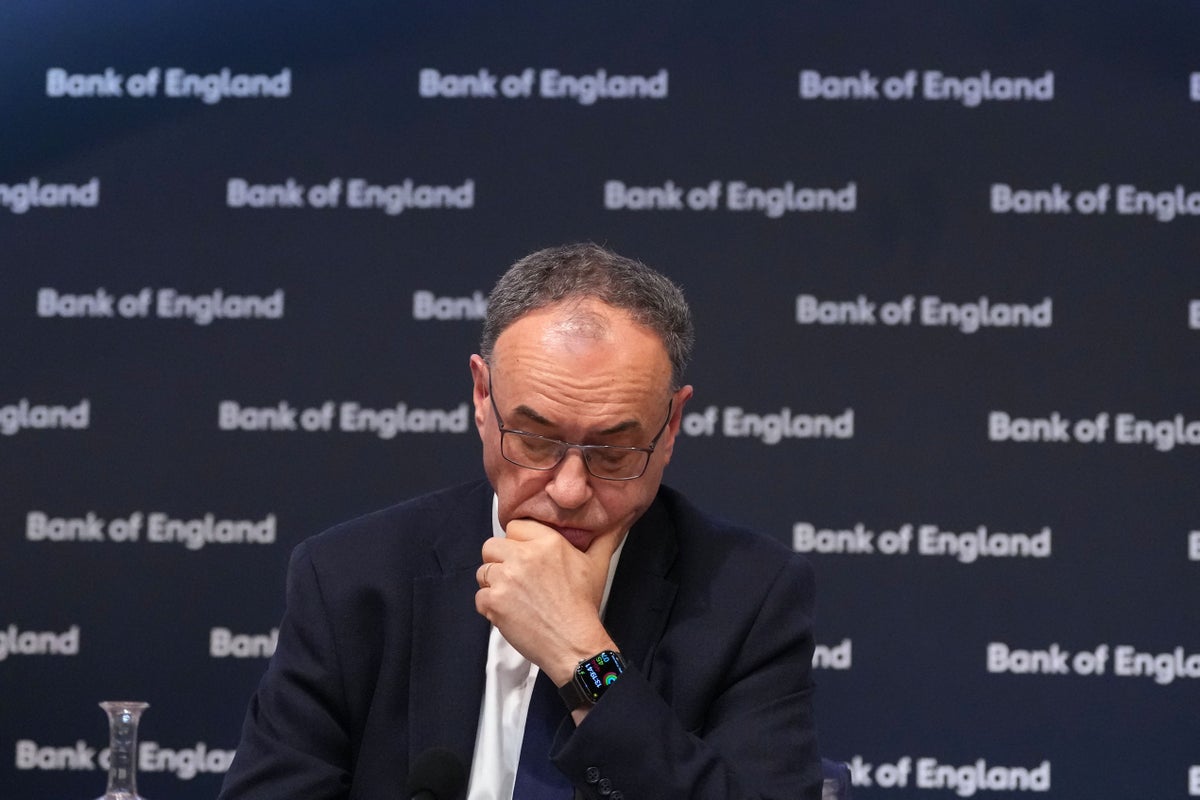
Andrew Bailey, the Bank’s governor, said: “It would be a mistake to wait to see the second-round effects before acting, because it would be too late.”
The committee considered several ways that events could unfold but a worst-case scenario could lead to multiple rate rises and an increased risk of recession.
In this scenario, energy prices rise sharply, with Brent crude oil hitting about 130 US dollars a barrel and staying there for a prolonged period.
This could see inflation peak at 6.2% and not drop back to the Bank’s target rate of 2% in the next four years.
Mr Bailey said in the meeting that he had placed “some weight” on the most extreme predictions, which “would require a stronger monetary policy response”.
He added that the situation was highly unpredictable and that the Bank was monitoring events closely.
One policymaker, Huw Pill, voted to increase rates to 4% at the latest meeting, saying “higher energy prices represent an inflationary shock to the UK economy”.
The price of Brent crude rose as high as 126 dollars a barrel on Thursday, the highest in four years, following reports that US President Donald Trump was preparing for an escalation of the Iran war with further military action.
Mortgage rates have risen sharply since the conflict escalated, although in recent weeks many lenders have been reducing rates.
Following the Bank’s decision, some economists said they were now expecting rates to rise this year.
Experts at Pantheon Macroeconomics said they were now pencilling in increases in June and September, while ING also said the Bank was “inching closer” to a hike in June.
The MPC’s decision comes after the European Central Bank also kept its interest rate on hold but said it had considered a hike given the risks to inflation.
Policymakers noted that the rate of Consumer Prices Index (CPI) inflation rose to a three-month high of 3.3% in March, according to the latest official data, on the back of accelerating fuel prices.
The central bank has predicted that inflation is likely to slow slightly to 3.1% over the second quarter of this year, driven by a lower energy price cap for households.
The April report, which uses three potential scenarios for the impact of the crisis, said inflation is then set to increase even if there is a resolution to the conflict and oil and gas prices cool.
The most benign predictions would see inflation peak at 3.6% by the end of this year.
The Bank said that each scenario would also result in a slowdown in economic growth.
It said the economy is likely to grow by 0.8% in 2026 and 1% in 2027, in its more benign projections, while this could be 0.7% this year and 0.8% next year if the situation worsens.
In its previous forecast in February, the Bank pointed to 0.9% growth this year and 1.5% growth next year.
All Bank projections also saw it increase its forecasts for unemployment.
It previously said unemployment would peak at 5.3% this year, slowing to 5.2% in 2027 and 5.1% in 2028.
On Thursday, the Bank’s most positive forecast indicated that unemployment would hit 5.5% for 2027, with this increasing to 5.6% in a more extreme scenario.
Following the vote, Chancellor Rachel Reeves said: “The war in the Middle East is not our war, but it is one we have to respond to.
“Every choice I make will be about keeping costs down for families and businesses, without repeating the mistakes we’ve seen in the past that resulted in higher inflation and higher interest rates.”