Who is Banksy? Unmasking the elusive street artist
28 minutes ago
Share
Save
Add as preferred on Google
Bea Swallow
Bristol
Reuters
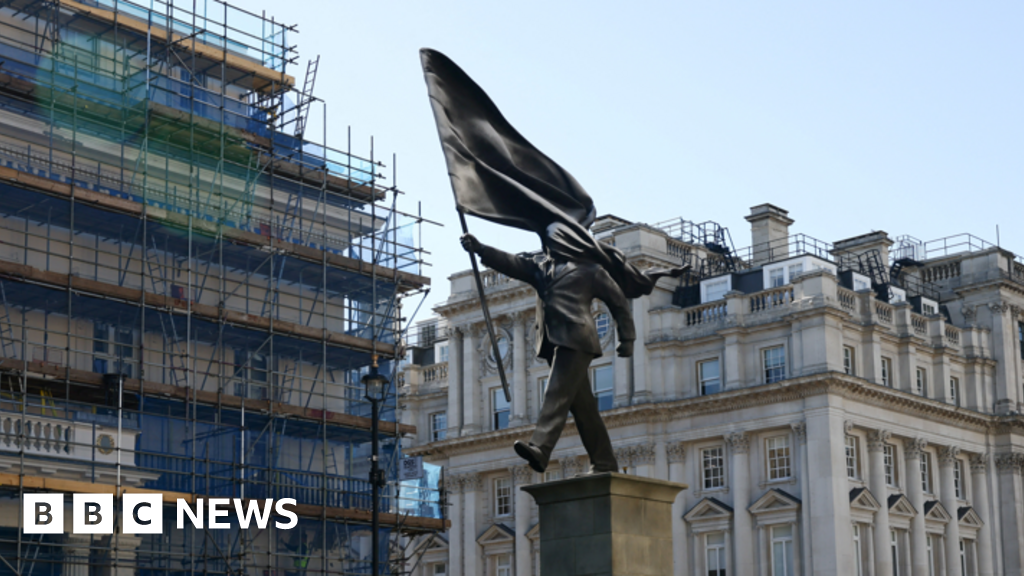
Banksy has confirmed a statue which has appeared in central London is his work
For three decades, Banksy has challenged authority, mocked consumer culture and transformed public spaces into poignant canvases - all while keeping his true identity hidden from the world.
His signature artworks often appear without warning, sparking global conversation, but the culprit quietly dodges the limelight.
Often described as "elusive" and "secretive" by the press, the "guerrilla street artist" is a hero to some and a vandal to others. But who is the man behind the stencils?
The debate has resurfaced after an
investigation by Reuters
claims to have finally unmasked the world's most famous street artist. But, many fans believe the news agency has got it wrong and the speculation continues.
Early career
The Reuters investigation claims to trace the artist's real name - a theory that has been challenged by those closest to him.
Combined with a succession of new murals appearing across London and beyond, it has reignited a familiar question: who really is Banksy?
Peter de Boer
Banksy ran art sessions with young people in a deprived area of Bristol
Banksy is believed to have been born at Bristol Maternity Hospital in the early 1970s.
He rose to prominence after he began spray-painting his now-trademark stencilled designs around Bristol in the early 1990s.
He even
hosted art classes for teenagers
in Lawrence Weston, the same year he would go on to paint his famous
Mild, Mild West
mural in Stokes Croft in 1999. The photos from these sessions, obtained exclusively by the BBC, are some of the earliest-known images of him.
The city's influential music and arts scene are believed to have inspired his work.
Getty Images
The anonymous street artist has become synonymous with subversion, satire and secrecy
Laughing all the way to the Bank(sy)
By the mid-2000s, Banksy's work became more ambitious and began popping up in cities all over the world, attracting a media frenzy.
His mythical status as the masked artist poking fun at authority brought him - or at least his brand - international recognition.
Exhibitions of his work, in cities including Los Angeles and London, became sell-out events.
His often politically-charged works began to sell for vast amounts of money, with A-List customers including Brad Pitt, Paul Smith and Christina Aguilera.
Getty Images
The subversive tourist attraction Dismaland was conceived as a "bemusement park", offering a satirical twist on mainstream tourist resorts
The 2010 documentary film Exit Through The Gift Shop - showing Banksy at work - was
nominated for an Oscar
and a Bafta.
In 2015, he transformed the dilapidated Tropicana lido in Weston-super-Mare, which he had visited as a child, into the
subversive tourist attraction Dismaland.
Three years later, in a highly theatrical piece of performance art, he
staged a live destruction
of his Girl with Balloon at Sotheby's auction house - moments after it was sold for £1m.
How are Banksy artworks verified?
Banksy's work is authenticated through
Pest Control Office
, a body set up by the artist to handle verification, sales and copyright disputes.
If Pest Control does not certify a piece, it is not recognised as an official Banksy - regardless of how convincing it appears.
Getty Images
Banksy's Girl with Balloon was shredded seconds after the hammer fell at an auction at Sotheby's in October 2018
What do we actually know about Banksy's identity?
A number of names have been linked with Banksy in the past, including Robert Del Naja, Robin Gunningham, Art Attack's Neil Buchanan or a Bristol art collective.
The name Gunningham first emerged in what declared to be a
world exclusive by The Mail
in 2008, describing him as "a former public schoolboy brought up in middle-class suburbia".
Compounding this theory, the BBC
unearthed an interview
in 2023 in which the artist appears to confirm his first name as "Robbie".
Steve Lazarides
A photograph by Banksy's former agent is said to show the artist at work
In March 2026, Reuters reported that it had identified Banksy as Robin Gunningham, citing historic legal records from the US.
The news agency said these documents linked a graffiti arrest in New York to the artist, as police records contained his real name.
They said the extraordinary efforts to hide his identity began to fall apart in September 2000, after he was charged with defacing a billboard in New York.
According to Reuters, Banksy was born Robin Gunningham but later took the name David Jones - though it is unclear whether he still uses this particular alias.
Those close to Banksy strongly dispute this interpretation.
Banksy's former manager Steve Lazarides said the agency was "pursuing a ghost", adding that the artist legally changed his name decades ago and deliberately erased previous identities.
"There is no Robin Gunningham," he said.
"The name you've got I killed years ago. You'll never find him."
More on this story
Banksy: What it was like to work for street artist
Banksy 'confirms' first name in lost BBC interview
How Banksy's Dismaland pushed boundaries 10 years ago
Banksy posts video of shredding stunt
Banksy today
Now believed to be in his 50s, Banksy remains prolific.
As the artist moves into middle age, his prolific creative output continues, if anything with works that are more outspoken and political than earlier pieces.
In recent years, his work has addressed the
war in Ukraine
,
the right to protest
,
immigration
, wildlife loss and policing powers.
His murals often vanish within days - they are either stolen, defaced or removed - reinforcing both their fragility and their cultural value.
PA Media
This mural appeared two days after almost 900 people were arrested at a London protest against the ban on Palestine Action
But not all his work is overtly political, with many having a comic, or sardonic, message about society.
In 2021, 10 pieces of street art titled
The Great British Spraycation
depicted seagulls dive-bombing for chips, children playing with sand and in boats, as well as a rat leaning back in a deckchair while enjoying a cocktail.
In the summer of 2024,
wildlife artworks appeared in London
- with eight revealed over as many days.
As is often the case, not all the art survived intact.
The
elephants were soon defaced
with stripes,
the wolf appeared to be stolen
within hours of being confirmed as a Banksy, the cat was taken down the same day it was revealed, and a masked man spray painted a tag over the rhino.
Last year, a mural unveiled on the side of the Royal Courts of Justice building - depicting a judge wielding a gavel over a protestor - was also
quickly erased
.
On 30 April 2026, Banksy confirmed a large statue in St James's, London,
depicting a suited man walking forward off a plinth
while carrying a flag that covers his face, was his work.
'The masked crusader'
John Brandler, director of Brandler Art Galleries, believes it is convenient for Banksy to remain anonymous "so he can walk down the street" without being recognised, but says the Banksy brand would survive regardless.
"To the art world, it doesn't matter any more," he said.
"[When he started], being anonymous helped him stand out - the masked crusader - but now it doesn't matter any more.
"His people have made the brand Banksy such an incredible thing, it wouldn't make any difference.
"He's very clever. It's brilliant marketing."
Follow BBC Bristol on
Facebook
,
X
and
Instagram
. Send your story ideas to us on email or via
WhatsApp on 0800 313 4630
.
More on this story
Banksy confirms he's behind statue in central London
Two identical Banksy murals appear in London
Nine days of Banksy, but what do the works mean?
Banksy's new urban jungle sparks hunt for hidden meaning
Related Internet Links
Banksy
Culture
Graffiti
Art
Street art
Bristol
Banksy
Who is Banksy? What we do and don't know about elusive street artist