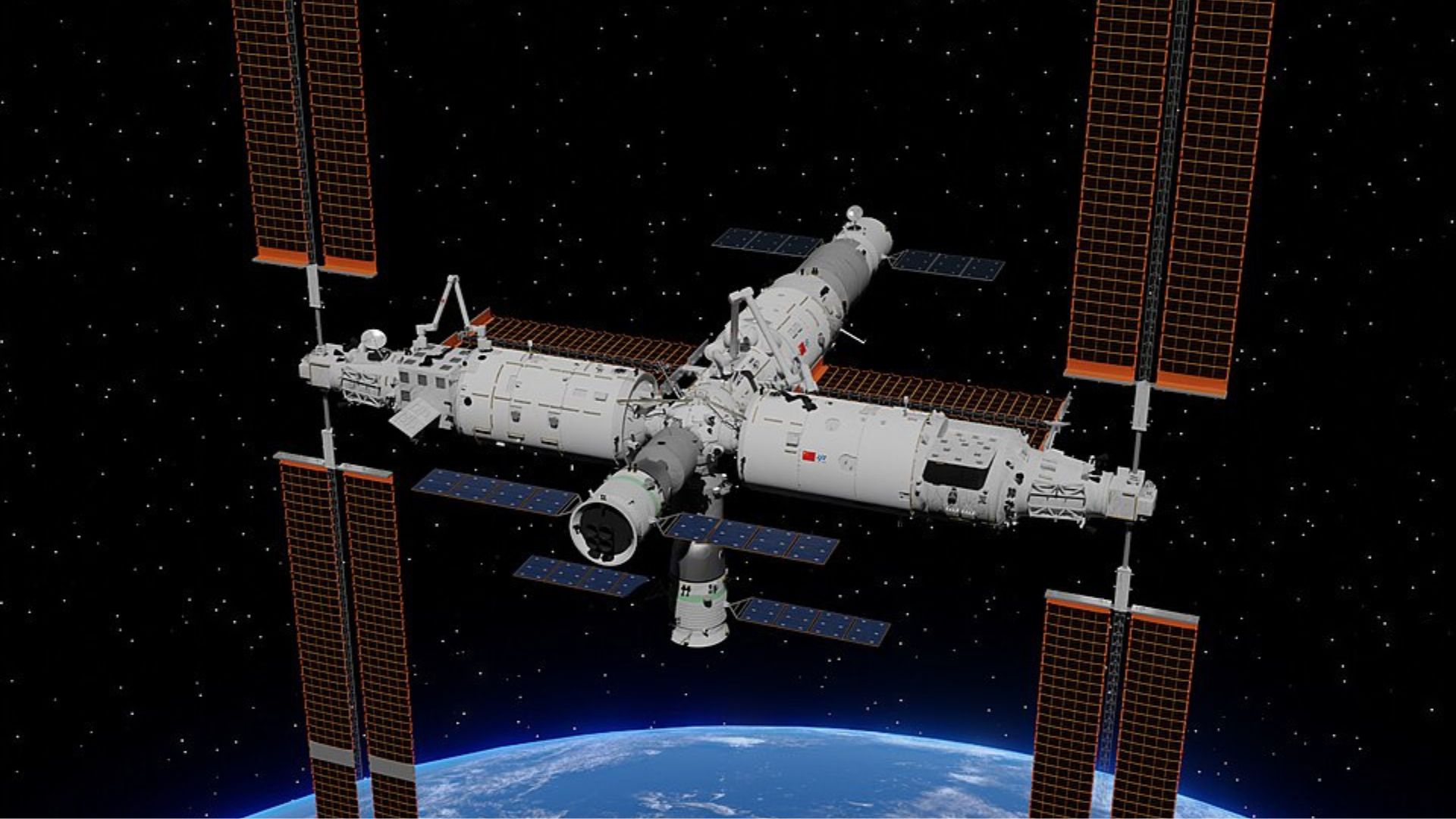
The US-China space race is set to intensify on the orbital front. With the International Space Station (ISS) set to retire in 2030, the US still has to finalize a potential replacement. On the other hand, China has already solidified its position in low Earth orbit with its Tiangong space station. In fact, recent reports suggest that China is planning to expand its space station in the coming years.
The current T-shaped structure will transition into a cross-shaped configuration, eventually reaching a six-module structure. As per the plans, the expansion will add a multifunctional module larger than the current core. Although a firm schedule remains under wraps, the expansion is designed to satisfy a growing need for orbital research and broaden horizons for global partnerships. Space station expansion The timing is everything. Since 1998, the ISS has been the undisputed heavyweight of orbit. As the largest man-made structure ever assembled in orbit, this 15-nation collaboration has served as a prolific orbital laboratory for thousands of microgravity-based experiments. But now, NASA plans to retire the aging giant, tasking a SpaceX “deorbit vehicle” with guiding the structure to a watery grave in the South Pacific. If China hits its targets, Tiangong will be the only game in town, or to say orbit.
The South China Morning Post (SCMP) reported that the evolution of the Tiangong is set to begin with the addition of a multifunctional extension to the Tianhe core. Designed as a central hub, this fourth module will provide several docking interfaces and a specialized airlock for spacewalks, while serving as the primary mounting point for two upcoming laboratory segments. This modular expansion could also pave the way for a massive six-module assembly, ultimately bringing the station’s total mass to approximately 180 tonnes (198 tons). Altogether, the addition would boost its capacity for international research and long-term habitation. Reportedly, this expansion is supported by hardware upgrades, including a more powerful, multi-stage Long March 5B rocket with an enlarged payload fairing. In addition, engineers at the China Academy of Space Technology are enhancing the station’s robotic arms, giving them the precision and strength required for the increasingly complex assembly and maintenance tasks ahead.
International astronauts Since its completion in 2022, the Tiangong space station — roughly the size of a three-bedroom apartment — has hosted over two dozen astronauts and supported more than 260 experiments. The station also made history when its crew clocked a record-breaking 9-hour, 6-minute spacewalk. This feat narrowly eclipsed the long-standing NASA record of eight hours and 56 minutes, which had remained unbeaten for 22 years. Beijing is also changing who can become an astronaut. For years, the ISS was the exclusive club for 15 nations. Now, China is opening its airlocks. Astronauts from Pakistan, Hong Kong, and Macau are expected to join missions as early as this year. This is a pointed shift in space diplomacy. While NASA is barred by law from collaborating with China, Beijing is positioning Tiangong as a “global laboratory” open to anyone.
The station is designed to operate for 15 years, positioning it to potentially be the only operational space station in LEO once the ISS is deorbited by SpaceX in 2030.