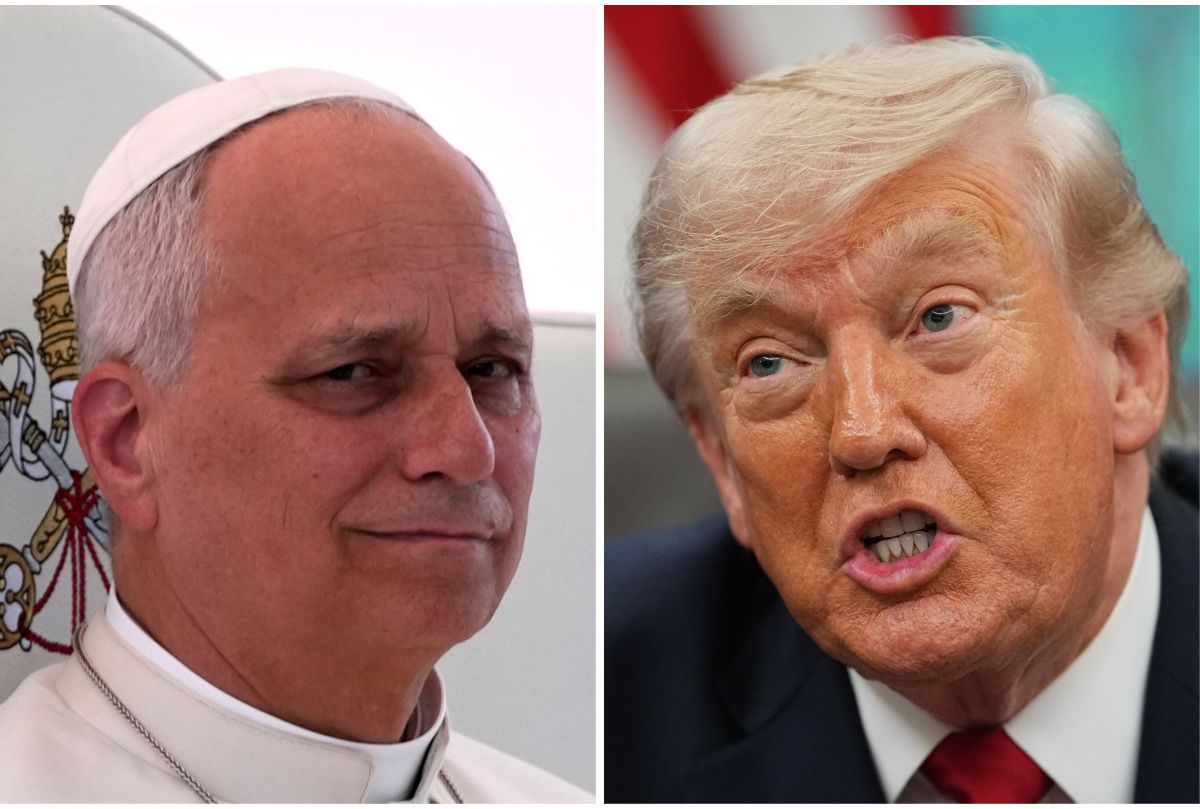
Pope Leo XIV has appointed three new U.S. bishops who have expressed criticism of President Donald Trump's actions.
Washington Auxiliary Bishop Evelio Menjivar has been named as the new bishop for the Diocese of Wheeling-Charleston covering West Virginia, according to the Catholic Standard. Father Gary Studniewski and Father Robert Boxie III have been named as new auxiliary bishops for the Archdiocese of Washington.
The appointments place outspoken clerics in influential roles at a moment of strained relations between the Vatican and the White House, particularly on immigration, civil rights and U.S. foreign policy.
When approached for comment, the White House pointed Newsweek to remarks made by Vice President JD Vance on April 19, when he sought to play down tensions between Pope Leo and Trump.
Posting while quote‑sharing a video of the pope speaking aboard the papal plane, Vance said the media had overstated the dispute, adding that while “real disagreements have happened and will happen,” the situation was “often much more complicated.”
He said Pope Leo was right to preach on moral issues, while he argued that the administration’s role was to apply those principles “in a messy world.”
Newsweek has contacted the Vatican for comment via email.
...
Why It Matters
The Archdiocese of Washington plays an outsized role in U.S. Catholic public life, serving government officials, lawmakers and federal workers at the center of American power.
Elevating bishops who have publicly challenged Trump's policies signals that Pope Leo is not retreating from confrontational moral positions despite rising political tensions.
Evelio Menjivar And Immigration Criticism
Menjivar criticized the Trump administration's immigration policies, writing in the National Catholic Reporter last April: "The federal government has pursued a 'shock and awe' campaign of aggressive threats and highly visible operations of questionable legality that go far beyond mere immigration 'enforcement.'"
In that opinion piece, Menjivar warned that aggressive enforcement tactics were instilling fear across immigrant and refugee communities, including among people with legal status and U.S. citizen family members.
He urged Catholics to speak out against what he described as violations of human dignity, drawing parallels to experiences many migrants fled in their countries of origin.
Menjivar, who had served as an auxiliary bishop in Washington, will now lead the Diocese of Wheeling‑Charleston, which covers the entire state of West Virginia.
...
Robert Boxie and Concerns Over DEI Rollbacks
Boxie previously expressed concern over Trump's efforts to eliminate diversity, equity and inclusion initiatives across the U.S.
Speaking to OSV News in 2025, Boxie framed those efforts as part of a broader moral and cultural regression.
"In a lot of ways we have made great progress, but in so many ways, I feel like we're regressing," Boxie said. "It's really frustrating—especially this moment that we’re living in. The attacks on 'DEI'—I don't even know what that means anymore. It's a term that's been hijacked. It means a lot of things to a lot of different people."
Boxie, who serves as Catholic chaplain at Howard University, has emphasized that diversity and inclusion are consistent with Catholic teaching and the country’s pluralistic identity.
His elevation makes him one of the youngest auxiliary bishops in the U.S. hierarchy.
Gary Studniewski and January 6
Studniewski criticized the riot at the U.S. Capitol in 2021, describing it as "very disturbing, very disheartening."
A longtime pastor on Capitol Hill, Studniewski experienced the events of January 6 at close range as rioters stormed Congress during certification of the 2020 election.
In homilies delivered in the days that followed, he warned against political manipulation, violence and the erosion of democratic norms.
"It was a normal day, until all that sickening unrest in the afternoon," he said, according to the Catholic Standard.
Studniewski, a former U.S. Army chaplain who retired with the rank of colonel, has frequently spoken about the moral responsibility of civic leaders and citizens to reject extremism and uphold peaceful democratic processes.
Tensions With the White House
Pope Leo's announcement comes amid a public feud with Trump after criticizing the U.S. war in Iran in April. The pope’s remarks drew a sharp response from the president.
Trump later called Pope Leo "weak on crime, and terrible for foreign policy," adding: "If I wasn't in the White House, Leo wouldn't be in the Vatican."
The exchange underscored the widening gap between the Trump administration and senior Catholic leadership, particularly as disputes have expanded beyond immigration to encompass war, foreign policy and civil rights.
Catholics Are Comfortable With Pope Criticizing Trump: Poll
Polling shared with Newsweek this week suggests the Vatican’s confrontational stance carries little political downside among Catholic voters—and may even align with public expectations.
A national Verasight survey fielded April 21-23 among 2,000 U.S. adults, with a margin of error of plus or minus 2.3 percentage points, found that 48 percent of Catholics said it was appropriate for Pope Leo to criticize Trump’s policies, compared with 21 percent who felt it was appropriate for Trump to criticize the pope.
The findings indicate that Catholic voters are broadly comfortable with papal moral commentary on public policy, even as they recoil from presidential attacks on religious leaders.
“The data reflects a widely held norm that religious figures retain moral authority to speak on public policy, while elected officials are expected to show restraint when responding in kind,” Ben Leff, the CEO and co‑founder of Verasight, told Newsweek.
Powerful Diocese With National Reach
The Archdiocese of Washington spans Washington, D.C., and surrounding Maryland communities, placing its bishops in regular contact with policymakers, diplomats and national media. Statements delivered from its pulpits often reverberate well beyond parish boundaries.
With Menjivar, Boxie and Studniewski now holding senior episcopal roles, Pope Leo has reinforced a leadership group known for speaking forcefully on social justice, racial equality and democratic principles—even when doing so places them in direct conflict with the White House.