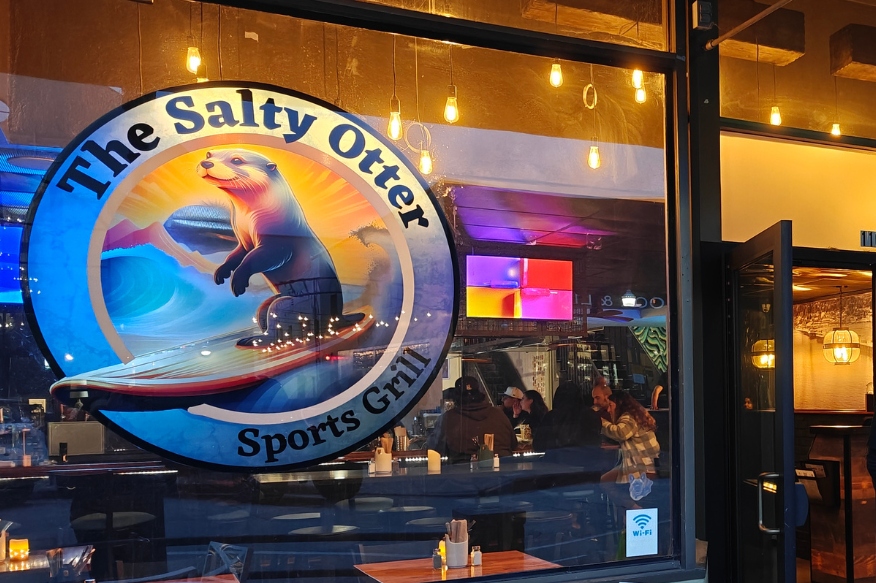
The old logo at the Salty Otter at 110 Walnut Ave. in Santa Cruz, Calif., which the owner recently changed after the restaurant received negative reviews referencing its use of AI. Rachael Smith
Up until last week, a colorful logo of an otter on a surfboard welcomed customers to the Salty Otter, a restaurant and sports bar that opened in downtown Santa Cruz last spring. But backlash to the owner’s use of AI in creating the logo recently prompted her to change it to plain white text against a black background, reported Lookout Santa Cruz. On Friday, owner Rachael Smith shared a lengthy post on Instagram explaining why the surfing otter had vanished from the restaurant’s branding.
“A lifelong dream has been crushed by a group of locals,” Smith wrote in the post. “I have received one star reviews from people saying they want 99 Bottles back and that I should have paid for a local artist to do the logo instead of a crappy AI logo.”
Advertisement Article continues below this ad
Smith debuted the Salty Otter last March at 110 Walnut Ave., a space that was most recently home to Firefly Tavern and before that 99 Bottles, a beloved pub that closed in 2020 after 28 years. Previously, Smith had another restaurant on Monterey’s Cannery Row called the Salty Seal, which she and her business partner sold last July.
Smith told SFGATE that she received numerous one-star reviews on Google and Yelp criticizing the otter logo, although many have since been removed. One remaining one-star review on Google reads, “Their logo is AI generated, if they can’t make the effort to create a logo they definitely won’t make the effort to cook good food.”
Another on Yelp reads, “The AI slop otter screams cheap and lacks in any kind of artistic taste.”
The Salty Otter’s old logo (left), which owner Rachael Smith used AI to create, and its new logo (right). Rachael Smith
“I used a little bit of AI, and it’s this big uproar thing now,” Smith told SFGATE. “But I think AI is so sensitive right now everywhere with people.”
Advertisement Article continues below this ad
She explained that while she has 26 years of experience in computer graphic art, she used some AI on Canva to create the otter to save time and money — but still put around 20 hours of work into it herself. She said she used Canva because it “cuts your work time in half when you’re having to pump out advertising and marketing for your business. That’s something I can’t afford to outsource.”
As the owner of a relatively new business, Smith said she takes reviews seriously, as she’s seen the deep impact they can have. She said she opted to change the logo to plain text because it seemed like the simplest way to quell the backlash.
“It’s a real struggle at the moment to keep my doors open,” she said. “And so if I’m going to have part of the community picking me apart and giving me one-star reviews that aren’t deserved, that’s not fair on my staff … if the whole problem is about a logo, then I’m just going to make plain text.”
Advertisement Article continues below this ad
Smith added that another simple logo featuring a line-drawn otter will now be used in the restaurant’s window and on flyers.
The sudden ubiquity of AI-generated content has sparked widespread concern among artists, who object to their original works being harvested without credit and fear their livelihoods are being undercut by automated tools. While some businesses have leaned into AI, using it for advertising, others have come out firmly against it. Oakland bar and music venue Thee Stork Club banned AI-generated concert flyers last September, criticizing how it undercuts artists and is “not very punk.” In December, Boichik Bagels owner Emily Winston told Eater she was unhappy when catering platform Forkable replaced real photos of her food with AI-generated images, calling them “creepy.”
With Santa Cruz’s high concentration of artists, Smith said she could see how the AI logo may have struck a nerve. But she also pointed to what she sees as their potential hypocrisy.
Advertisement Article continues below this ad