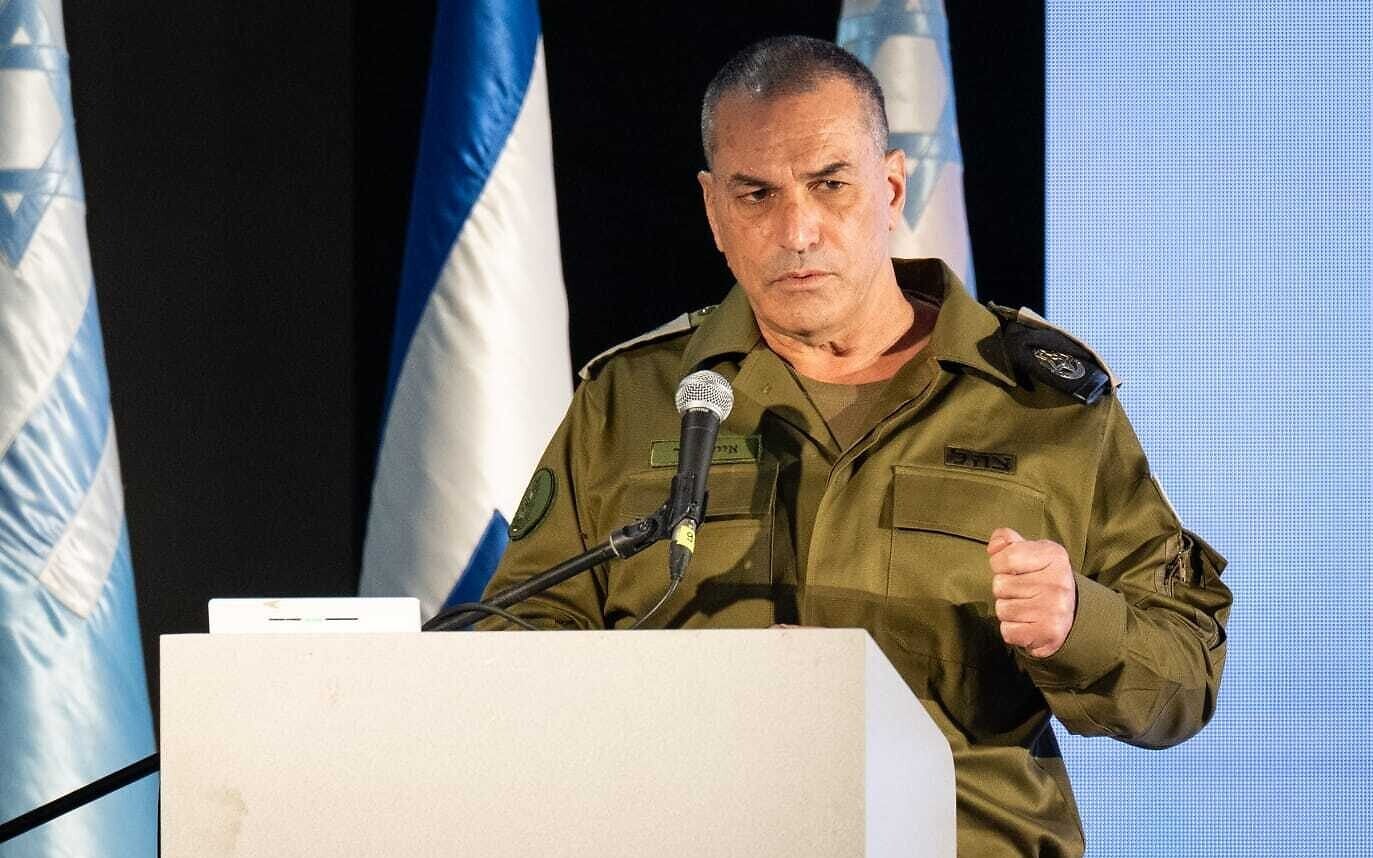
IDF Chief of Staff Lt. Gen. Eyal Zamir told senior officers on Monday that the military has seen discipline erode in Israel’s multi-front war over recent years, listing a number of incidents in which Israeli soldiers have behaved in ways that he described as “rebellion” against the army’s values.
Among other issues, he denounced reports of looting, the destruction of a statue of Jesus in Lebanon that prompted international outcry, and the trend of soldiers wearing unauthorized badges and patches bearing religious, messianic, political and inciteful messages.
“The unethical incidents we have seen are the product of a long and complex period, but that does not justify them. We must not compromise on our values. The erosion of norms could be no less dangerous than operational threats,” he said, while speaking at a conference of the IDF’s senior command staff.
During the conference, Zamir displayed a picture of a soldier wearing a patch that read “Stop the hatred. It is time for violence,” and asked the participants, “Is this the army you want? If there is even one person who thinks this reflects IDF values, stand up now.”
“This is not a minor incident. This is a rebellion against IDF values,” he said.
Get The Times of Israel's Daily Edition by email and never miss our top stories Newsletter email address Get it By signing up, you agree to the terms
Zamir said that the “phenomenon of looting, if it exists, is disgraceful and could stain the entire IDF,” after Haaretz reported last week that there has been widespread looting by Israeli soldiers in southern Lebanon, where many residents have fled the fighting.
“If such incidents occurred, we will investigate them,” he said, adding that “I am not willing for us to become an army of looters.”
The IDF recently punished soldiers who took part in the smashing of a statue of Jesus in southern Lebanon, and said it was investigating a video of soldiers damaging solar panels. During his address, Zamir showed a widely circulated picture of the crucifix being smashed.
Advertisement
The statue incident caused international outrage, and the IDF dismissed from combat service the soldier who destroyed the figure, as well as the serviceman who filmed him, also jailing both of them. The military replaced the damaged statue in the Christian village of Debel with a new one.
Zamir also said that soldiers, both in the standing army and reserves, “must not use social media as a tool to spread controversial messages or for self-promotion.”
“This is a red line that must not be crossed, and those who do so will be dealt with disciplinarily,” he said. Soldiers are rarely punished for posting content online, though videos posted by IDF soldiers have at times circulated widely and led to efforts by pro-Palestinian activists to prosecute them abroad.
In a press release issued by the IDF on Zamir’s speech, there was no mention of any remarks from the chief of staff regarding the military’s failure to tackle spiraling Jewish terrorism in the West Bank. Zamir last month issued a sharp condemnation of settler violence, calling attacks against Palestinian civilians and soldiers in the West Bank “morally and ethically unacceptable” and a major strategic impediment.
Zamir also addressed the status of women in the IDF in light of renewed criticism of alleged religious coercion in the armed forces. This month, female soldiers were court-martialed for wearing purportedly revealing clothes to a base when they arrived to be discharged, sparking criticism.
Zamir said women are “an inseparable part of the IDF and its operational strength.”
Advertisement
“There will be no exclusion of women in the IDF,” he stressed. He also referred to concerns that women will face additional restrictions in the military, as it seeks to increase draft numbers among the ultra-Orthodox, who adhere to strict rules of gender separation.
“We will continue to enable service for diverse populations, without harming others or at their expense. We will do this while preserving the identity and values of the IDF,” Zamir said.
Still, Zamir said he backed the officer, Col. Mazzie Swissa, who court-martialed the female soldiers for their clothing.
‘I back you. I know you’ve taken hits in recent days, but I tell all of you, enforce the law and the orders in the army. We need to clear ourselves of background noise and do the right thing,” he said.
Zamir said Swissa “did not act out of religious coercion, and she is not the modesty police.”
“Soldiers who do not comply with orders, their commander is authorized to discipline them,” he added.
Zamir: IDF ready for ‘a return to intense fighting in all sectors’
On operational matters, Zamir said that the IDF will likely remain fighting on multiple fronts throughout 2026, an assessment he has also made previously. The IDF has fought on several fronts since the Hamas-led October 7, 2023, attack that sparked the war in Gaza. Ceasefires are currently in effect in Gaza, Lebanon, and Iran, though the latter two are considered fragile.
Advertisement
“Since October 7, the IDF has been engaged in combat, in an ongoing multi-front campaign. We continue to be prepared and on alert for a return to intense fighting in all sectors. 2026 may continue to be a year of combat on each of the fronts,” he said.
He also said that the IDF urgently needs more troops: “In light of the growing burden of missions on the IDF in the coming years, the urgent need facing the State of Israel is to increase the number of those serving and fighting, and we will insist on this.”
A bill under consideration in the Knesset would preserve blanket exemptions from conscription for most Haredi men. While its supporters say it will draw more Haredim to the IDF, the bill has drawn criticism for not significantly increasing draft numbers and for preserving a disparity in who is obligated to enlist in the army.