Cuba has accused the United States of issuing a “clear and direct threat of military aggression” after President Donald Trump suggested American forces could “immediately” seize control of the island.
The comments came as tensions escalated following new U.S. sanctions on Havana and fresh rhetoric from Trump referencing the possible use of military assets in the Caribbean.
During a speech late on Friday, Trump jokingly remarked that the world's largest aircraft carrier, the USS Abraham Lincoln, may approach Cuban shores and force officials to "give up" after the U.S. ends its war against Iran.
The Trump administration has long had Cuba's communist leadership in its crosshairs, ramping up decades of pressure on the island and hinting at a possible military takeover after U.S. operations in Venezuela at the start of January.
Havana was heavily dependent on Venezuelan oil imports, and the U.S. said in March it had allowed a Russian oil tanker to reach Cuba for "humanitarian reasons."
Trump announced additional sanctions on Friday, impacting swathes of people linked to Havana's economy.
Washington imposed a fuel blockade on Cuba in early 2026, dwindling supplies often plunging the island's residents into blackouts and wiping away much of the country's vital tourist trade.
...
Cuba's foreign minister, Bruno Rodríguez, said on Saturday the U.S. had raised its level of aggression against Cuba to "dangerous levels."
In a separate statement, Cuban President Miguel Díaz-Canel said Trump had stepped up his threats against his country to an "unprecedented" point.
"We Cubans do not let ourselves be intimidated," Rodríguez said in a post to social media.
Newsweek reached out to the White House via email outside of standard working hours.
Cuba 'Doesn't Have Much Time Left'
Several top U.S. officials have repeatedly predicted an end to the current Cuban leadership, even as negotiations between the two countries have continued.
Responding to Díaz-Canel's Saturday social media statement, Florida Representative Carlos Giménez, a Republican, said the government in Havana "doesn't have much time left," adding: "Greetings from Washington."
Havana has insisted it is prepared to defend itself, while saying there is "no excuse for the United States to resort to military aggression as a way out to resolve our differences."
Cuba lies less than 100 miles from Florida.
The Trump administration said on Friday a new raft of sanctions target Cuba's security institutions, the island's financial, defense and energy sectors, plus anyone the U.S. accuses of being "complicit in government corruption or serious human rights violations."
Rodríguez called the measures "illegal and abusive" and said they amounted to the “collective punishment” of Cuba's population.
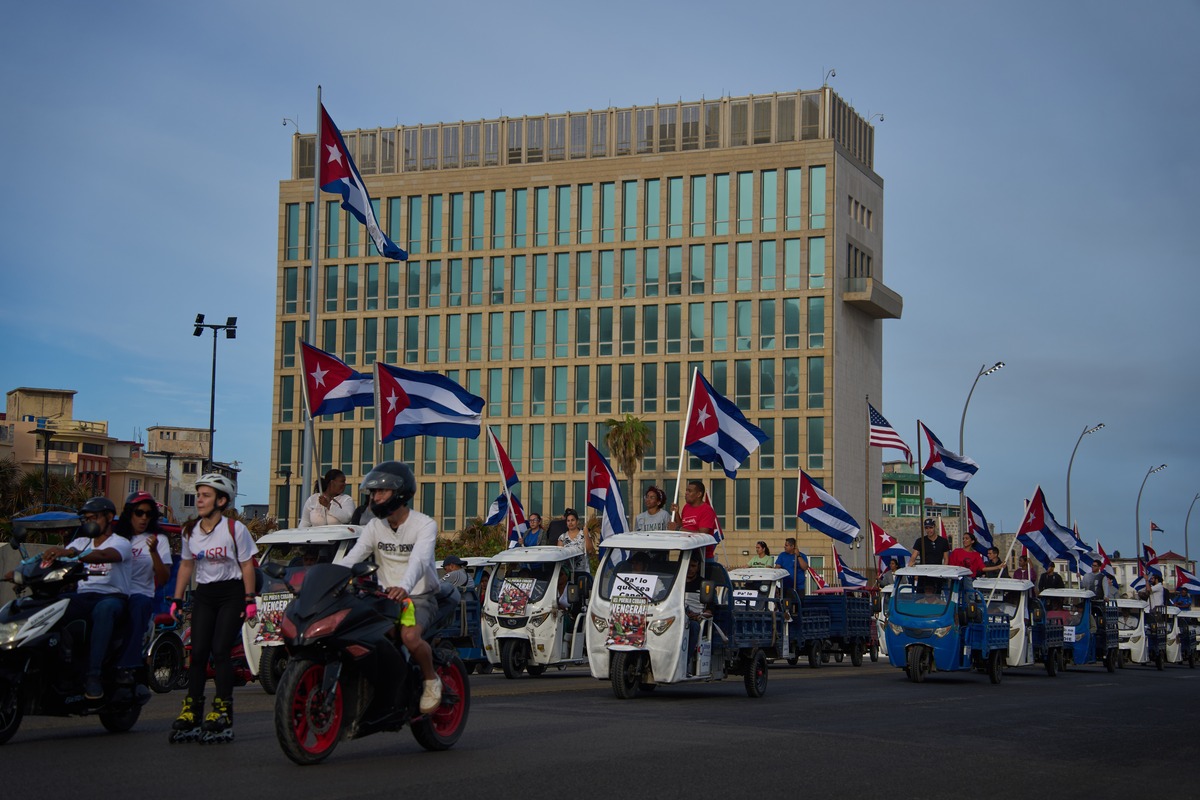
Crowds amassed in the Cuban capital on Friday, converging outside the U.S. Embassy and bearing banners with the slogan, "defend the homeland."
Update 5/3/2026 at 7:40 a.m. ET: This article has been updated with additional information.