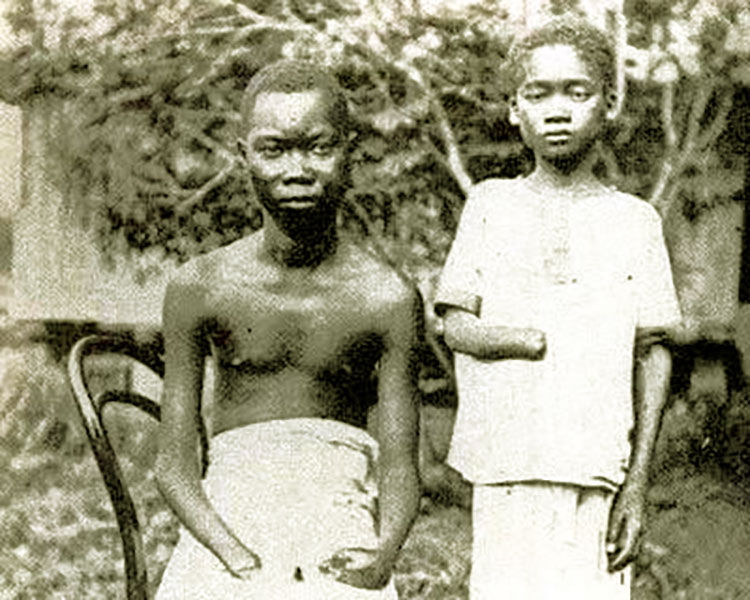
The central part of Africa was privately owned by King Leopold II of Belgium. It was 76 times the size of Belgium, established in 1885, and called the ‘Free state of Congo’. All sorts of expatriate Belgian, South African and other European white folk ran the colony whose people, it was said, were treated as children at best and animals at worst. They were whipped, maimed and killed, at the drop of a hat. Many had their right arms cut off as punishment. There were also many white missionaries who were outraged. Initially, the natives were never taught to read or write. Then, there were also Arab slave dealers running a roaring slave trade, by raiding and decimating villages to capture the natives. It was literally the law of the jungle. There were over 250 tribes within the Congo.!
While many European countries were limiting their operations to the coastal areas of Africa, King Leopold’s minions, led by a Welsh -American agent called Henry Morton Stanley (of “Livingston I presume” fame), worked at the King’s behest to find the source of the Congo River and there discovered 200 miles of turbulent ‘Rapids’ after which there were miles and miles of calm water. So, it was Stanley who suggested that steamboats be dismantled and carried by cart roads upriver to be re-assembled and used for transportation. Many trading posts were established along the river. A railway line was also built. There was a French team of explorers, too.
Initially, the main products from Congo were Ivory and Rubber. Rubber sap came from vines and not from trees. After the pneumatic tire was invented by John Boyd Dunlop, in 1888, the demand for Rubber was even greater. The Congo Free State, now nicknamed the ‘Dark Continent’ by many writers who experienced the appalling conditions that the natives (savages) had to work under. In 1889, at the Paris Exhibition, commemorating hundred years after the French revolution, they even had a human Zoo from the colonies, displaying people, including from the Congo, in a so-called ‘natural’ or ‘primitive’ state. Writers such as Stanley himself and Joseph Conrad of ‘Lord Jim’ fame, wrote about the Congo and imperialism in The Heart of Darkness.
Although King Leopold never set foot in Congo, it was big money for him. There were a few others like the UK educated Frenchman Edward Dene Morel, a shipping clerk and a surveyor/activist named Roger Casement who noticed that trade was only one way from Congo. Goods from Antwerp, Belgium, to Congo, Africa, consisted mainly of arms, ammunition and manacles (handcuffs). That seemed rather odd. They wrote a report about it in 1904. The phrase ‘Human Rights’ was first used in these writings. Arthur Conan Doyl and the American writer, Mark Twain, too, commented about the appalling conditions that prevailed. It was then that the world suspected that all was not well in the dark continent and brutality of the King’s regime. The King then appointed a Commission of inquiry into the affairs of the Congo Free State. (Sounds familiar?)
Eventually, under international pressure, in 1908 the Belgian Government took over its running and the Congo ceased to be ‘private property’ of the King. The State of Free Congo became Belgian Congo. Interestingly, in 1915, high grade (65% pure) Uranium was discovered in the Shinkolobwe Mines in the Katanga Province in the Congo. It was from here that Uranium was supplied for the two Atom bombs dropped on Hiroshima and Nagasaki by the USA to end WWII. The world discovered that Congo was also mineral rich in Copper, Cobalt and Diamonds. The western world and the USA cast their greedy eyes on them.
In Belgian Congo, living conditions of the natives slightly improved as in a ‘normal’ colony. Now there were missionary schools which gave rise to educated elites who then started clamouring for independence from Belgium.
On 30th June,1960, Belgium, without much warning (lead time), granted independence to the country. It was now called the Democratic Republic of Congo (DRC). A Congolese activist Joseph Kasavubu was elected as President, while another charismatic young activist, by the name of Patrice Emery Lumumba, a one-time postal clerk from a rival political party, was elected as Prime Minister. Since they could not individually form a government, they had to go for a ‘Coalition’. At the Independence Day ceremony King Boudouin (a kinsman of King Leopold II) was in attendance.
He said, “The Independence of the Congo is formed by the outcome of the work of King Leopold II’s genius, undertaken by him with tenacious and continuous courage with Belgium’s perseverance.”
President Kasavubu made it a point to acknowledge and thank the Belgian Authorities for all they had done in the past.
Then Prime Minister Lumumba, who was not even scheduled to speak, stood up and recalled all the atrocities carried out by agents of Belgium. How the natives were controlled and impoverished. He spoke about white supremacy and exploitation. (An estimated 15 million were killed in the process while Belgium got rich.) He was only 35 years old.
He said “Although this independence was proclaimed today by agreement with Belgium, no Congolese will ever forget that independence was won in struggle. We are deeply proud of our struggle and our wounds are too fresh, too painful to be forgotten.”
“We have experienced forced labour in exchange for pay that did not allow us to satisfy our hunger, to clothe ourselves, to have decent lodgings or to bring up our children as dearly loved ones. Morning, noon and night, we were subjected to jeers, insults and blows because we were ‘Negroes’. We have not forgotten that the law was never the same for the White and the Black. That it was lenient to the one and cruel and inhuman to the other. Our lot was worse than death itself.”
Lumumba’s speech did not go down with the King and Belgian nation and the Western world. They were furious. From that day he became a marked man among the CIA and Belgian Intelligence. They plotted to assassinate him as he spoke up for the whole of Africa and not only Congo.
It seemed that independence was only on paper. Almost immediately afterwards the army, expecting quick changes, mutinied. Their leaders were still Belgian Officers with no change in their attitudes towards the natives. Many white Belgians fled the country and Belgium claimed that Belgians were at risk. Then the Belgian army moved, in without the permission of the new government. Almost simultaneously, the mineral rich Katanga, instigated by the mining companies, declared independence under the leadership of a pro Belgian Congolese politician Moise Tshombe as their head. Obviously, Belgium and the western world wanted to retain control of the mines which were the economic heart of DRC.
Lumumba appealed to the UN to intervene and send UN troops to get the Belgian forces to leave. The UN Secretary General, Dag Hammarskjold, under pressure of Western powers and the USA, refused such action. UN peacekeeping troops were sent with strict instructions to not interfere. Nikita, Krucheve of the USSR, called for the resignation of the Secretary General Hammarskjold, saying that he was pro Belgium. Lumumba had no alternative but to turn to Soviet Union for help.
This was during the height of the cold war. In the eyes of the USA, and the western world, Lumumba was confirmed to be a communist which he was not. He was only a nationalist. Looking at the declassified information, Allen Dulles, head of the Central Intelligence Agency (CIA) was authorised by President Eisenhower, for Lumumba to be eliminated. Lumumba’s CIA code name was ‘Satan’.
The country was in chaos. The rift between President Kasavubu and Prime Minister Lumumba widened. In early September, 1960, Kasavubu announced on radio that Lumumba had been sacked by him. A few days later Lumumba announced on radio that Kasavubu was sacked! However, there was a coup carried out by the army head Col. Mobutu, on14 September, 1960, to neutralise both politicians. It is now known that Mobutu was a CIA agent and was a secret supporter of President Kasavubu, the ‘Belgian puppet’.
Prime Minister Lumumba was put under house arrest. While the UN forces watched. He attempted to escape one night with his family, but was located by CIA and Belgian intelligence, captured by Mobutu’s forces, brutally beaten up in front of his wife and son and then imprisoned. A few days later he and two others were flown to an airfield in Katanga and killed by a firing squad. His body parts were subsequently dissolved in Sulfuric acid and destroyed, lest the Congolese rally round his burial place and make it a sort of mausoleum. He was still very popular among the people. Killed on 17 January, 1961, at the age of 36, two or three days before John Fitzgerald Kennedy (JFK) took oaths as the 35th President of the United States of America.
The declassified secret CIA documents and investigations by the Parliament of Brussels in 2001/2002 that the above action was planned in Washington and Brussels and executed in Africa. The incumbent police Commissioner, Gerrard Soete, who had been present at Lumumba’s execution and destruction had kept a tooth as a souvenir. This was returned to the family and buried with full honours.
One wonders where Congo and the rest of Africa would have been if Lumumba survived till JFK, another Charismatic young leader was appointed. Today, there are statues and roads named after Patrice Emery Lumumba in Congo and other parts of Africa and Brussels, Belgium. Patrice Lumumba Peoples’ Friendship University Moscow, to help nations to assist countries that had recently achieved independence from colonial powers was also established in 1960.
Col. Mobutu Sese Seko, ruled as a dictator for 32 long years. The name of Congo was changed to Zire (River), on 27th October 1971. After his overthrow in 1997, the country was known again as Democratic Republic of Congo (DRC).
What a shame!
God Bless America and no one else!
by Guwan Seeya