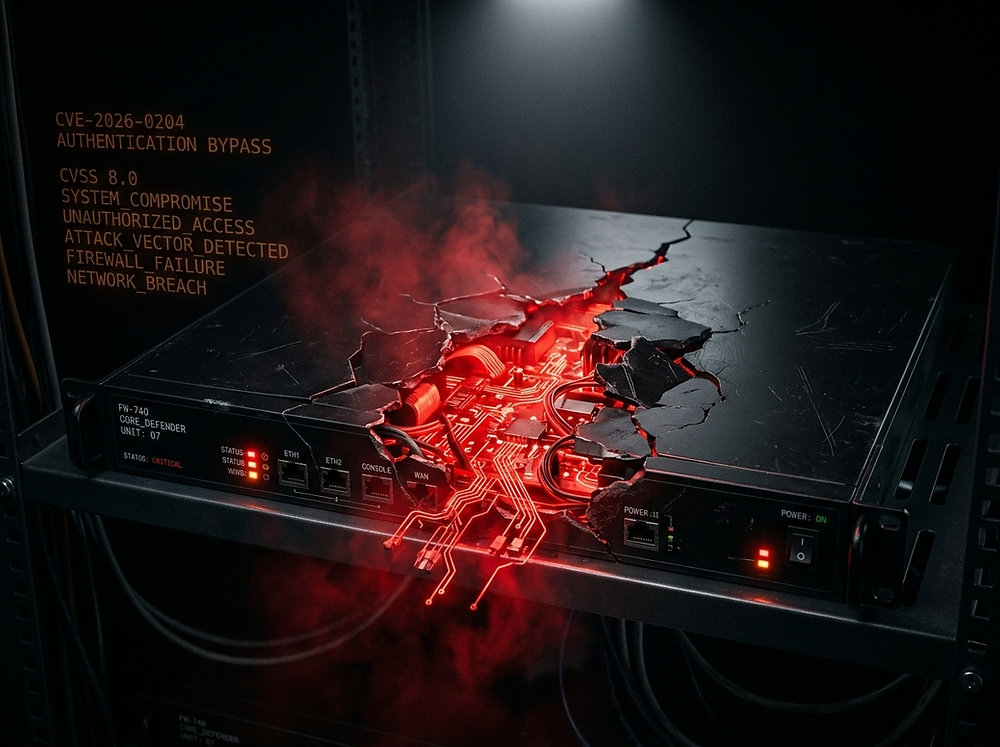
On April 29, 2026, SonicWall's Product Security Incident Response Team (PSIRT) published advisory SNWLID-2026-0004, disclosing three vulnerabilities inside SonicOS — the operating system that powers every current-generation SonicWall firewall appliance. The research was conducted by CrowdStrike's Advanced Research Team, who responsibly disclosed the flaws before public release.
The centrepiece is CVE-2026-0204, a SonicWall SonicOS authentication bypass vulnerability rated CVSS 8.0 (High). Under specific network conditions, an unauthenticated attacker on an adjacent network can bypass SonicOS authentication controls and reach sensitive management interface functions — effectively walking into the room that controls your perimeter.
Two companion vulnerabilities — CVE-2026-0205 (path traversal, CVSS 6.8) and CVE-2026-0206 (stack-based buffer overflow / DoS, CVSS 4.9) — complete a three-stage threat picture that ranges from unauthorized access to full firewall takedown. The blast radius covers Gen6, Gen7, and Gen8 hardware and virtual firewalls. For most enterprise networks, that means every SonicWall device in production is currently in scope.
"If a firewall is breached, the attacker may gain visibility into traffic flows, VPN access, routing policies, and segmentation controls. Compromising the firewall can be more valuable than compromising an endpoint."
— Security researchers analysing SNWLID-2026-0004 impact
What Is the CVE-2026-0204 SonicWall SonicOS Authentication Bypass?
CVE-2026-0204 is classified under CWE-1390 (Weak Authentication). The root cause lies in how SonicOS enforces — or more accurately, fails to enforce — access control on certain management interface functions. Under specific conditions, authentication checks that should gate administrative access are not correctly applied, leaving those interface paths reachable without valid credentials.
The practical consequence: an attacker positioned on an adjacent network — a co-located cloud environment, a shared segment, or an internal network with lateral movement capability — can invoke management interface functions that are supposed to require privileged authentication. SonicWall's own advisory language confirms the scope: "an attacker with access to the management interface could potentially modify firewall configurations and disable security protections."
This is not a theoretical threat surface. Any SonicWall firewall with its management interface reachable from an adjacent network — and many enterprise deployments allow exactly this for remote administration — is exposed. Modifying firewall rules, disabling IPS signatures, or opening new access policies are all operations that fall within the scope of what an unauthenticated actor could attempt via this flaw.
The Full Threat Triad: CVE-2026-0204, CVE-2026-0205, CVE-2026-0206
The SonicWall SonicOS authentication bypass does not stand alone. The three vulnerabilities disclosed in SNWLID-2026-0004 form a coherent attack progression when chained together.
CVE Type CVSS Auth Required Impact CWE CVE-2026-0204 Access Control Bypass 8.0 HIGH None Management interface access; config manipulation CWE-1390 CVE-2026-0205 Path Traversal 6.8 MED Post-auth Access to restricted services; potential escalation CWE-22 CVE-2026-0206 Stack Buffer Overflow 4.9 MED High privilege Remote firewall crash; full DoS condition CWE-121
CVE-2026-0204 — Authentication Bypass (CVSS 8.0)
The primary flaw. Weak authentication logic inside SonicOS allows adjacent-network attackers to reach management interface functions without presenting valid credentials. The attack requires no user interaction and has low attack complexity. Confidentiality, integrity, and availability are all rated as impacted. Exploitation can result in an attacker gaining the ability to rewrite access rules, disable protective services, or pivot SonicOS into a conduit for further intrusion.
CVE-2026-0205 — Path Traversal (CVSS 6.8)
This post-authentication companion flaw allows a logged-in attacker to break out of intended directory boundaries inside SonicOS and interact with services that should be restricted. In real-world terms, an actor who has used CVE-2026-0204 to gain a foothold can then escalate via CVE-2026-0205 to reach underlying system services — following a classic lateral movement pattern from the firewall OS layer toward deeper infrastructure.
CVE-2026-0206 — Stack-Based Buffer Overflow / DoS (CVSS 4.9)
The third flaw targets SonicOS's SSL-VPN component. A high-privilege attacker can send a specially crafted packet that overflows a fixed-size stack buffer, triggering an immediate crash of the SonicOS device. The result: the firewall goes offline. For networks relying on SonicWall as their primary perimeter control or VPN gateway, even a temporary outage during a coordinated attack could produce severe cascading consequences — especially if the crash is engineered to coincide with a secondary intrusion attempt through the now-unmonitored perimeter.
Technical Attack Chain: How SonicWall SonicOS Authentication Bypass Exploitation Works
While no public proof-of-concept exploit code has been released as of publication, the attack chain against a fully vulnerable SonicWall deployment follows a predictable three-stage model that security teams should model in their threat hunting scenarios.
1
Reconnaissance — Management Interface Discovery: Attacker scans for SonicWall devices with HTTP/HTTPS management or SSLVPN exposed on adjacent or internet-facing segments. Shodan/Censys queries for SonicOS banners return thousands of exposed interfaces globally.
2
Initial Access — CVE-2026-0204 Exploitation: Attacker sends specially crafted requests to management interface endpoints that bypass authentication enforcement under CWE-1390. No credentials required. Vulnerable firmware versions fail to apply the expected auth gate on targeted management functions.
3
Privilege Escalation — CVE-2026-0205 Path Traversal: With partial management access established, attacker leverages path traversal to reach restricted service directories — SSL-VPN internals, user databases, VPN tunnel configurations.
4
Persistence / Impact: Attacker modifies ACL policies, disables IPS, inserts malicious VPN access, or exfiltrates routing tables. Alternatively, invokes CVE-2026-0206 to crash the firewall as a distraction while a secondary payload deploys on the internal network.
Detection — SonicOS Management Audit Log Pattern (SIEM rule)
# Watch for unauthenticated management API access on standard SonicOS ports # High-fidelity IOC for CVE-2026-0204 exploitation attempts event.category: "network" AND destination.port: (443 OR 4433 OR 8443) AND url.path: ("/management/" OR "/cgi-bin/management*" OR "/api/sonicos*") AND http.response.status_code: (200 OR 302) AND user.name: ("-" OR "anonymous" OR "") AND NOT source.ip: [trusted_admin_ranges] # CVE-2026-0206 — DoS trigger pattern (SSL-VPN crash precursor) event.category: "network" AND destination.port: (4433 OR 8443) AND network.bytes > 65535 AND event.outcome: "failure"
Affected SonicWall Firewall Versions
The SonicWall SonicOS authentication bypass affects all three current firewall generations. If you are running any of the firmware versions below, your device is exposed.
Generation Hardware Models Vulnerable Firmware Patched Version Gen 6 TZ 300/400/500/600, NSA, SM, SOHO series ≤ 6.5.5.1-6n 6.5.5.2-28n Gen 7 TZ270–TZ670, NSa 2700–6700, NSsp, NSv (ESX/KVM/AWS/Azure) ≤ 7.0.1-5169 / ≤ 7.3.1-7013 7.3.2-7010 Gen 8 TZ80–TZ680, NSa 2800–5800 ≤ 8.1.0-8017 8.2.0-8009
Critical Gen6 downgrade warning: SonicWall explicitly states that downgrading from firmware 6.5.5.2-28n to any prior version is unsupported and will result in the deletion of all LDAP users and a complete MFA configuration reset. Always take a full configuration backup before upgrading.
Why the SonicWall SonicOS Authentication Bypass Is a Critical Infrastructure Risk
The firewall is not just a security appliance — it is the enforcer of every other security control in a network architecture. Perimeter segmentation, VPN access policies, IPS rulesets, NAT translations, and traffic inspection all live inside SonicOS. A SonicWall SonicOS authentication bypass that grants access to management functions without credentials is therefore not a single-system compromise — it is a compromise of the control plane for your entire network.
This threat model becomes more acute when you factor in scale. SonicWall appliances are deployed across SMBs, critical infrastructure operators, healthcare organizations, and government agencies. Gen7 and Gen8 devices are widely used as primary perimeter firewalls and as SSL-VPN gateways — exactly the kind of chokepoints that nation-state actors and ransomware operators prize as entry points.
Security researchers tracking the advisory are already warning that threat actor scanning for exposed SonicWall management interfaces will begin within days of public CVE assignment. Historically, perimeter device CVEs attract botnet activity within 72–96 hours of disclosure, and CVE-2026-0204 has a CVSS 8.0 rating and an unauthenticated attack path — both signals that make it a high-priority acquisition target for automated exploitation toolkits.
Patch and Mitigation Checklist for CVE-2026-0204 SonicWall SonicOS Authentication Bypass
Identify all SonicWall Gen6, Gen7, and Gen8 appliances across your estate. Include cloud-deployed NSv virtual firewalls on AWS, Azure, ESX, and KVM.
Back up full SonicOS configurations before beginning any firmware upgrade. For Gen6: mandatory. Downgrade from 6.5.5.2-28n is unsupported and will reset LDAP and MFA.
Apply patched firmware immediately: Gen6 → 6.5.5.2-28n / Gen7 → 7.3.2-7010 / Gen8 → 8.2.0-8009. Download directly from the official SonicWall support portal.
Interim workaround (if patching is delayed): Fully disable HTTP/HTTPS-based firewall management and SSLVPN on all interfaces. Restrict management access to SSH only per SonicWall PSIRT guidance.
Audit management interface exposure: ensure no SonicWall management port (443, 4433, 8443) is internet-facing or accessible from untrusted adjacent segments.
Enable logging for all management-plane events. Feed SonicWall syslog into your SIEM. Create alert rules for unauthenticated management API hits matching CVE-2026-0204 patterns.
Run YARA-based scans or threat hunting queries against historical SonicWall logs to detect any pre-patch exploitation attempts dating back to discovery window.
Verify firmware integrity using SonicWall's published checksums before deployment to rule out supply chain tampering.
⬡ Editorial Continuity — Legacy Intelligence Link