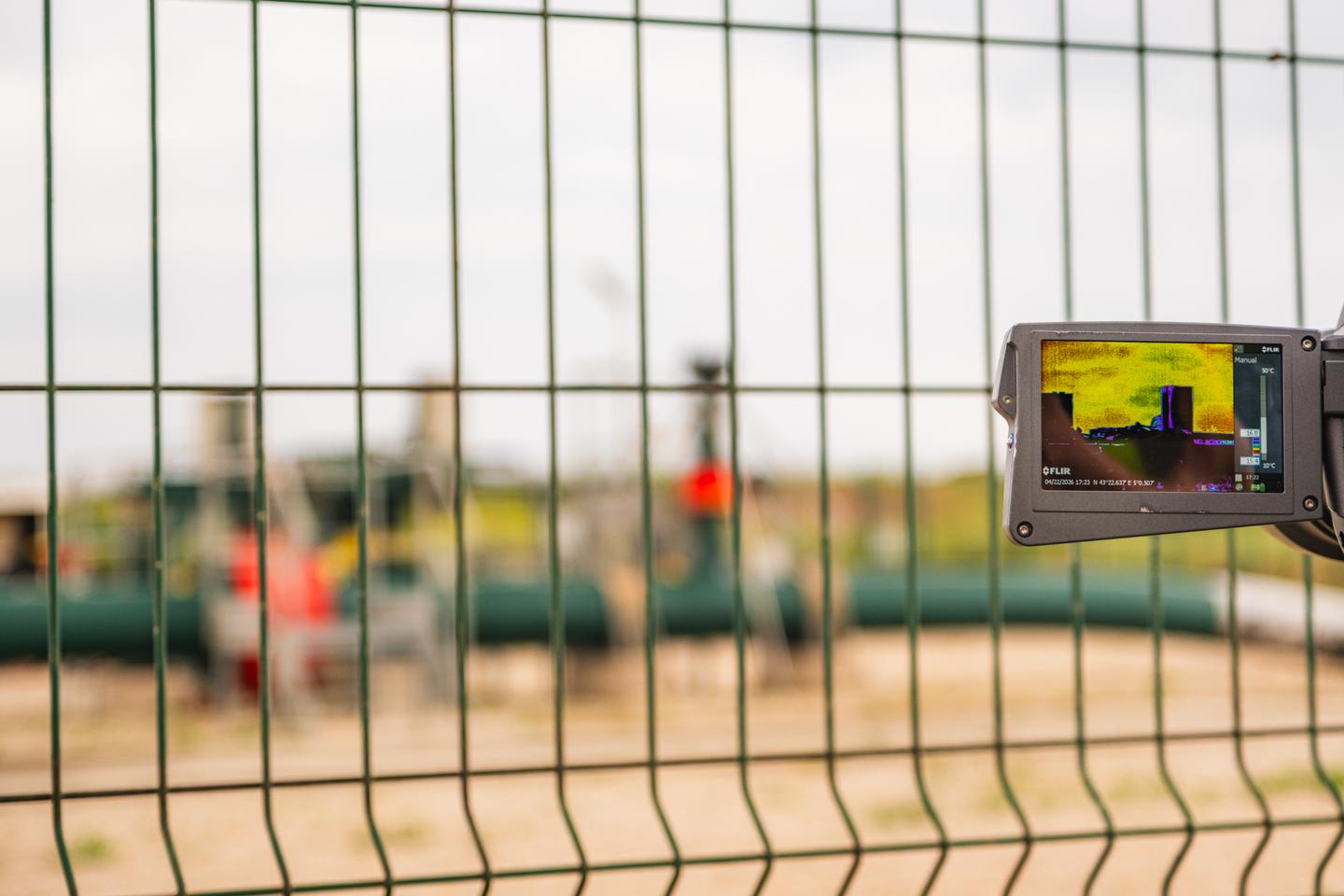
The Petroineos gas station in front of a refinery in the French Mediterranean port town of Fos-sur-Mer, on April 22, 2026. SYLVAIN TRUC
Théophile Humann-Guilleminot walked along the fence topped with barbed wire, searching for the best angle. He unfolded his tripod and set up his infrared camera. The image on the screen left him with no doubt: A plume of smoke was billowing from a pipeline valve. Though it was invisible to the naked eye, Humann-Guilleminot, the representative of Clean Air Task Force, an environmental NGO, could clearly see the leak on the monitor.
The technician trained in thermography – the science of detecting gases using optical imaging – used his binoculars to continue scanning the industrial site, an enclosure containing about 10 large green pipes rising up several meters from the ground before plunging back down again. Yellow tape had been applied to some pipe joints, but it was punctured in several places. In just half an hour, he detected five leaks, from which methane– the main molecule in natural gas and a powerful greenhouse gas – was seeping out at the sectioning station in the southwestern French village of Urgosse, a site notably used to monitor gas flow during maintenance or emergencies.
You have 86.15% of this article left to read. The rest is for subscribers only.