Science News
from research organizations
Scientists turn plastic waste into clean hydrogen fuel using sunlight
Date:
May 4, 2026
Source:
Adelaide University
Summary:
Scientists are using sunlight to turn plastic waste into clean fuels like hydrogen, offering a breakthrough solution to both pollution and energy challenges. While still in development, the approach could transform trash into a valuable resource for a low-carbon future.
Share:
Facebook
Twitter
Pinterest
LinkedIN
Email
FULL STORY
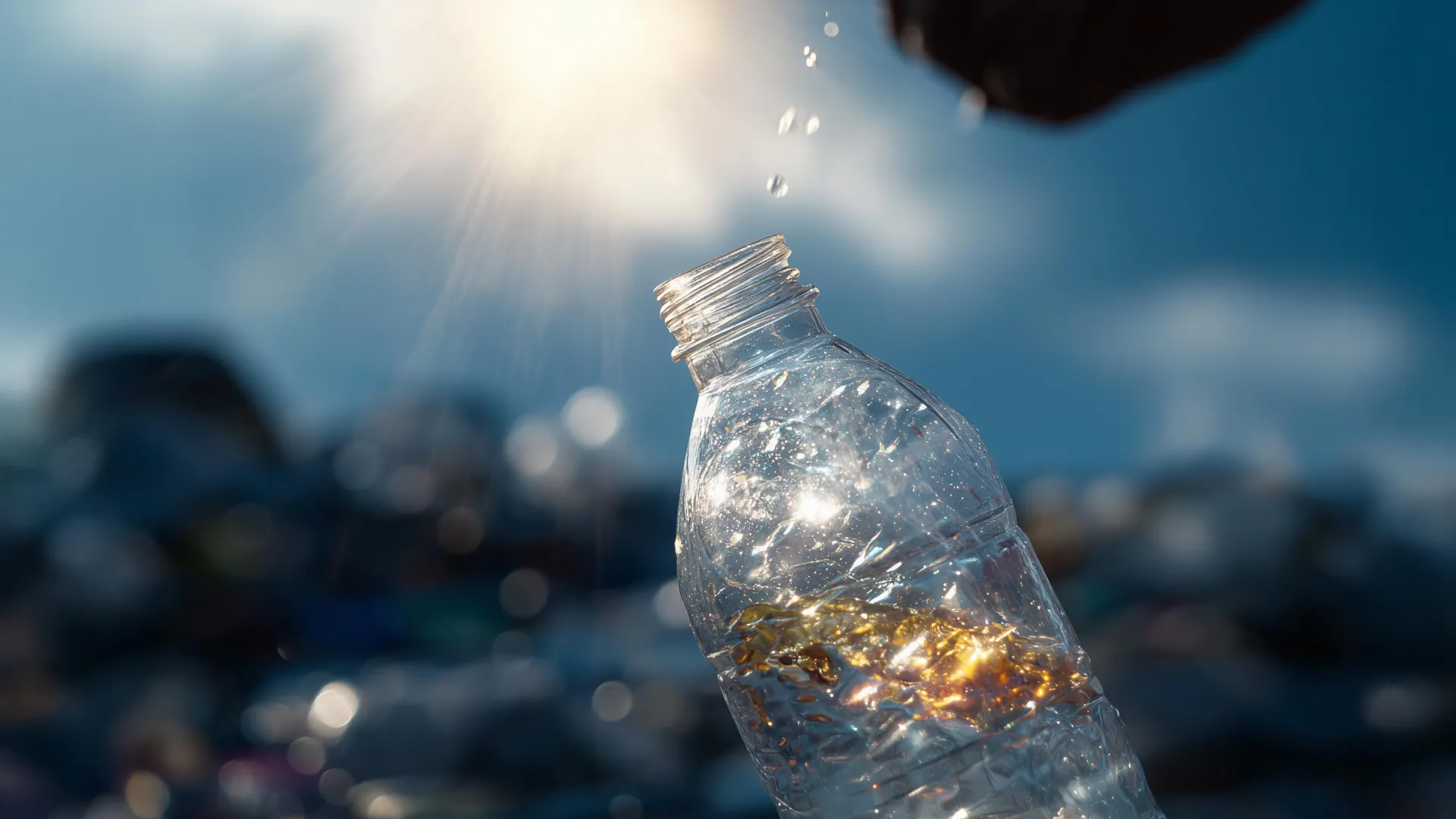
Sunlight-powered tech could soon turn plastic trash into clean fuelâtackling pollution and energy in one bold move. Credit: AI/ScienceDaily.com
Scientists are developing a new way to tackle two major global problems at once: plastic pollution and the demand for clean energy. By using sunlight, they are finding ways to turn discarded plastic into useful fuels.
A recent study led by Adelaide University PhD candidate Xiao Lu examines how solar-powered systems can convert waste plastics into hydrogen, syngas, and other industrial chemicals. This approach could help create a more sustainable, circular economy by giving new value to materials that are usually thrown away.
Plastic Waste as a Hidden Energy Resource
More than 460 million tonnes of plastic are produced worldwide each year, and large amounts end up polluting land and oceans. At the same time, the need to move away from fossil fuels has intensified the search for cleaner energy alternatives.
The research, published in Chem Catalysis, shows that plastics, which are rich in carbon and hydrogen, can be treated as a resource rather than just waste.
"Plastic is often seen as a major environmental problem, but it also represents a significant opportunity," said Ms Lu. "If we can efficiently convert waste plastics into clean fuels using sunlight, we can address pollution and energy challenges at the same time."
How Sunlight Converts Plastic Into Fuel
The method, called solar-driven photoreforming, relies on light-sensitive materials known as photocatalysts. These materials use sunlight to break down plastics at relatively low temperatures.
Through this process, plastics can be transformed into hydrogen, which is a clean fuel that produces no emissions at the point of use, along with other valuable industrial chemicals.
Compared to traditional water splitting for hydrogen production, this approach can be more energy-efficient. Plastics are easier to oxidize, which makes the reactions require less energy and increases the potential for large-scale use.
Promising Results From Early Studies
According to senior author Professor Xiaoguang Duan from the School of Chemical Engineering at Adelaide University, recent experiments have delivered strong results.
Researchers have reported high levels of hydrogen production, as well as the creation of acetic acid and even diesel-range hydrocarbons. Some systems have run continuously for more than 100 hours, demonstrating improving stability and performance.
Challenges to Scaling the Technology
Despite this progress, several obstacles must be addressed before the technology can be widely adopted.
"One major hurdle is the complexity of plastic waste itself," Prof Duan said. "Different types of plastics behave differently during conversion, and additives such as dyes and stabilisers can interfere with the process. Efficient sorting and pre-treatment are therefore essential to maximise performance and product quality."
Another key issue involves the photocatalysts themselves. These materials need to be highly selective and durable, capable of operating under demanding chemical conditions without losing effectiveness. Current versions can degrade over time, which limits their long-term reliability.
"There is still a gap between laboratory success and real-world application," Prof Duan said. "We need more robust catalysts and better system designs to ensure the technology is both efficient and economically viable at scale."
Engineering and Efficiency Hurdles
Separating the final products is also a challenge. The reactions often produce a mix of gases and liquids, which must be separated through energy-intensive processes. This can reduce the overall environmental benefits.
To overcome these issues, researchers emphasize the need for a more integrated strategy. This includes improvements in catalyst design, reactor engineering, and overall system optimization. New ideas being explored include continuous-flow reactors, systems that combine solar with thermal or electrical energy, and advanced monitoring tools to improve efficiency.
A Roadmap Toward Real-World Use
Looking ahead, the team has outlined steps for scaling up the technology. Their goals include boosting energy efficiency and enabling continuous industrial operation over the coming decades.
"This is an exciting and rapidly evolving field," Ms Lu said. "With continued innovation, we believe solar-powered plastic-to-fuel technologies could play a key role in building a sustainable, low-carbon future."
RELATED TOPICS
Matter & Energy
Engineering and Construction
Energy and Resources
Nature of Water
Construction
Earth & Climate
Sustainability
Environmental Issues
Energy and the Environment
Global Warming
RELATED TERMS
Renewable energy
Solar power
Pollution
Air pollution
Energy development
Alternative fuel vehicle
Radioactive waste
Photosynthesis
Story Source:
Materials provided by
Adelaide University
.
Note: Content may be edited for style and length.
Journal Reference
:
Xiao Lu, Wenjie Tian, Xiaoguang Duan.
Opportunities and challenges in sustainable solar fuel production from plastics
.
Chem Catalysis
, 2026; 101746 DOI:
10.1016/j.checat.2026.101746
Cite This Page
:
MLA
APA
Chicago
Adelaide University. "Scientists turn plastic waste into clean hydrogen fuel using sunlight." ScienceDaily. ScienceDaily, 4 May 2026. <www.sciencedaily.com
/
releases
/
2026
/
05
/
260504023841.htm>.
Adelaide University. (2026, May 4). Scientists turn plastic waste into clean hydrogen fuel using sunlight.
ScienceDaily
. Retrieved May 4, 2026 from www.sciencedaily.com
/
releases
/
2026
/
05
/
260504023841.htm
Adelaide University. "Scientists turn plastic waste into clean hydrogen fuel using sunlight." ScienceDaily. www.sciencedaily.com
/
releases
/
2026
/
05
/
260504023841.htm (accessed May 4, 2026).
Explore More
from ScienceDaily
RELATED STORIES
Scientists Define the Ingredients for Finding Natural Clean Hydrogen
May 13, 2025 Â
Researchers have detailed the geological ingredients required to find clean sources of natural hydrogen beneath our feet. The work details the requirements for natural hydrogen, produced by the Earth ...
Four Global Policies Could Eliminate More Than 90% of Plastic Waste and 30% of Linked Carbon Emissions by 2050
Nov. 14, 2024 Â
A new study determines that just four policies can reduce mismanaged plastic waste -- plastic that isn't recycled or properly disposed of and ends up as pollution -- by 91% and plastic-related ...
Finding Pearls in the Mud: Eco-Friendly Tungsten Recovery from Semiconductor Waste
Aug. 8, 2024 Â
Semiconductor industry waste is typically seen as a costly disposal problem and an environmental hazard. But what if this waste could be transformed into a valuable resource? In an exciting ...
Harnessing Hydrogen at Life's Origin
Mar. 18, 2024 Â
A new report uncovers how hydrogen gas, the energy of the future, provided energy in the past, at the origin of life 4 billion years ago. Hydrogen gas is clean fuel. It burns with oxygen in the air ...
A Baking Soda Solution for Clean Hydrogen Storage
June 12, 2023 Â
Imagine using baking sodaânot just for cookies, but to power the future. At Pacific Northwest National Laboratory, scientists are exploring hydrogen as a clean, scalable energy source, and ...
Success in Synthesizing Biodegradable Plastic Materials Using Sunlight and CO2
Oct. 3, 2022 Â
Scientists have achieved an 80% conversion yield of a biodegradable plastic material from acetone and CO2, tackling the plastic waste crisis while moving toward carbon neutrality. Scientists have ...
TRENDING AT
SCITECHDAILY.com
A Simple Molecule Could Unlock Safer, Easier Weight Loss
Researchers Unveil Groundbreaking Sustainable Solution to Vitamin B12 Deficiency
Scientists Identify Immune Protein That Could Mimic Anti-Aging Effects of Calorie Restriction
Cancer-Like Mutations Found in the Brain May Be Driving Alzheimerâs Disease
Â
Print
Â
Email
Â
Share
Breaking
this hour
MIT Scientists Crack a Materials Mystery
Da Vinci Bloodline Unlocks DNA Secrets
The Truth About Creatine
Blood Test May Detect Depression
Evolution Isnât as Random as Thought
Coffee Rewires Your Gut and Mood
A Deadly Disease Split Early Humans
The Sound You Canât Hear May Stress You
Scientists Find a Flaw in Time
Brain Starts Full Then Refines Memory
Trending Topics
this week
PLANTS & ANIMALS
Extinction
Spiders and Ticks
Biotechnology
EARTH & CLIMATE
Earthquakes
Climate
Energy and the Environment
FOSSILS & RUINS
Human Evolution
Cultures
Lost Treasures
Strange & Offbeat
Â
PLANTS & ANIMALS
Malaria Didnât Just Kill Early Humans, It Shaped Who We Became
Scientists Stunned as Pink Katydid Transforms Into Green Camouflage
This 275-Million-Year-Old Animal Had a Twisted Jaw Like Nothing Alive Today
EARTH & CLIMATE
18th-Century Mechanical Volcano Roars to Life 250 Years Later
This âPink Floydâ Spider Hunts Prey 6x Its Size and Lives in Walls
Scientists Just Found a Chilling Way Life May Have Begun
FOSSILS & RUINS
50-Foot Ancient Snake Discovered in India May Be One of the Largest Ever
Scientists Think They Finally Know Why Neanderthals Vanished
Blood Vessels Found in T. Rex Bones Are Rewriting Dinosaur Science
Scientists turn plastic waste into clean hydrogen fuel using sunlight